Artwork
The Dog on the Kennel
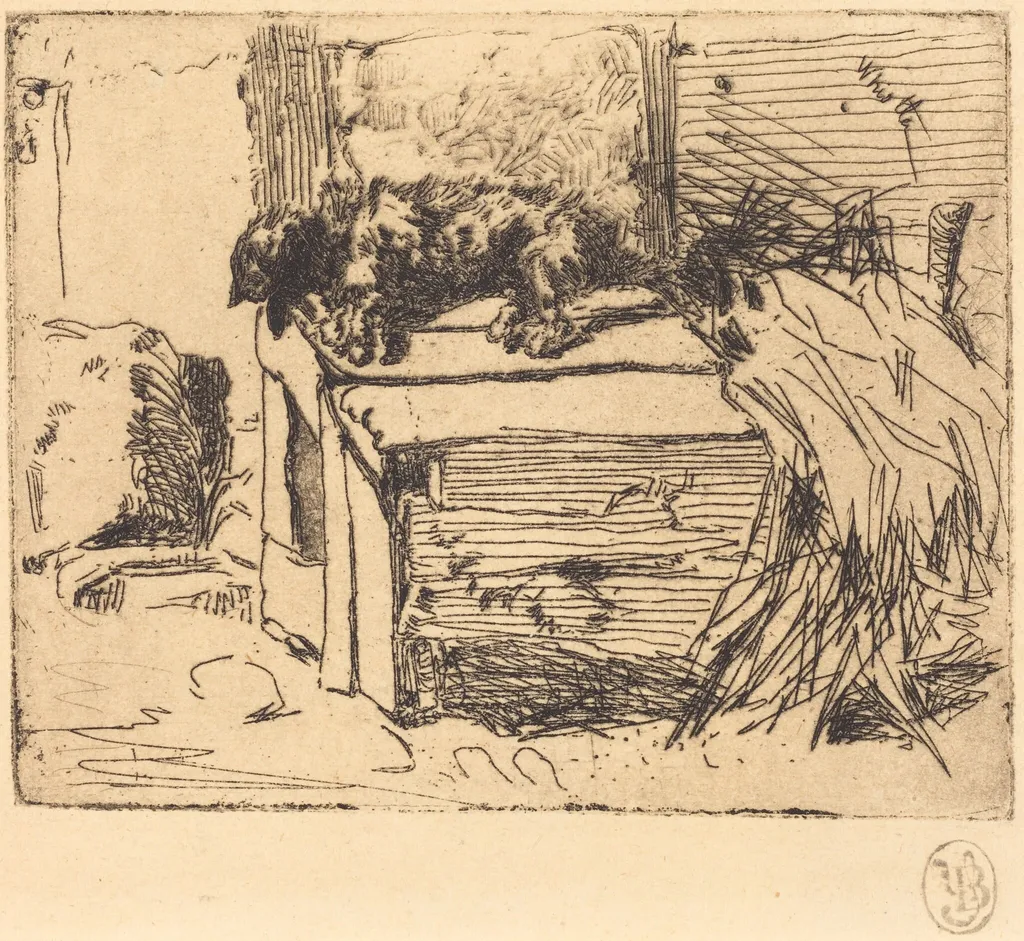
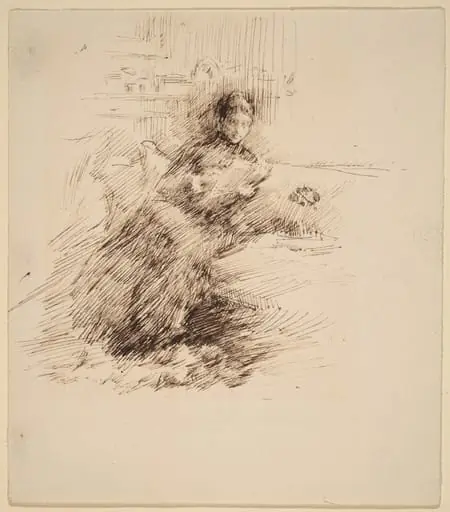
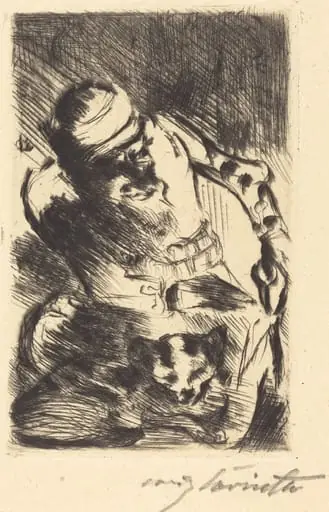
The Dog on the Kennel is an ink print by the Impressionist artist James McNeill Whistler. It dates from 1858 and is held in the collection of the National Gallery of Art.
About this work
Overview
Created in 1858, *The Dog on the Kennel* is an early etching by James McNeill Whistler, made before his rise to prominence in transatlantic art circles.
Created in 1858, *The Dog on the Kennel* is an early etching by James McNeill Whistler, made before his rise to prominence in transatlantic art circles. Executed on wove paper, the work belongs to his formative period in printmaking, when he was refining his approach to line and tone. Unlike his later, more polished compositions, this piece retains a spontaneous, sketchlike quality, revealing his developing interest in visual economy over narrative.
Subject & Meaning
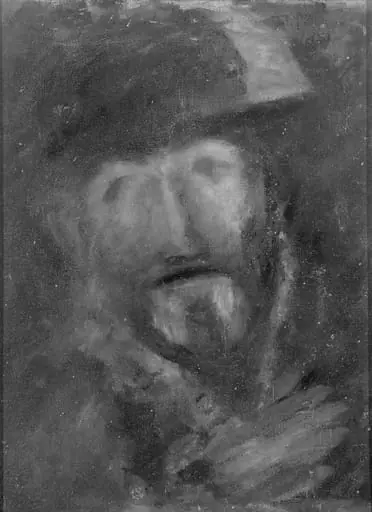
The image depicts a small dog peering from a modest wooden kennel, its fur rendered in loose, energetic strokes. No human figures are fully formed—only a partial hand and scattered foliage suggest a surrounding environment. The subject is unembellished, avoiding sentimentality or moral symbolism. Whistler’s focus lies in the quiet presence of the animal, treated as a visual motif rather than a narrative centerpiece.
Technique & Style
Whistler employed etching to achieve a delicate, scratchy texture, using fine lines to suggest form without heavy shading. The kennel’s wooden slats and the dog’s fur are defined by rapid, irregular marks that convey movement and immediacy. The composition is intentionally sparse, with minimal background detail, emphasizing the interplay of light, shadow, and line. This restrained approach anticipates his later emphasis on tonal harmony over descriptive detail.
History & Provenance
The print originates from Whistler’s early years in London, when he was experimenting with printmaking alongside oil and watercolor. It predates his adoption of the butterfly signature and his public advocacy for 'art for art's sake.' While no detailed provenance is widely documented, the work is recognized as part of his early graphic output, reflecting his engagement with the etching revival of the 1850s.
Context
In the late 1850s, Whistler was immersed in the London art world, influenced by Japanese prints and the growing interest in tonal harmony among printmakers. While many contemporaries favored detailed storytelling, he pursued abstraction and mood. *The Dog on the Kennel* aligns with this shift—its simplicity and focus on surface texture reflect a broader movement away from Victorian sentimentality toward aesthetic autonomy.
Legacy
Though not among Whistler’s most celebrated prints, *The Dog on the Kennel* illustrates the foundations of his mature style: an emphasis on composition over narrative, and a preference for subtle, evocative marks. It demonstrates his early commitment to visual refinement and foreshadows the formal discipline that would define his later work. The piece remains a quiet example of his transition from apprentice to innovator in printmaking.
Own this work as a print
Artist & collection
Artist
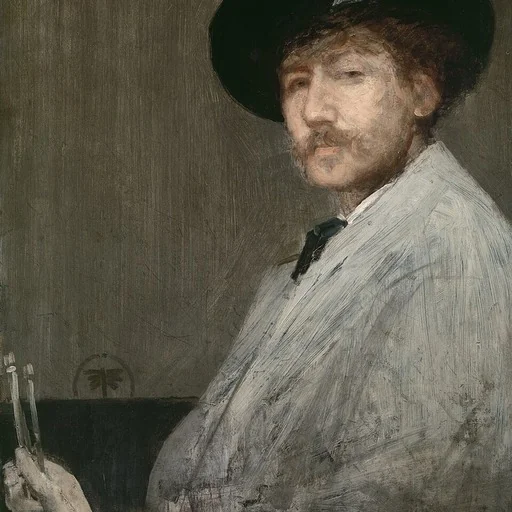
James Abbott McNeill Whistler was an American painter in oils and watercolor, and printmaker, active during the American Gilded Age and based primarily in the United Kingdom.

 Arrangement in Black, No. 3: Sir Henry Irving as Philip II of Spain
 Arrangement in Flesh Colour and Black: Portrait of Theodore Duret
 Gold and Brown: Self-Portrait
 Edward Guthrie Kennedy
 Harmony in Yellow and Gold: The Gold Girl—Connie Gilchrist
 George W. Vanderbilt
 Symphony in White, No. 1: The White Girl
 Henry Irving as Philip II of Spain