Artwork
The 'Revenge' Leaving Plymouth to Meet the Armada
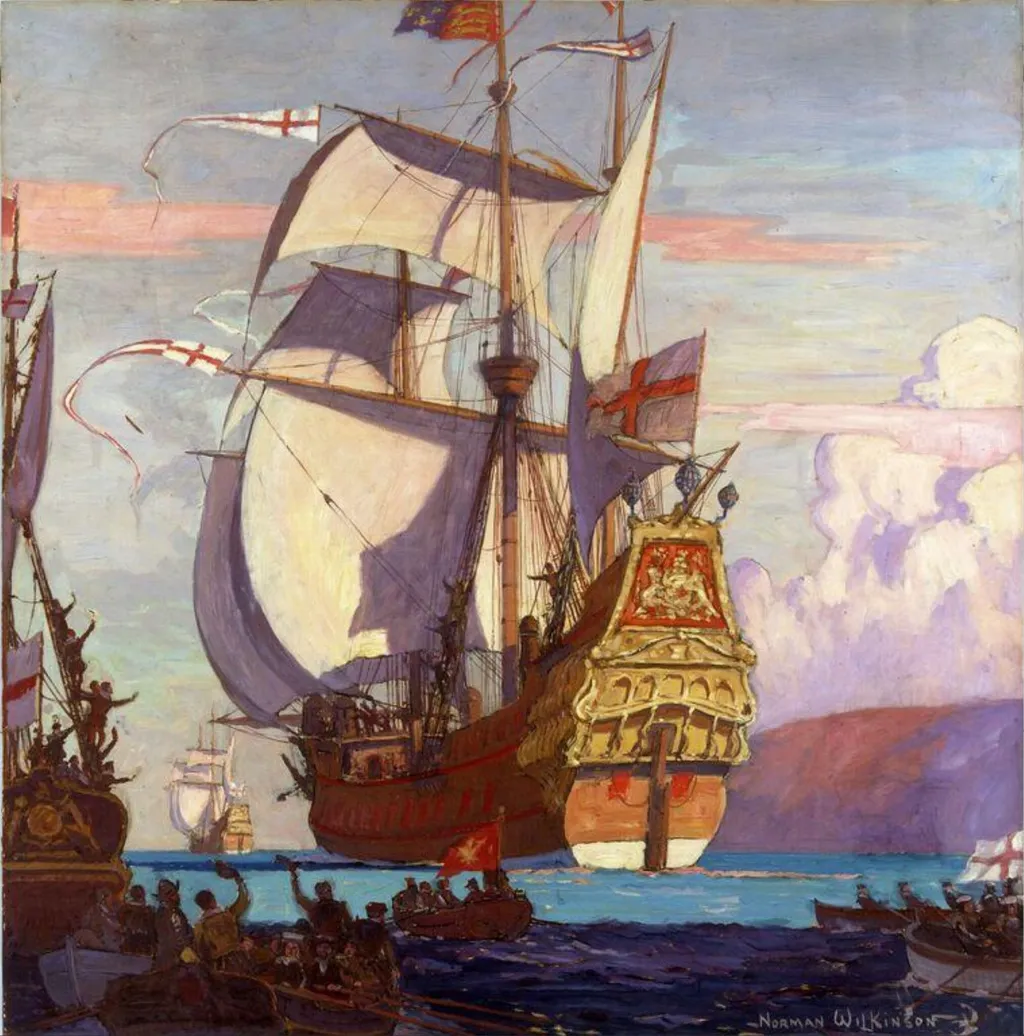
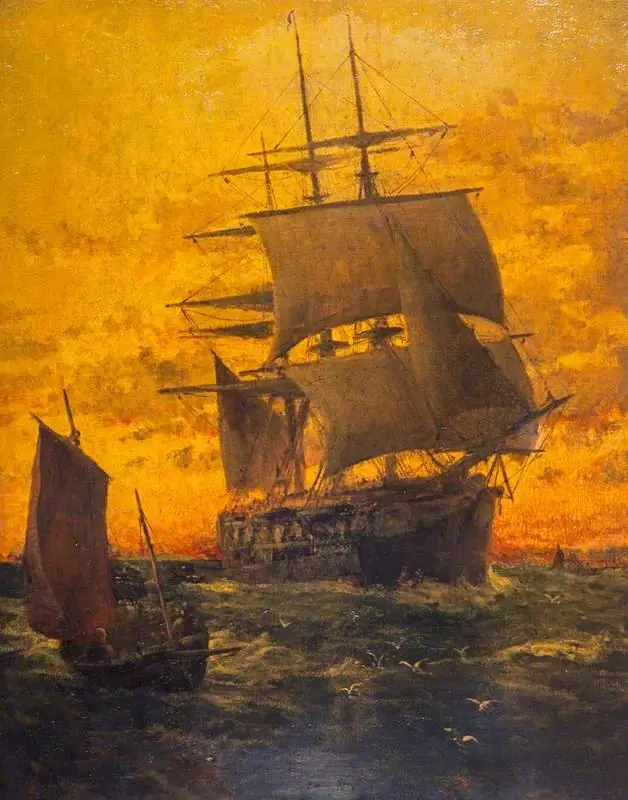
The 'Revenge' Leaving Plymouth to Meet the Armada is a paint painting by Norman L. Wilkinson. It dates from 1912 and is held in the collection of the Victoria and Albert Museum. Norman Wilkinson’s oil on canvas depicts a towering warship cutting through turbulent seas beneath a brooding sky.
About this work
The play’s producer wanted Britons to feel the same grit that beat the Spanish Armada, right when war with Germany loomed.
You see a tall ship slicing through choppy waves under a stormy sky, sails full of wind and flags snapping.
This painting was made for a play about Sir Francis Drake, not as a history lesson but as a patriotic pep-talk in 1912. The play’s producer wanted Britons to feel the same grit that beat the Spanish Armada, right when war with Germany loomed. Wilkinson turned the stage backdrop into a stand-alone picture—bright enough to grab attention in a theater lobby.
If you like this mix of sea drama and stagecraft, look up the technique impasto.
Overview
Norman Wilkinson’s oil on canvas depicts a towering warship cutting through turbulent seas beneath a brooding sky. The vessel’s billowing sails and fluttering flags convey a sense of forward momentum, while the churning waves and dark clouds heighten the drama of a perilous voyage. The composition balances vigorous brushwork with a clear narrative focus, inviting viewers to imagine the ship’s imminent encounter with an enemy fleet.
Subject & Meaning
The scene illustrates the moment a fleet departs to confront the Spanish Armada, a historical episode celebrated for English resolve. Though not intended as a literal illustration of the 1588 battle, the painting serves as a visual rallying point, symbolising national determination and the willingness to face overwhelming odds. Its energetic portrayal reinforces themes of courage and collective resolve.
Technique & Style
Wilkinson employs a robust impasto technique, applying thick layers of paint to render the foam‑tossed sea and the texture of canvas‑clad sails. The palette is dominated by muted grays and deep blues, punctuated by the bright whites of wind‑filled canvas and the occasional flash of flag. His handling of light and shadow creates a palpable sense of movement and atmospheric tension.
History & Provenance
Created in 1912, the work was one of three large backdrops commissioned for Sir Herbert Beerbohm Tree’s stage production of "Drake" at His Majesty’s Theatre. The painting, along with a companion piece, was reproduced in a colour leaflet to promote the play. After the production’s revival in 1914, the canvas entered private collections and has since been exhibited as an example of early twentieth‑century theatrical art.
Context
The early 1910s saw rising anxieties over a possible conflict with Germany. Tree’s revival of the Armada drama was intended to stir patriotic sentiment, drawing parallels between the Elizabethan triumph and contemporary geopolitical tensions. Wilkinson’s contribution, originally a theatrical set piece, thus functioned as both visual spectacle and political statement, reflecting the era’s intertwining of art, theatre, and national identity.
Artist & collection

Artist
Norman Wilkinson was an English artist who specialised in marine art. He created several propaganda posters for the British government during the world wars and invented dazzle camouflage to protect Allied ships from…