Artwork
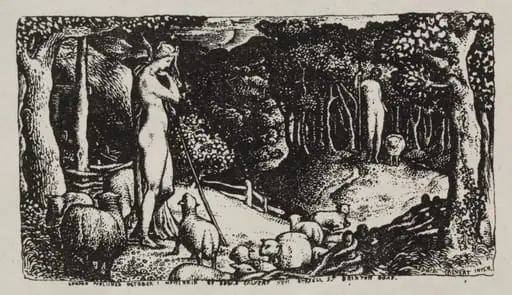
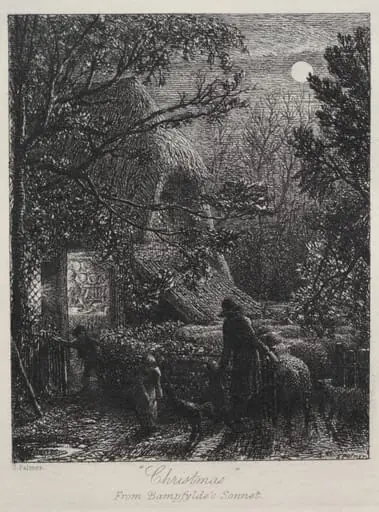
The Pastorals of Virgil, Eclogue I: The Shepherd Chases away a Wolf
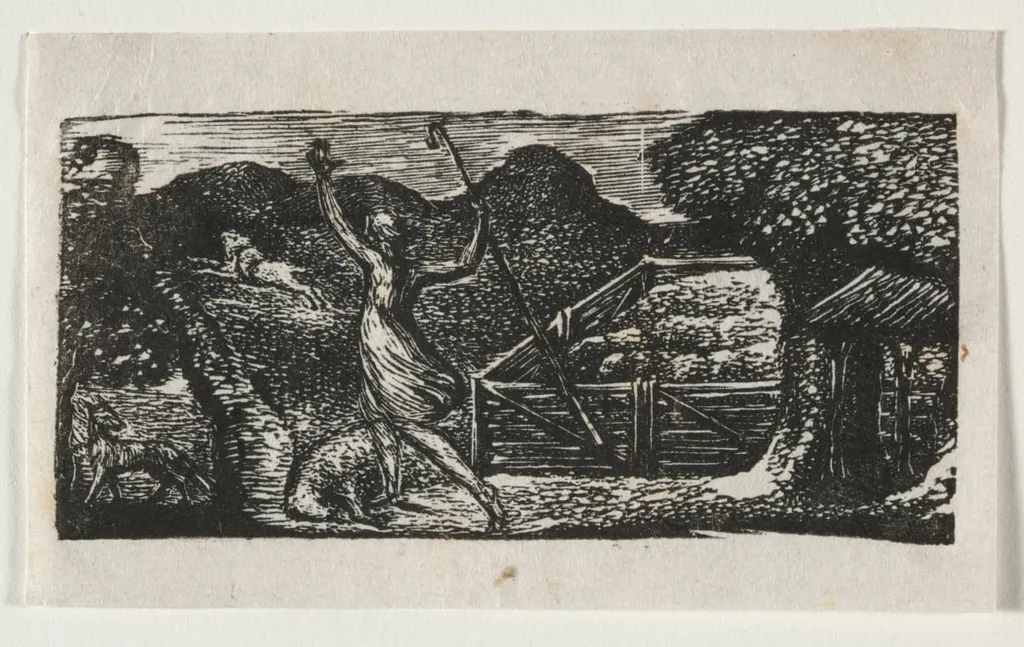
The Pastorals of Virgil, Eclogue I: The Shepherd Chases away a Wolf is a print by the Romanticist artist William Blake. It dates from 1821 and is held in the collection of the Cleveland Museum of Art.
About this work
Overview
His approach transformed the pedagogical text into a visually rich, emotionally charged experience, emphasizing nature’s presence over literal narrative.
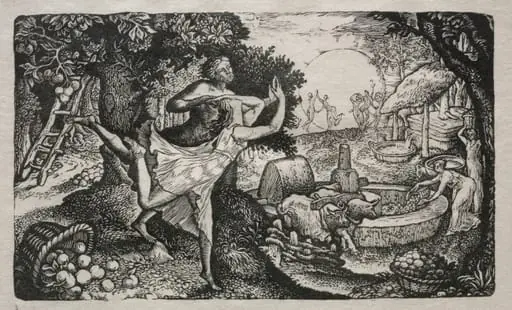
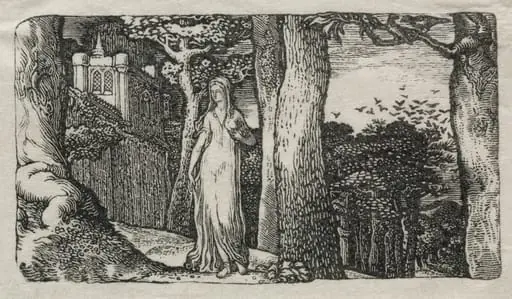
William Blake created twelve wood engravings for Dr. Robert John Thornton’s 1821 edition of Virgil’s Pastorals, a widely used Latin textbook. These were Blake’s sole works in the wood engraving medium, distinct from his usual relief etchings. The illustrations accompanied translations of Virgil’s pastoral poems, blending classical themes with Blake’s personal vision. His approach transformed the pedagogical text into a visually rich, emotionally charged experience, emphasizing nature’s presence over literal narrative.
Subject & Meaning
The scene depicts two shepherds confronting a wolf retreating into woodland, a moment drawn from Virgil’s first Eclogue. Rather than merely illustrating the text, Blake imbues the encounter with symbolic weight—nature as both sanctuary and threat. The wolf’s departure suggests vulnerability and vigilance, while the shepherds’ postures convey quiet resolve. Blake’s interpretation moves beyond pastoral idealism, hinting at tension between human order and wild forces beyond control.
Technique & Style
Blake employed wood engraving, a technique involving incising lines into the end grain of hardwood to create fine, sharp contrasts. Unlike his typical illuminated printing, this method required removing material to leave white lines on a black field. The result is a crisp, linear quality resembling ink drawings, with dense textures in foliage and bark achieved through meticulous cross-hatching. His handling of light and shadow anticipates chiaroscuro, though executed through carving rather than brushwork.
History & Provenance
Commissioned by Thornton for his educational edition of Virgil, Blake’s engravings were produced between 1820 and 1821, near the end of his life. Though intended for classroom use, they were not widely distributed or celebrated in his time. Only a limited number of copies were printed, and the plates were later lost or destroyed. Their survival in a few surviving volumes makes them rare artifacts of Blake’s late career and his engagement with classical literature.
Context
In early 19th-century Britain, Virgil’s Eclogues were standard in Latin education, valued for their moral and linguistic clarity. Thornton’s edition aimed to make them accessible to students through translation and illustration. Blake’s involvement was unusual—he was not a conventional illustrator, and his visionary style clashed with the book’s didactic purpose. His images subtly subverted the classical idealism expected in such texts, introducing psychological depth and naturalistic unease.
Legacy
Blake’s Virgil engravings remain significant as his only foray into wood engraving and as a rare instance of his work serving a mainstream educational project. Though overlooked in his lifetime, they are now studied for their technical innovation and expressive intensity. They reveal how Blake infused classical subjects with his own symbolic language, bridging ancient literature and Romantic sensibility. Their survival offers insight into his late artistic priorities and his enduring engagement with nature and myth.
Artist & collection
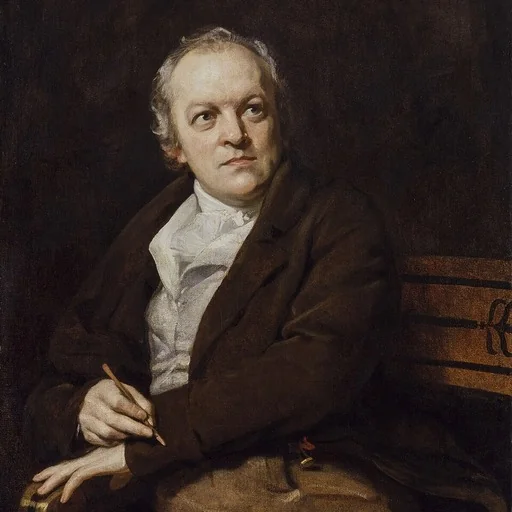
Artist
William Blake (28 November 1757 – 12 August 1827) was an English poet, painter and printmaker.