Artwork
Print No.2
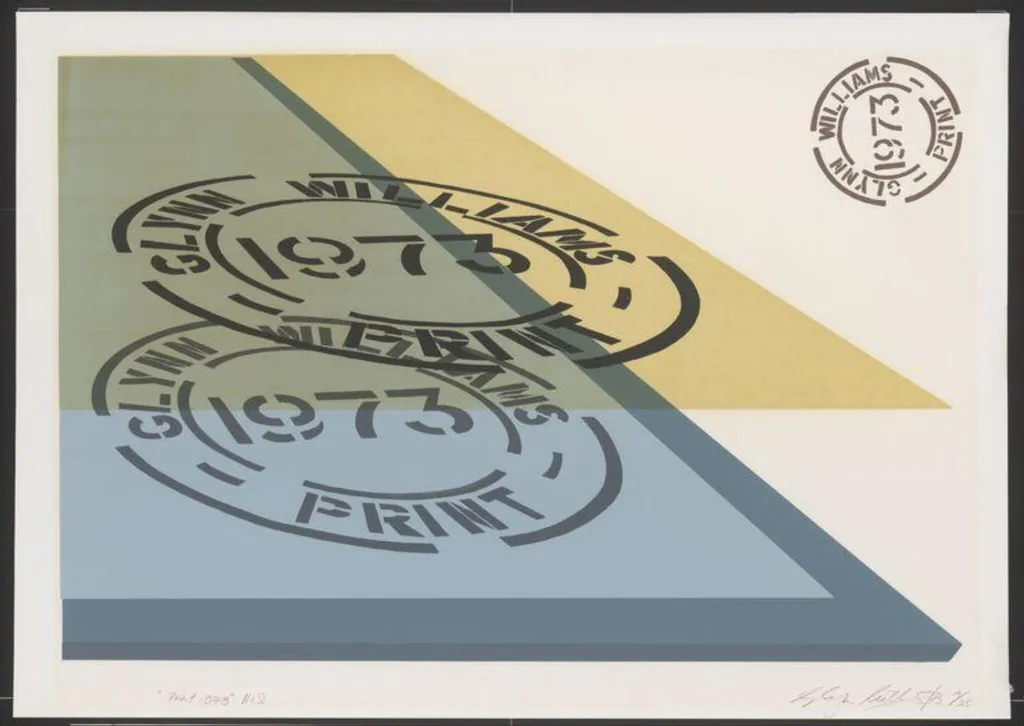
Print No.2 is a print by Glynn Williams. It dates from 1973 and is held in the collection of the Victoria and Albert Museum.
About this work
The artist often worked in three dimensions then, playing with space and shadows.
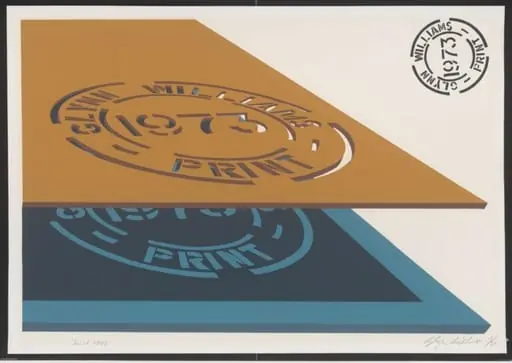
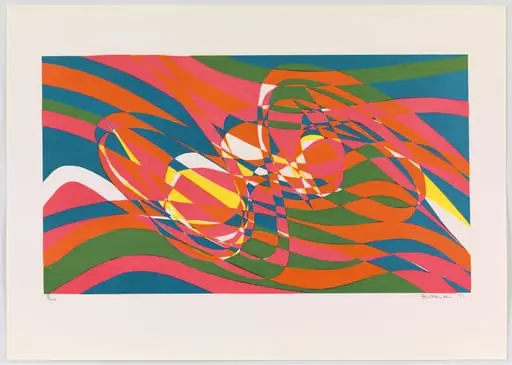
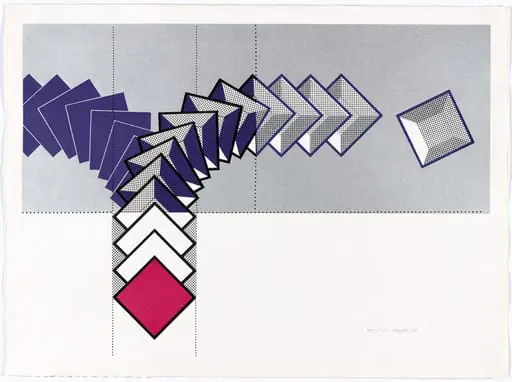
Glynn Williams made this print in 1973. It’s a flat image, but it feels like stacked shapes. The artist often worked in three dimensions then, playing with space and shadows.
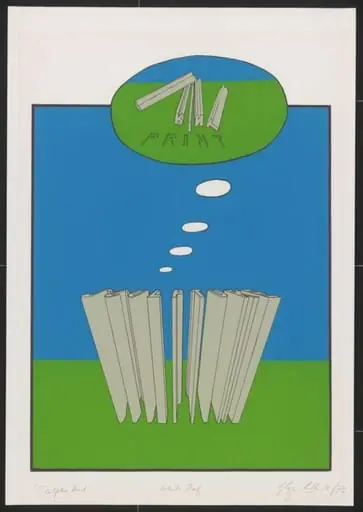
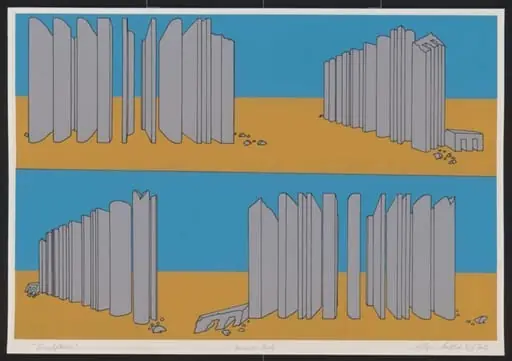
Here he pushes that idea onto paper. The print copies how wood panels stack and twist in his sculptures. It keeps the flatness of a print but hints at depth.
Check out Williams’ later sculpture at the Victoria and Albert Museum.
Overview
Glynn Williams created this 1973 screenprint as part of a series exploring spatial relationships through two-dimensional media. Though primarily known for sculpture, Williams used printmaking to extend his investigations into form and depth, translating the layered compositions of his wooden assemblages into flat, inked surfaces without relinquishing their sense of architectural tension.
Subject & Meaning
The print does not depict recognizable objects but evokes the arrangement of cut and overlaid wood panels from Williams’s early 1970s sculptures. It suggests stacking, rotation, and partial concealment, treating shadow and negative space as tangible elements. The work interrogates perception, blurring the boundary between what is physically present and what is implied by contour and overlap.
Technique & Style
Using screenprinting, Williams applied flat planes of color with sharp edges to mimic the geometric precision of his sculptural materials. The technique’s inherent flatness is deliberately employed to contrast with the illusion of depth created by overlapping forms. No modeling or perspective is used; instead, spatial ambiguity arises from alignment, alignment, and implied layering.
History & Provenance
This print dates from a transitional phase in Williams’s career, when he was shifting from abstraction toward more figurative work. It was made during a period when he was actively producing wooden constructions in his studio, many of which were later exhibited in UK galleries. The print serves as a direct visual counterpart to those three-dimensional experiments, though its provenance remains tied to the artist’s personal archive.
Context
In the early 1970s, British artists were re-examining the materiality of art and the limits of representation. Williams’s work aligned with broader interests in process, structure, and the physicality of support systems. His use of shadow as a formal element echoed contemporaneous explorations in Minimalism and Constructivism, though his approach remained rooted in handmade, tactile processes.
Legacy
Though Williams later turned to figurative sculpture, this print remains a key document of his abstract period. It illustrates how printmaking functioned not merely as reproduction but as a parallel mode of inquiry. The work’s influence is visible in later artists who treat print as a site for spatial experimentation rather than illustration.
Artist & collection
Artist
Glynn Williams made prints in 1973 that blend sharp lines with sculptural depth. “Print” and “Print No.2” use crisp angles and layered ink to give flat surfaces a tactile push. These works sit between graphic art and…