Artwork
The Nooning
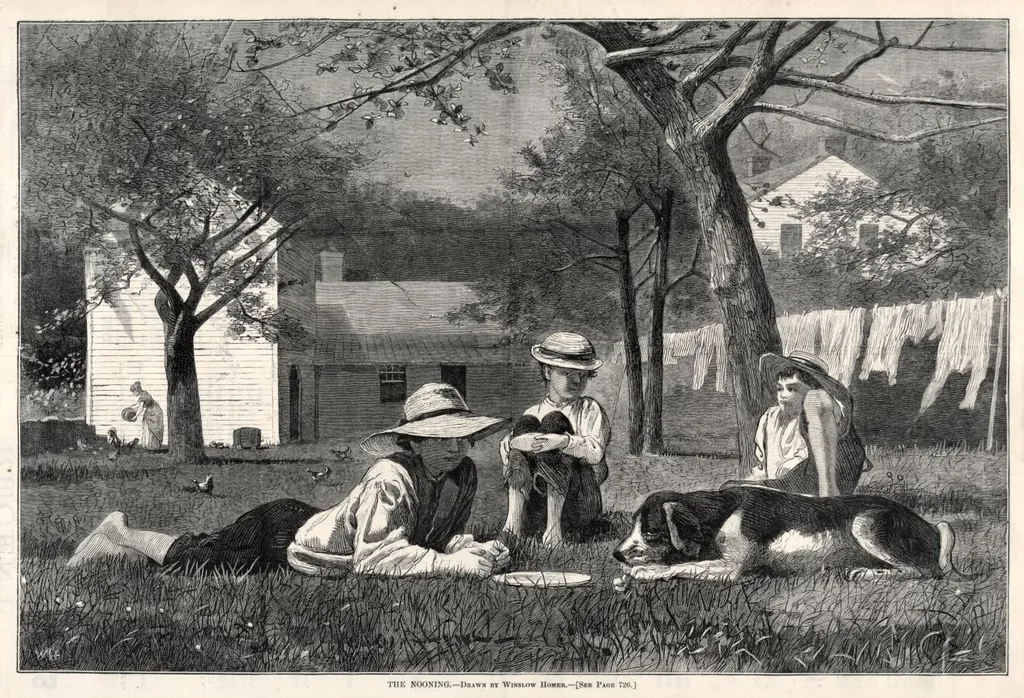
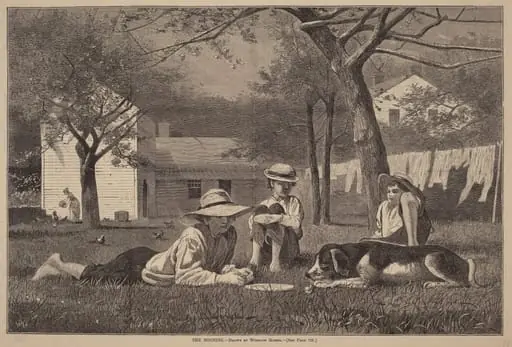
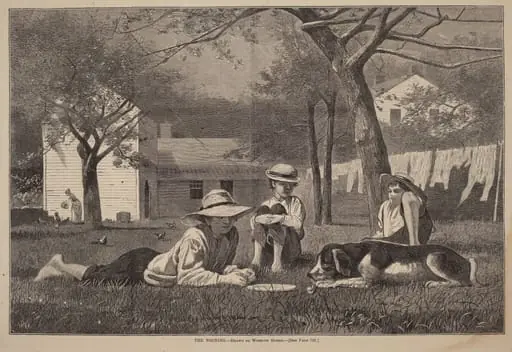
The Nooning is a print by the Impressionist artist Winslow Homer. It dates from 1873 and is held in the collection of the Cleveland Museum of Art.
About this work
One of the boys is reclining on the grass, while another is sitting with his legs crossed, and the third is leaning against a tree.
In the foreground, four individuals are gathered in a lush grassy area, surrounded by trees and a house in the background. The group consists of three boys and a woman, all attired in clothing typical of the late 19th century. One of the boys is reclining on the grass, while another is sitting with his legs crossed, and the third is leaning against a tree. The woman is seated on the grass, with a dog lying beside her.
The scene exudes a sense of tranquility, with the warm sunlight casting a gentle glow on the figures. The artist's use of chiaroscuro creates a striking contrast between light and dark, adding depth and dimension to the composition.
If you're interested in learning more about this style of painting, explore the world of Impressionism.
Overview
Created in 1873, *The Nooning* is a watercolor by Winslow Homer that captures a quiet moment of rest among rural laborers. Unlike his later, more dramatic seascapes, this work focuses on the stillness of midday in the countryside. Homer, who began as a commercial illustrator, turned to intimate scenes of everyday life, using watercolor to convey subtle shifts in light and mood with precision and restraint.
Subject & Meaning
The scene shows four figures—a woman and three boys—relaxing under the shade of trees during a midday break. Their postures suggest fatigue and respite, not leisure. The presence of a dog at the woman’s side reinforces the domestic, unguarded nature of the moment. There is no narrative drama; instead, the painting honors the quiet dignity of laborers in their brief pauses, reflecting Homer’s interest in authentic, unidealized rural life.
Technique & Style
Homer employed watercolor with a controlled yet fluid hand, allowing the paper’s white to suggest sunlight and using layered washes to build depth. Chiaroscuro is achieved through soft transitions between shadow and light, particularly in the way the trees frame the figures. The brushwork is economical, avoiding detail in favor of suggestive forms—clothing, grass, and foliage are rendered with minimal strokes that imply texture and volume.
History & Provenance
Painted during Homer’s early period of focusing on American rural subjects, *The Nooning* was likely created after his travels through the northeastern United States. It was acquired by the Metropolitan Museum of Art in 1907, part of a broader effort to preserve works by American artists. The piece remained relatively obscure compared to his later marine paintings but has been consistently exhibited as an example of his early mastery of watercolor.
Context
In the 1870s, American art was shifting from romanticized landscapes toward depictions of ordinary life. Homer’s work aligned with this trend, influenced by the realism of European painters and the growing interest in documenting the lives of working people. *The Nooning* reflects a national moment when rural labor was both romanticized and increasingly marginalized by industrialization, making its quiet observation all the more significant.
Legacy
Though less celebrated than Homer’s ocean scenes, *The Nooning* remains a key example of his early watercolor technique and his commitment to portraying unvarnished American life. It influenced later realist artists who sought to capture fleeting moments of rest and labor with emotional honesty. The work continues to be studied for its compositional restraint and its quiet, enduring humanity.
Artist & collection
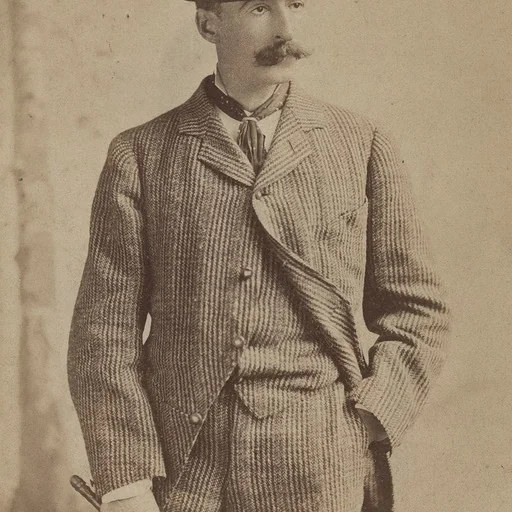
Artist
Winslow Homer (February 24, 1836 – September 29, 1910) was an American landscape painter and illustrator, best known for his marine subjects.