Artwork
The Nooning
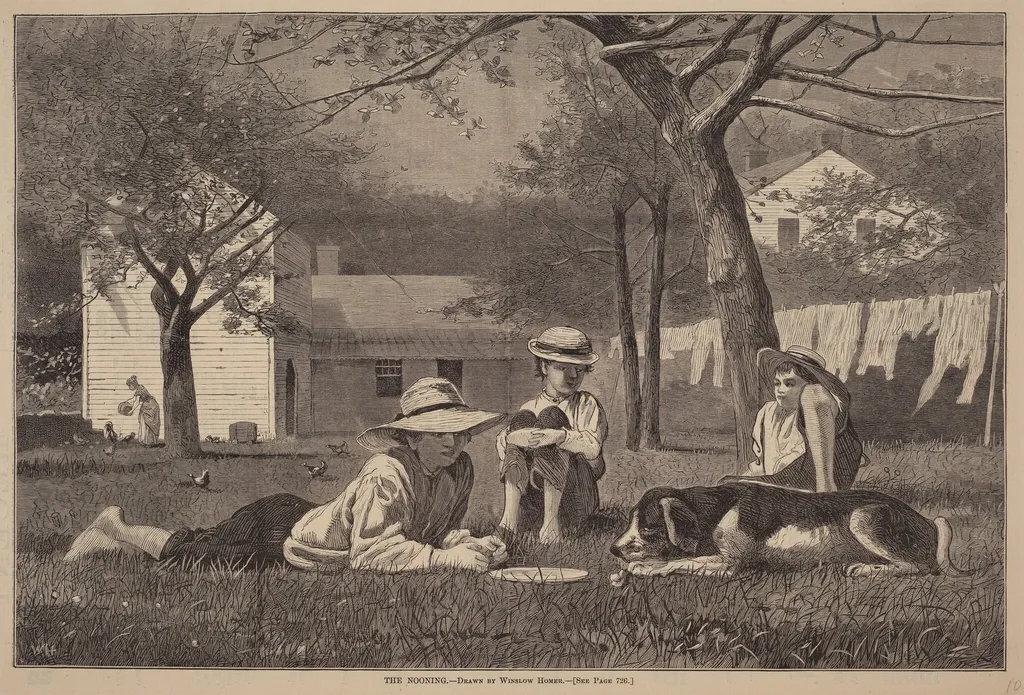
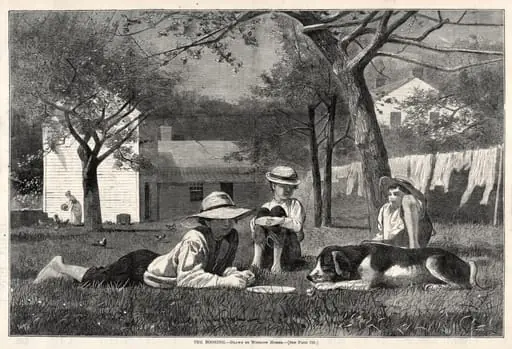
The Nooning is an ink print by the Impressionist artist American 19th Century. It dates from 1873 and is held in the collection of the National Gallery of Art. This wood engraving on newsprint depicts a quiet midday pause in a domestic yard.
About this work
Overview
Three figures rest in varying postures—seated, reclining, and leaning—while a dog, laundry on a line, and a distant house complete the scene.
This wood engraving on newsprint depicts a quiet midday pause in a domestic yard. Three figures rest in varying postures—seated, reclining, and leaning—while a dog, laundry on a line, and a distant house complete the scene. Bare trees and scattered birds suggest late winter or early spring. The image was produced using fine, precise lines typical of 19th-century print illustration, emphasizing texture and subtle tonal variation through hand-carved woodblocks.
Subject & Meaning
The scene captures an ordinary moment of respite, free from narrative drama or symbolic overload. The figures’ relaxed poses and the domestic elements—laundry, house, pet—point to rural or suburban daily life. The presence of birds in bare trees and the absence of active labor imply a pause between tasks, evoking a sense of stillness rather than idealized leisure. The composition invites quiet observation rather than interpretation.
Technique & Style
The artist employed wood engraving, a method involving incising fine lines into the end grain of hardwood to create detailed relief prints. The use of closely spaced strokes builds shadow and texture, particularly in the grass, tree bark, and clothing folds. Printed on newsprint, the work reflects the mass-produced aesthetic of illustrated periodicals, where clarity and reproducibility were prioritized over fine paper quality.
History & Provenance
The work originates from a period when wood engraving was the dominant technique for book and periodical illustration, roughly between the 1820s and 1880s. Its use of newsprint suggests it was published in a newspaper or magazine, likely as a vignette or accompanying image. No specific publication or artist is recorded, and its provenance remains undocumented beyond its material and stylistic context.
Context
During the mid-19th century, illustrated newspapers and magazines increasingly featured scenes of everyday life to appeal to a broad readership. This engraving aligns with a trend of depicting domestic tranquility, often idealized but grounded in observable detail. The technique allowed for mass reproduction, making such images accessible beyond elite art circles and contributing to a shared visual culture.
Legacy
Though unsigned and unattributed, the piece exemplifies the quiet documentary value of popular print media from its era. It preserves a visual record of ordinary routines and environments that were rarely the focus of fine art. As wood engraving gave way to photographic reproduction, such works became historical artifacts of a transitional moment in visual communication.
Artist & collection

Artist
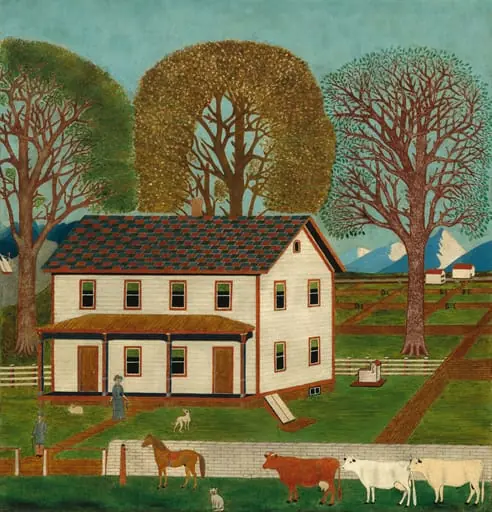
This artist painted everyday American life in the 1800s. Look at *Farmhouse in Mahantango Valley*—a quiet, sunlit scene of rural Pennsylvania. *Boy and Girl* shows two children standing close, their faces turned toward…