Artwork
The Island Sanctuary
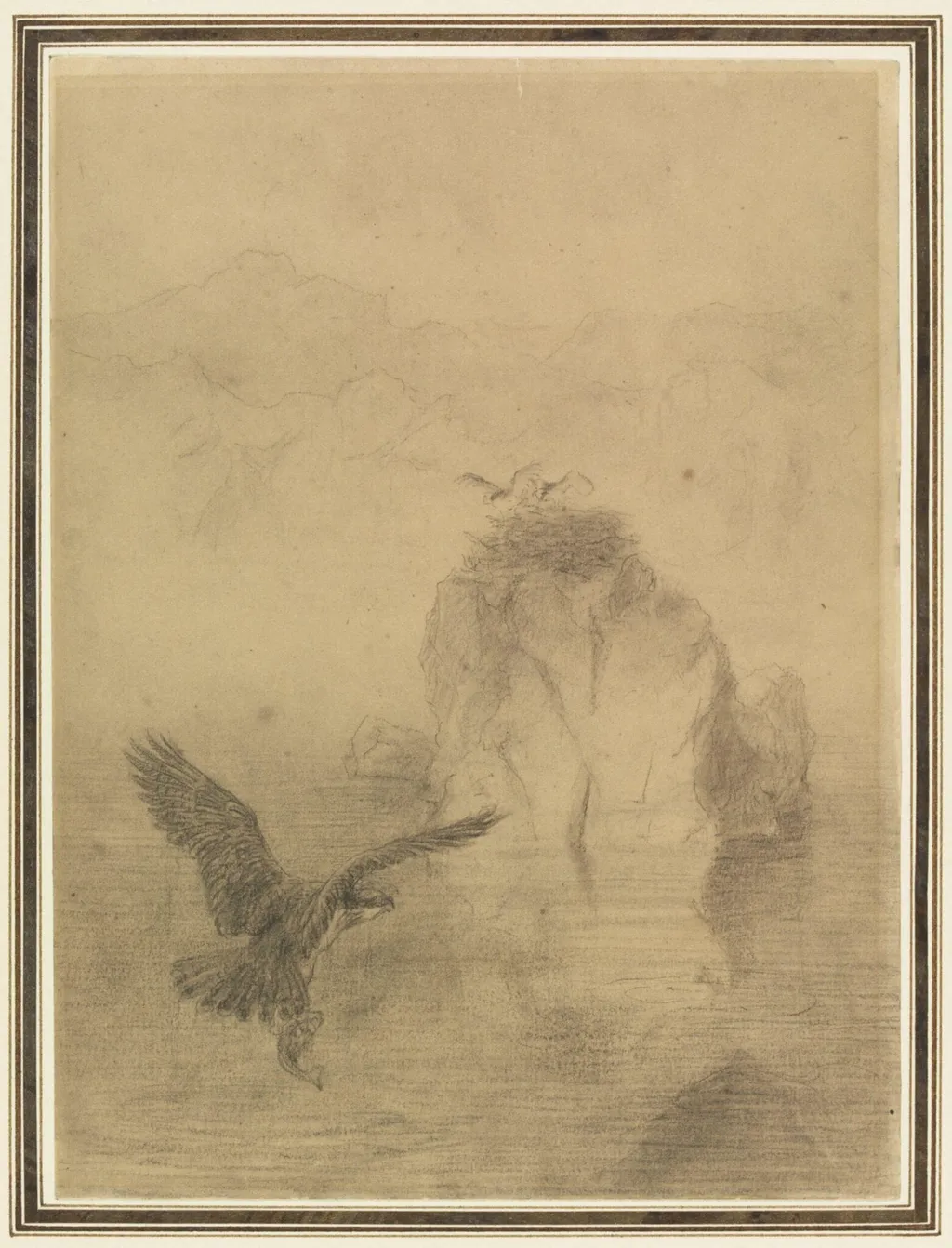
The Island Sanctuary is a drawing by the Impressionist artist Joseph Wolf. It dates from 1874 and is held in the collection of the Victoria and Albert Museum.
About this work
Overview
The work exemplifies Wolf’s precision in rendering wildlife, a hallmark of his contributions to nineteenth-century natural history illustration.
This graphite drawing, *The Island Sanctuary*, was created by Joseph Wolf as a preparatory study for Daniel Giraud Elliot’s 1874 publication *The Life and Habits of Wild Animals*. The composition presents a secluded rocky outcrop in open water, where avian life is observed in its natural habitat. The work exemplifies Wolf’s precision in rendering wildlife, a hallmark of his contributions to nineteenth-century natural history illustration.
Subject & Meaning
The scene centers on a rugged island, its surface marked by crevices and ledges that serve as nesting sites for two birds. A third bird hovers in mid-flight, suggesting movement and the dynamic interplay between predator and refuge. The setting evokes themes of isolation and survival, underscoring the delicate balance of ecosystems that Wolf frequently documented for scientific audiences.
Technique & Style
Wolf employed fine cross-hatching and stippling to model form and texture, achieving a high degree of realism in the depiction of feathers, rock strata, and water. The controlled linework conveys volume and depth, while the absence of extraneous detail directs attention to the subjects’ anatomical accuracy. Such methods align with the demands of scientific illustration, where clarity and fidelity to nature were paramount.
History & Provenance
Originally one of nineteen drawings Wolf produced for Elliot’s volume, this sheet was later exhibited at the Albany Gallery in 1968. That same year, it entered its current collection through an exchange for a work by J. D. Harding. The drawing’s orientation was reversed when reproduced in the published book, a common practice in printmaking to accommodate the printing process.
Context
During the mid-nineteenth century, natural history publications relied on artists like Wolf to bridge scientific observation and public engagement. His illustrations for Elliot’s work reflected the era’s growing interest in zoology and ornithology, as well as advancements in print technology that allowed for more detailed reproductions. Wolf’s collaboration with scientists positioned his drawings as both artistic and documentary records.
Own this work as a print
Artist & collection
Artist
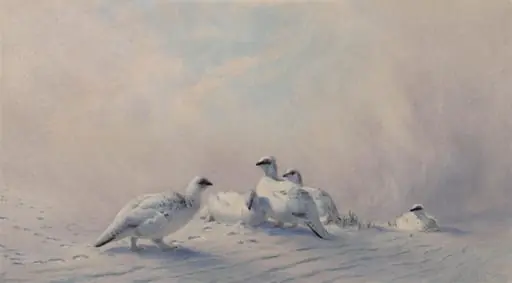
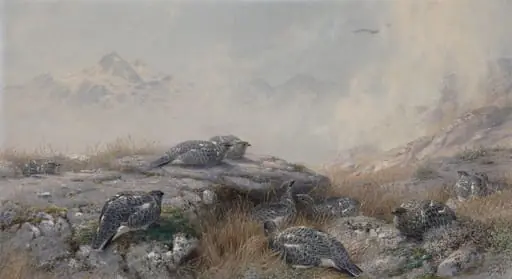
Joseph Wolf never met an animal he didn’t want to draw. Even on his honeymoon, he lugged a sketchbook up Swiss peaks to catch the snow ptarmigan molting from winter white to summer brown. That’s how he ended up…

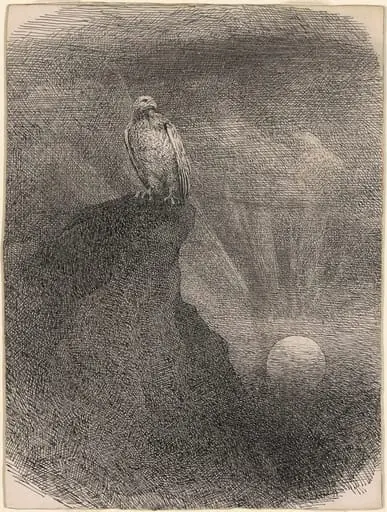 Genius
 清 張風 山水圖 冊 紙本|Landscapes
 Poetic Thoughts in a Forest Pavilion
 Landscape
 Aigle au vol
 Sheer Cliffs above a Coastal Road
 Landscape after Jing Hao and Guan Tong
 The First Prose Poem on the Red Cliff
 明 王紱 江山漁樂圖 卷|Joys of the Fisherman
 Landscape
 Reciting Poetry before the Yellowing of Autumn
 清 柳堉 山水圖 卷|Traveling Amid Streams and Mountains