Artwork
明/清 項聖謨 白菊圖 軸|White Chrysanthemums
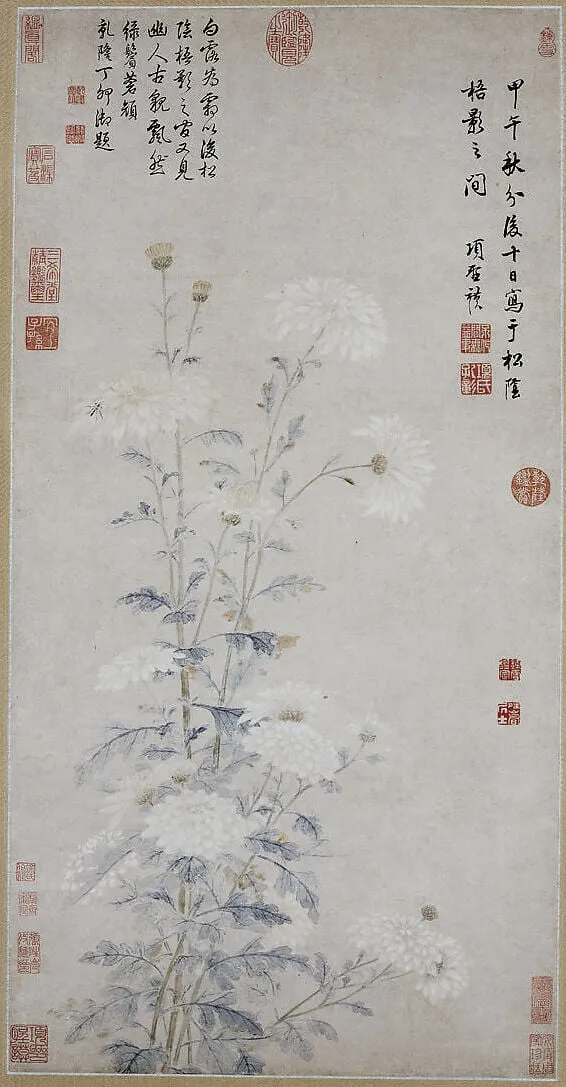
明/清 項聖謨 白菊圖 軸|White Chrysanthemums is a paint painting by the Baroque artist Xiang Shengmo. It dates from 1654 and is held in the collection of the Metropolitan Museum of Art.
About this work
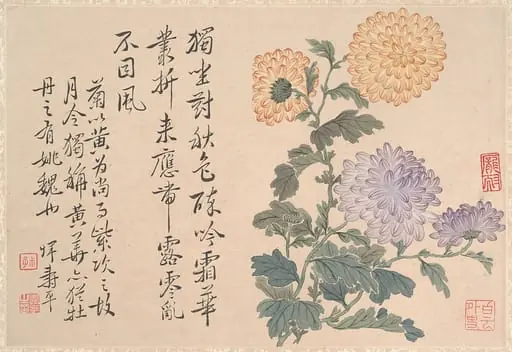
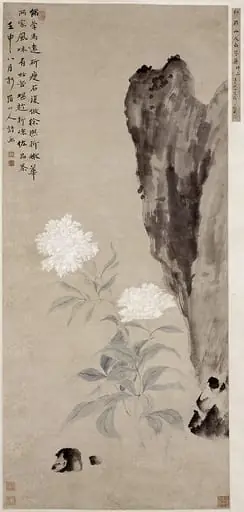
A tall scroll shows white chrysanthemums bending in a breeze. Dark stems and leaves fill the bottom; pale blooms float above like clouds.
Xiang Shengmo painted this in 1654, right after the Ming dynasty fell. The flowers look calm, but the empty space around them feels heavy—maybe a quiet protest.
To see how other Chinese artists painted flowers, look up flowers, china, flower.
Overview
The white chrysanthemum, a symbol of purity and reclusion, is rendered with precise brushwork that balances realistic observation with expressive restraint.
Painted in 1654 by Xiang Shengmo (1597–1658), White Chrysanthemums is a hanging scroll executed in color on paper. The composition features a cluster of white chrysanthemums rising from dark, sturdy stems and leaves at the bottom, with the pale blooms extending upward into a vast expanse of empty space. Xiang, a member of the prominent Xiang family of Huzhou and a direct descendant of the Ming imperial lineage, created this work shortly after the fall of the Ming dynasty and the establishment of the Qing regime. In the context of his career, the painting reflects his adherence to literati traditions while expressing the political and emotional turmoil of the dynastic transition. The white chrysanthemum, a symbol of purity and reclusion, is rendered with precise brushwork that balances realistic observation with expressive restraint. The heavy use of negative space surrounding the flowers is often interpreted by art historians as a visual metaphor for the artist's loyalty to the fallen Ming court and his refusal to serve the new Qing rulers. This work stands as a significant example of late Ming-early Qing painting, where botanical subjects frequently carried coded political meanings regarding integrity and resistance.
Subject & Meaning
The painting focuses on white chrysanthemums, a flower traditionally associated with resilience and purity in Chinese symbolism. Their gentle bending suggests a subtle response to an unseen breeze, while the surrounding emptiness creates a sense of quiet contemplation, possibly reflecting the artist’s response to the turbulent period following the fall of the Ming dynasty.
Technique & Style
Rendered with delicate brushwork, Xiang employs ink washes for the dark stems and leaves, contrasting with lighter, more translucent strokes for the petals. The use of color on paper allows for nuanced tonal variations, and the composition balances detailed botanical observation with the spacious, almost calligraphic negative space characteristic of literati painting.
History & Provenance
Created shortly after the Ming dynasty’s collapse, the scroll marks a transitional moment in Chinese art history as artists navigated new political realities under Qing rule. While specific ownership records are scarce, the work has been documented in several catalogues of Ming‑Qing painting and is recognized as a representative example of Xiang Shengmo’s later oeuvre.
Context
During the mid‑17th century, Chinese painters often turned to flower subjects to convey personal sentiment and moral virtue. Chrysanthemums, in particular, were favored for their ability to bloom in late autumn, symbolizing perseverance. Xiang’s choice of a monochromatic palette aligns with contemporary aesthetic preferences for restraint and scholarly expression.
Artist & collection