Artwork
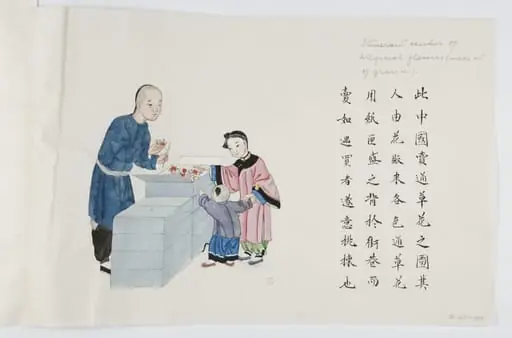
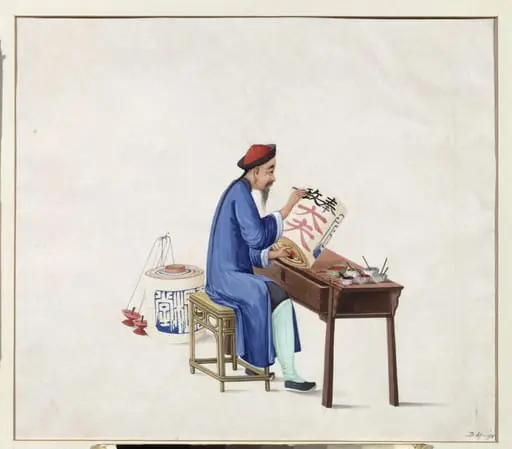
Man selling squares of painted paper as window panels
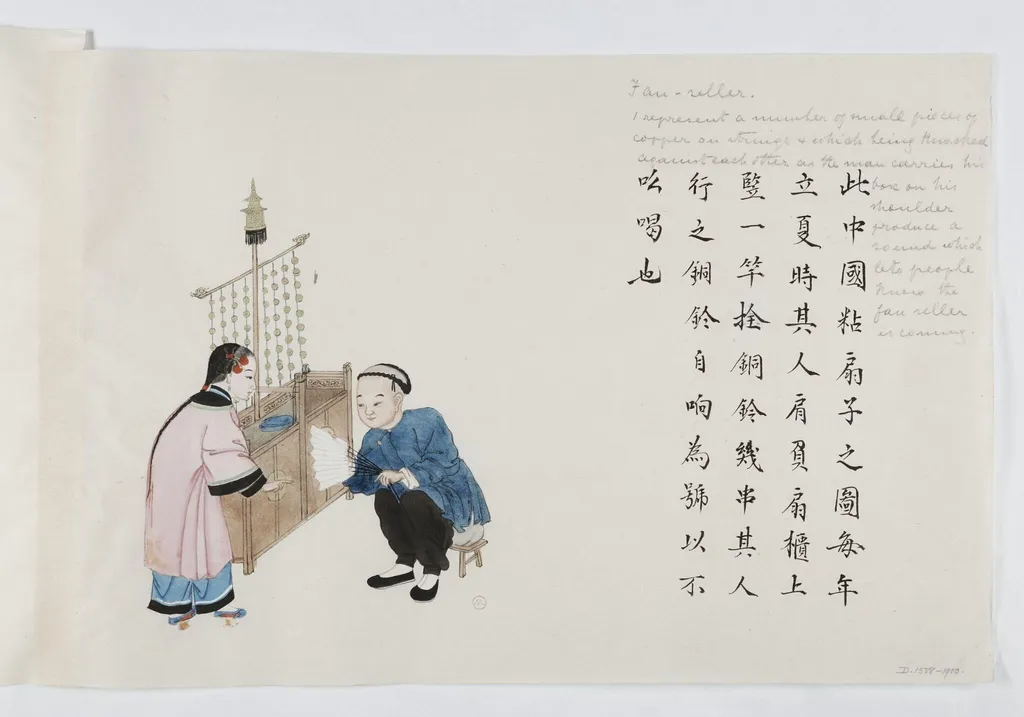
Man selling squares of painted paper as window panels is a paint painting by the Impressionist artist Peichun Zhou. It dates from 1885 and is held in the collection of the Victoria and Albert Museum. The work portrays a quiet exchange between a male vendor and a female customer.
About this work
Overview
The work portrays a quiet exchange between a male vendor and a female customer. The man, seated on a low stool, holds a fan in his right hand and offers a painted square of paper with his left. The woman, dressed in a pink robe with black trim, reaches forward to receive the paper. The composition is set against an unadorned background that isolates the interaction.
Subject & Meaning
The scene captures a moment of everyday commerce in a traditional Chinese setting, specifically the sale of painted paper intended for use as window panels. The vendor’s blue tunic and the customer’s pink attire highlight gendered color conventions, while the act of handing over the paper suggests a transaction rooted in domestic decoration practices.
Technique & Style
Executed in a flat, linear manner, the painting emphasizes clear outlines and modest shading, characteristic of late‑19th‑century Chinese genre painting. The figures are rendered with precise brushwork that defines clothing folds and facial features, while the neutral backdrop eliminates distraction, focusing attention on the exchange of objects.
History & Provenance
Created in 1885, the piece belongs to a larger album comprising over two hundred numbered paintings that document a range of occupations, customs, and social scenes. The album format reflects a systematic effort to catalog contemporary life, and the work has remained within that collection, offering insight into visual documentation practices of the period.
Context
The painting aligns with the visual language of artists such as Zhou Peichun, whose genre scenes similarly depict quotidian activities with an emphasis on narrative clarity. Its inclusion in an occupational series situates it within a broader cultural project to record and disseminate knowledge of everyday trades and domestic rituals in late Qing‑era China.
Artist & collection
Artist
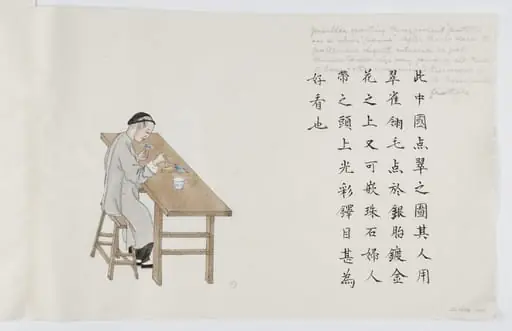
Peichun Zhou's tiny paintings feel like overheard gossip. Every inch of the page teems with someone’s daily hustle—silver hairpins, paper flowers, or a jeweler gluing kingfisher feathers onto a trinket. You can almost…