Artwork
The Master-Smith
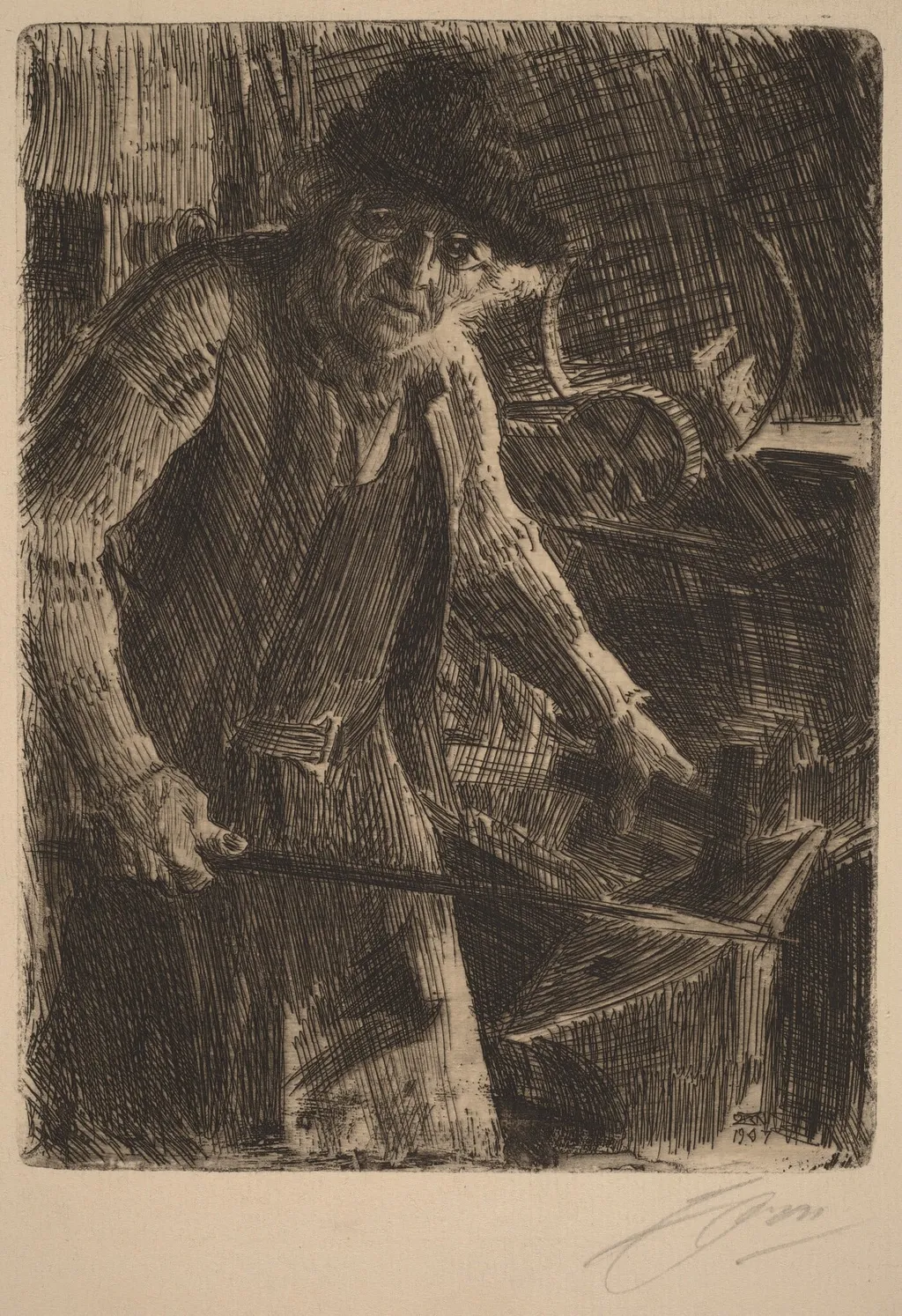
The Master-Smith is an ink print by Anders Zorn. It dates from 1907 and is held in the collection of the National Gallery of Art.
About this work
Overview
The composition focuses on the interaction between the figures, with minimal background detail, emphasizing the rawness of their task.
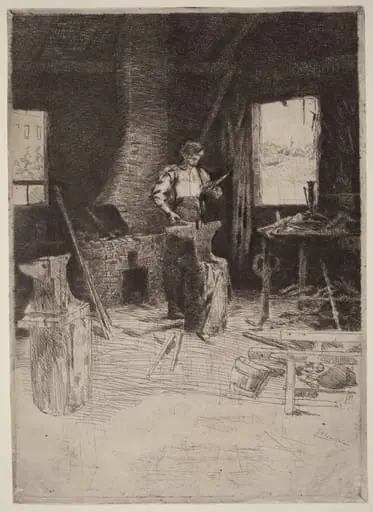
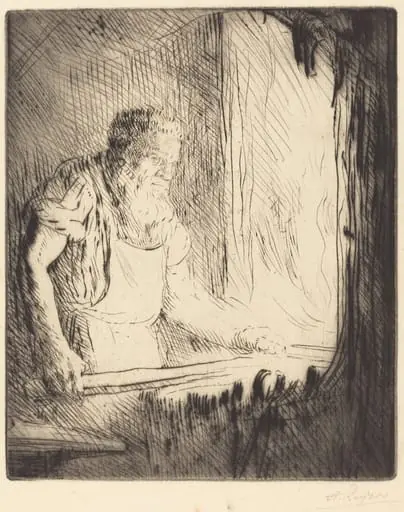
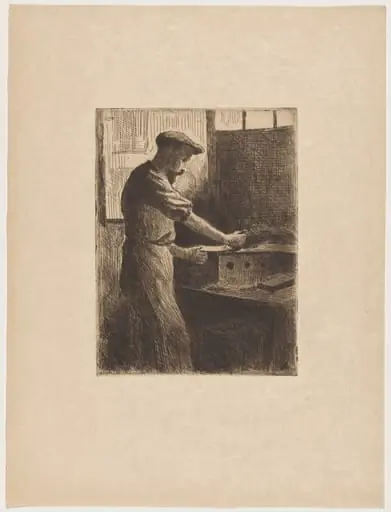
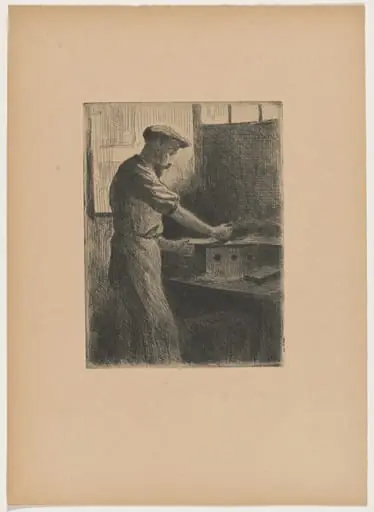
Created in 1907, this etching by Anders Zorn depicts two blacksmiths engaged in their labor. Rendered in ink on laid paper, the work captures a moment of intense physical effort. The composition focuses on the interaction between the figures, with minimal background detail, emphasizing the rawness of their task. The medium allows for rich tonal contrasts, enhancing the sense of weight and heat in the scene.
Subject & Meaning
The print portrays two laborers—one striking hot iron, the other gripping it with tongs—highlighting the coordination and physicality of traditional smithing. Their expressions and postures convey concentration and endurance. The absence of context or narrative detail directs attention to the act itself, suggesting a meditation on craftsmanship and human effort, rather than a specific historical or symbolic story.
Technique & Style
Zorn employed etching to carve fine lines into a metal plate, which held ink and transferred it to paper under pressure. The dense, intersecting strokes in the background evoke heat and motion, while the figures are rendered with controlled, textured lines that model form and shadow. The deep blacks and delicate grays create a tactile quality, making the metal appear molten and the skin weathered.
History & Provenance
This print was made during Zorn’s mature period, when he increasingly turned to printmaking after achieving fame as a painter. It reflects his interest in rural and industrial labor, themes he explored across his oeuvre. The work was likely produced in his studio in Mora, Sweden, and circulated among collectors of Scandinavian prints, though its early ownership records remain sparse.
Context
In early 20th-century Europe, industrialization was transforming traditional crafts, and artists like Zorn documented these vanishing trades with quiet reverence. His etchings of blacksmiths, fishermen, and farmers stood in contrast to urban modernism, offering a grounded, human-centered view of labor. This print aligns with broader Nordic realist traditions that valued authenticity over idealization.
Legacy
Zorn’s etching contributed to the revival of printmaking as a serious artistic medium in Scandinavia. Though not widely exhibited during his lifetime, it has since been recognized for its technical precision and emotional restraint. The work remains a reference for artists studying the expressive potential of line and tone in depicting manual labor.
Artist & collection

Artist
Anders Leonard Zorn was born in February 1860 in Mora, Dalarna, the illegitimate son of a Bavarian brewer and a Swedish farmer's daughter; his mother died shortly after his birth, and his grandparents raised him.