Artwork
Blacksmith (Le forgeron)
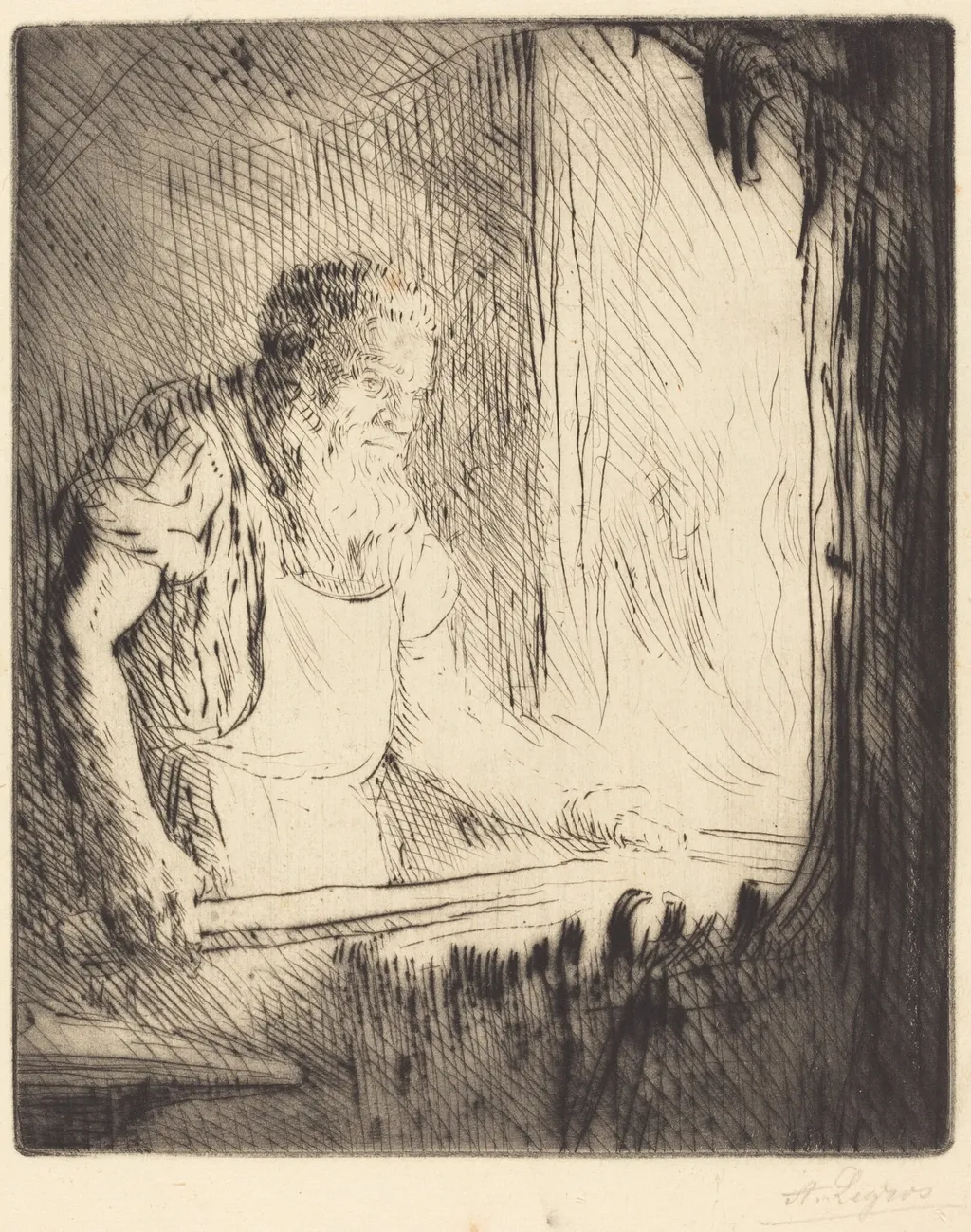
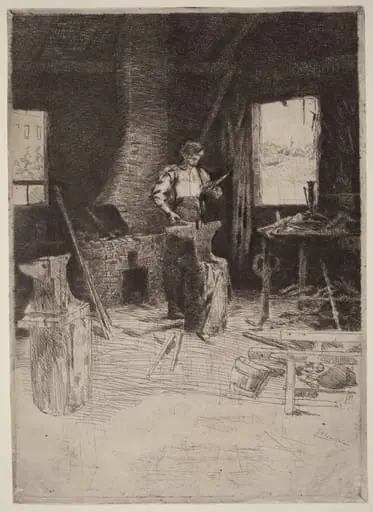
Blacksmith (Le forgeron) is an ink print by the Romanticist artist Alphonse Legros. It dates from 1874 and is held in the collection of the National Gallery of Art.
About this work
Overview
This work exemplifies his commitment to direct, expressive mark-making and his interest in laboring figures as subjects of serious artistic study.
Created in 1874, *Blacksmith (Le forgeron)* is an intaglio print by Alphonse Legros, combining drypoint and etching techniques. Though born in France, Legros had settled in London by 1863 and became a British citizen, playing a key role in the 19th-century revival of printmaking in Britain. This work exemplifies his commitment to direct, expressive mark-making and his interest in laboring figures as subjects of serious artistic study.
Subject & Meaning
The print portrays a blacksmith in mid-motion, hammer raised above an anvil, his body bent with effort. His face is obscured by tangled hair and swirling smoke, emphasizing physical exertion over individual identity. The anonymity of the figure underscores a broader focus on the dignity and intensity of manual labor, a theme Legros returned to throughout his career, reflecting social realism without overt commentary.
Technique & Style
Legros employed drypoint to carve directly into the plate, creating dense, scratchy lines with a burr that holds ink and produces rich, velvety blacks. The etching adds finer contours, but the dominant texture is rough and urgent, mimicking the force of the smith’s blows. The background dissolves into shadowy abstraction, heightening the figure’s presence through contrast and minimal detail.
History & Provenance
The print emerged during Legros’s early years in Britain, when he was actively engaged with the Royal Academy and the emerging etching revival. It was likely produced for private circulation or exhibition among artists and collectors interested in renewed printmaking practices. No documented early ownership is widely recorded, but its technical precision aligns with his pedagogical and artistic priorities at the time.
Context
In the 1870s, British art circles were re-engaging with etching as a fine art medium, moving away from reproductive prints. Legros, influenced by French Realism and Dutch Old Master prints, championed direct, hand-crafted imagery. His focus on laborers like the blacksmith aligned with broader European interest in the working class, though his approach remained quiet and observational rather than polemical.
Legacy
Legros’s *Blacksmith* contributed to the legitimacy of etching as a vehicle for expressive, non-illustrative art in Britain. His use of drypoint’s raw texture influenced later generations of printmakers who valued immediacy over polish. Though less known today than his contemporaries, his technical rigor and thematic focus on labor remain significant in the history of 19th-century printmaking.
Own this work as a print
Artist & collection

Artist
Alphonse Legros (French pronunciation: ; 8 May 1837 – 8 December 1911) was a French, later British, painter, etcher, sculptor, and medallist.