Art Museum
Palace of Caserta

Image: Wikimedia Commons.
Palace of Caserta is an art museum in Caserta, Italy.
About Palace of Caserta
Overview & Identity
The Palace of Caserta, known as the Reggia di Caserta, is a monumental royal residence located in Caserta, Italy. It was constructed to serve as the political and social model for displaying the power and grandeur of an absolute Bourbon monarchy. The complex is one of the largest royal residences in the world by volume, measuring approximately 2 million cubic metres (70 million cubic feet). It stands as a testament to the architectural ambitions of the 18th century and remains a significant cultural landmark in Italy.
History & Founding
Construction of the palace began in 1752 under the direction of the architect Luigi Vanvitelli. Vanvitelli died in 1773, at which point the construction was continued by his son, Carlo Vanvitelli. The project was intended to rival other great European palaces, drawing inspiration from French predecessors. The palace was listed as a UNESCO World Heritage site, recognizing its outstanding universal value. The site's history is deeply intertwined with the Bourbon dynasty's rule in the Kingdom of Naples.
Architecture & Scale
The palace features a rectangular plan measuring 247 m × 190 m (810 ft × 623 ft), with four sides connected by internal courtyards. The structure comprises five floors and contains 1,200 rooms, including two dozen state apartments. Additional architectural features include 1,742 windows, 34 staircases, and 1,026 fireplaces. The complex also houses a large library and a theatre modelled after a specific classical design. An ambitious plan for an avenue running 20 kilometres between the palace and Naples was conceived but never realized.
Gardens & Grounds
The palace is accompanied by a vast garden, a typical example of the Baroque extension of formal vistas, which stretches for 120 hectares (300 acres) partly on hilly terrain. The landscape features fountains and cascades, each filling a specific hydraulic and aesthetic role. Many figures from classical Antiquity within the gardens were modelled by Gaetano Salomone and executed by large workshops. The garden design emphasizes the integration of water and sculpture to create a grand theatrical experience for visitors.
Wartime History & Damage
The Palace of Caserta suffered its most serious documented wartime damage during World War II. In September 1943, an aerial bombardment struck the palace, causing significant destruction. From 1923 to 1943, the palace served as the location of the Allied headquarters in Italy, highlighting its strategic importance during the conflict. The site also suffered later accidental and structural damage, notably on 4 November 1998, shortly after its inscription on the World Heritage list.
Collection & Conservation
In 2025, the museum announced a programme to create publicly accessible storage areas for historical-artistic objects that had not previously formed part of the public visitor offer. A survey of the palace and park identified objects dispersed through the complex, often without an organic location or secure archival references. The programme includes the recovery, cataloguing, digitization, and conservation of paintings, frames, furnishings, stone material, paper documents, applied arts, textiles, sacred vestments, and presepe elements. The palace has also been a filming location for notable films and television series, including Star Wars.
What to see at Palace of Caserta
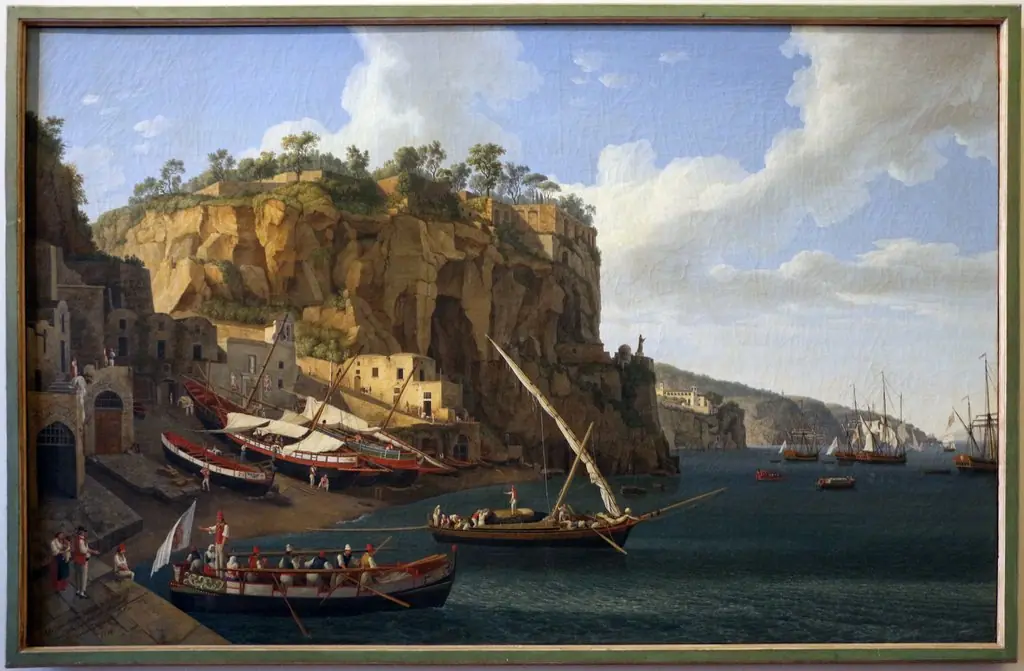
Start with View of the Small Marina of Sorrento by Jacob Philipp Hackert.

Plan your visit
Palace of Caserta