Artwork
Ruiner og et tårn ved Kaiserswerth, Düsseldorff
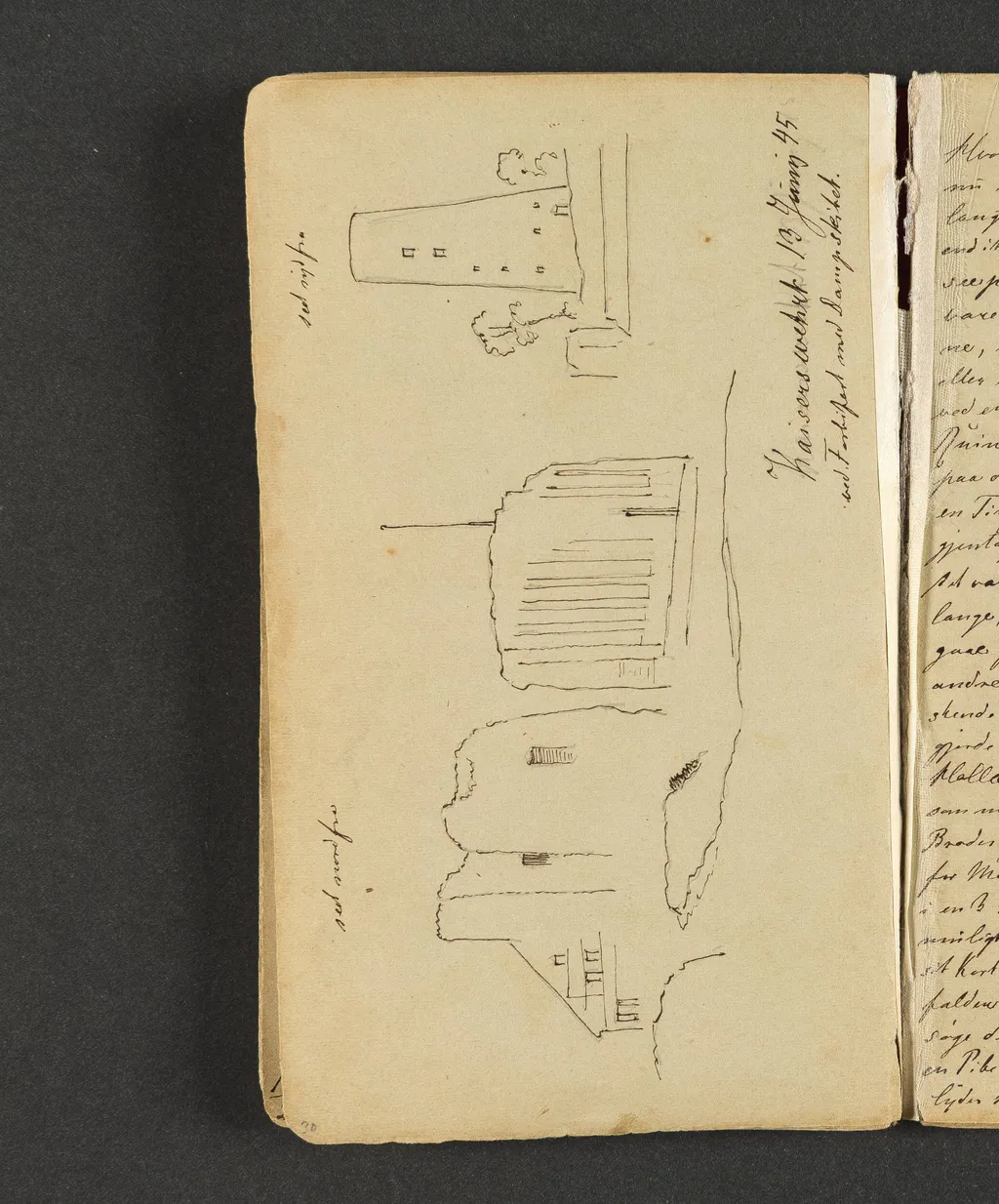
Ruiner og et tårn ved Kaiserswerth, Düsseldorff is an unspecified painting by the Romanticist artist Unknown. It dates from 1845 and is held in the collection of the Statens Museum for Kunst.
About this work
Overview
Its loose, rapid linework suggests it was made on-site as a documentary record rather than a polished composition.
Created in 1845, this pencil sketch depicts the ruins of a stone structure with a prominent tower and an adjacent smaller building near Kaiserswerth, just outside Düsseldorf. Executed on yellowed paper, the work bears marginal handwritten notes. Its loose, rapid linework suggests it was made on-site as a documentary record rather than a polished composition. The sketch is held in the collection of the Museum of Ethnography.
Subject & Meaning
The subject is a decaying architectural complex, likely a former religious or defensive site, reduced to fragments by time and neglect. The artist’s focus on structural collapse and shadowed voids implies an interest in transience. Rather than romanticizing decay, the sketch functions as a visual archive—preserving form before further erosion or demolition. The marginal notes may indicate dates, measurements, or personal observations tied to the site’s condition.
Technique & Style
The drawing employs quick, uneven pencil strokes that capture volume through tone rather than precise contour. Details are omitted; surfaces are suggested with smudged shadows and hatched lines. The paper’s texture and age contribute to the work’s atmospheric quality. This method reflects a topographical approach—prioritizing spatial accuracy and structural clarity over aesthetic finish, typical of field studies in the mid-19th century.
History & Provenance
The sketch was made during a period of heightened interest in regional heritage sites in the Rhineland. Though the artist’s identity is not specified in the source, such studies were often conducted by architects, antiquarians, or students affiliated with Düsseldorf’s art academy. It entered the Museum of Ethnography’s collection likely as part of a broader ethnographic or architectural survey, reflecting 19th-century efforts to document vanishing cultural landmarks.
Context
In the 1840s, German-speaking regions saw growing scholarly attention to medieval ruins, spurred by Romantic-era ideals and rising nationalism. While painters often imbued ruins with emotional symbolism, this sketch diverges by emphasizing factual recording. Its existence aligns with institutional projects to catalog architectural remnants before industrialization or restoration altered them irreversibly.
Legacy
As a working drawing, this sketch holds value as a primary record of a site’s condition in the mid-19th century. It contributes to understanding how architectural heritage was observed and preserved before photography became widespread. Though not widely exhibited, it remains a quiet testament to the practice of on-site documentation in an era of rapid cultural change.
Artist & collection

 Domestic Scene
 Giacomo and Cardinal Marco, investing Andrea, Abbot of San Zeno, with his Benefice
 The Nymph of Fontainebleau
 Portrait of a Woman
 Madonna and Child with Saints in the Enclosed Garden
 Venus and Minerva
 Family Group of Four on Sofa
 Wall painting from Room H of the Villa of P. Fannius Synistor at Boscoreale
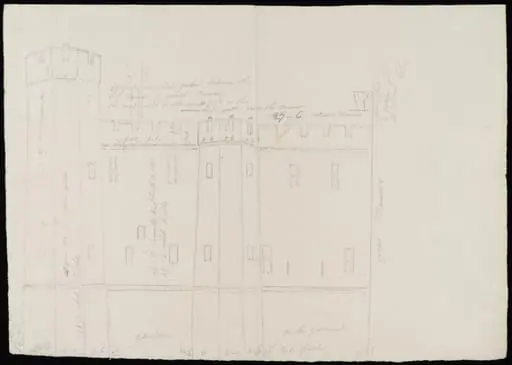 Elevation of part of the façade.
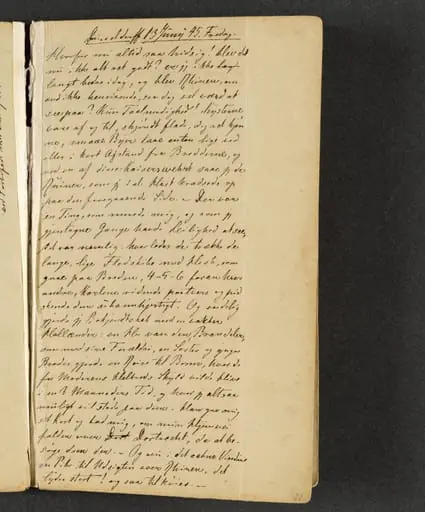 Rejsedagbog
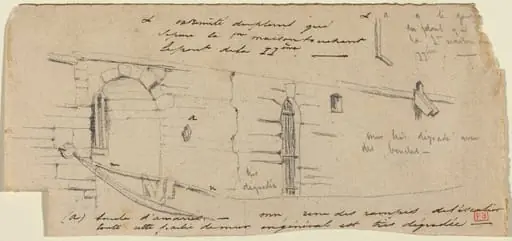 Study for "Le Petit Pont"
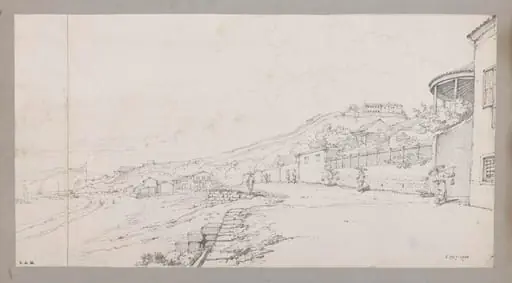 Part of Macao Bay, looking west
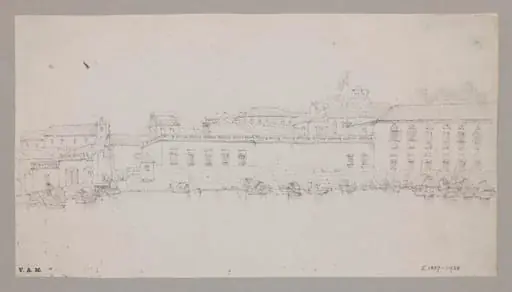 Buildings flanking the Inner Harbour, Macau
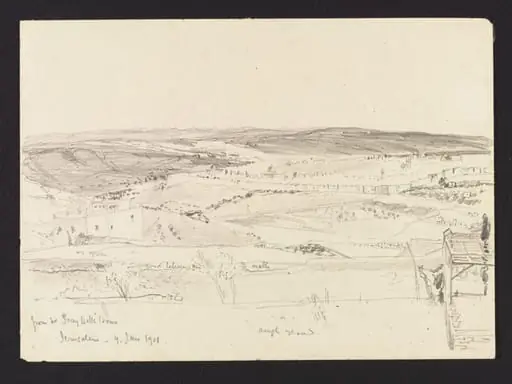 From Mr Gray Hill's House, Jerusalem
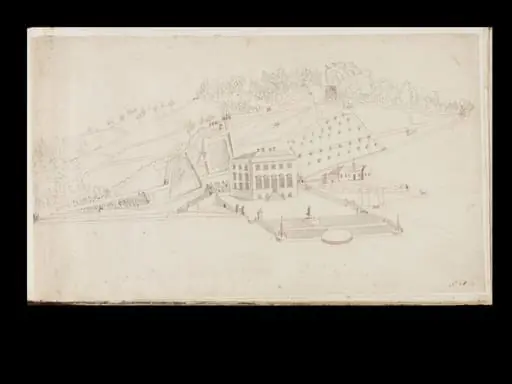 View of Painswick House and Gardens, Gloucestershire
 The Mill
![Head of a Monkey; Inventory of Bottles and Beverages [verso], by Paul Gauguin](https://artifactworldgallery.com/img/paul-gauguin--head-of-a-monkey-inventory-of-bottles-and-beverages-verso--0d4bb62a8bd056d4-w320.webp) Head of a Monkey; Inventory of Bottles and Beverages [verso]
Head of a Monkey; Inventory of Bottles and Beverages [verso] Landscape Near Aix-en-Provence
 Terrace by a River with a Villa and Trees Beyond
 O ruină din München