Artwork
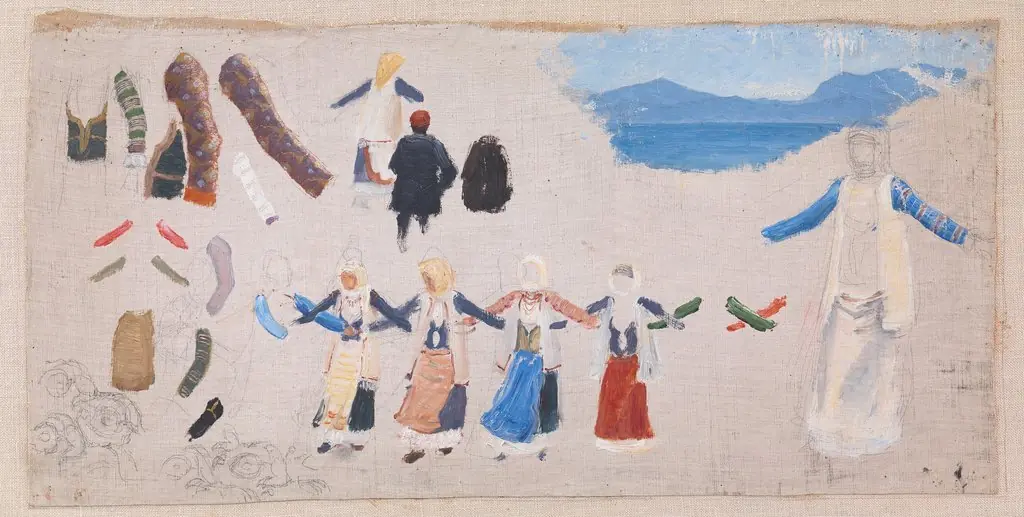
Kvindedansen i Megara
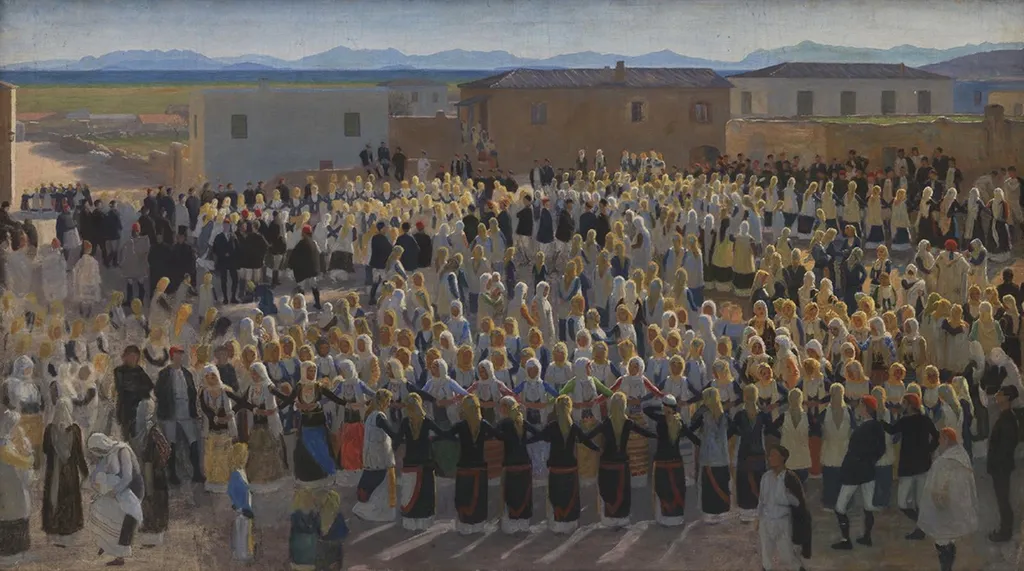
Kvindedansen i Megara is a photography by the Impressionist artist Unknown. It dates from 1889 and is held in the collection of the Statens Museum for Kunst.
About this work
Overview
Kvindedansen i Megara, painted in 1889 by 1232_person, depicts a communal dance in an outdoor courtyard.
Kvindedansen i Megara, painted in 1889 by 1232_person, depicts a communal dance in an outdoor courtyard. The work is part of the collection at the Museum of Ethnography. It captures a moment of collective ritual, rendered with attention to the spatial arrangement of participants and the quiet atmosphere of a traditional gathering. The scene is neither theatrical nor idealized, reflecting a documentary approach to everyday life.
Subject & Meaning
The painting portrays a circle of women dancing in traditional dress, their white headscarves and colorful belts distinguishing them from the darker-clad men standing behind. The formation suggests a ritual or celebratory dance, common in rural communities. The presence of men as observers, not participants, implies gendered roles in the event. The setting, framed by a long building and distant mountains, anchors the scene in a specific cultural and geographic context.
Technique & Style
The artist employed soft, blended brushwork to unify the dense crowd without losing individual forms. Colors are muted yet distinct, with the women’s garments providing subtle contrast against the neutral tones of the architecture and landscape. The composition avoids dramatic lighting or exaggerated motion, favoring a calm, observational tone. This approach aligns with Realist principles, emphasizing authenticity over embellishment.
History & Provenance
Created in 1889, the painting entered the collection of the Museum of Ethnography shortly after its completion. Its acquisition reflects the institution’s interest in documenting folk traditions during a period of increasing cultural preservation efforts. There is no record of public exhibition prior to its museum acquisition, suggesting it was initially intended for private or scholarly viewing rather than broad display.
Context
The scene likely represents a local custom from the Megara region, where such dances were performed during seasonal or religious festivals. In late 19th-century Europe, ethnographic interest in rural customs was growing, driven by nationalism and anthropological curiosity. This work contributes to a broader visual archive of folk practices, recorded before industrialization altered traditional life.
Legacy
Kvindedansen i Megara remains a quiet but significant record of regional dance traditions. While not widely known outside ethnographic circles, it exemplifies how artists contributed to cultural documentation during a time of rapid social change. Its restrained style and focus on ordinary ritual distinguish it from more romanticized depictions of folk life, offering a grounded perspective on community practices.
Artist & collection

 Domestic Scene
 Giacomo and Cardinal Marco, investing Andrea, Abbot of San Zeno, with his Benefice
 The Nymph of Fontainebleau
 Portrait of a Woman
 Madonna and Child with Saints in the Enclosed Garden
 Venus and Minerva
 Family Group of Four on Sofa
 Wall painting from Room H of the Villa of P. Fannius Synistor at Boscoreale