Artwork
Studie af lyserød rose og blå blomst
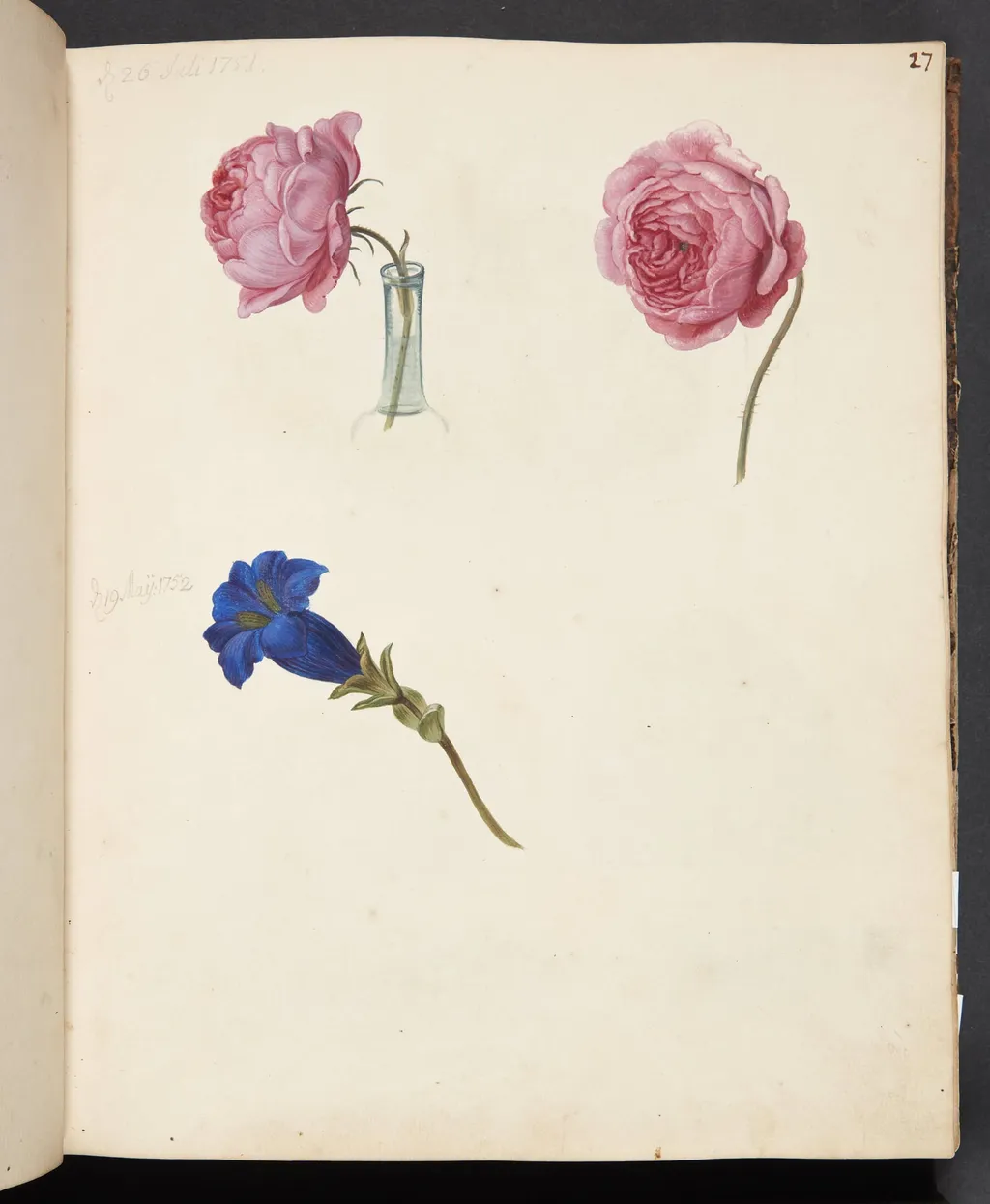
Studie af lyserød rose og blå blomst is an unspecified work on paper by the Rococo painting artist Unknown. It dates from 1751 and is held in the collection of the Statens Museum for Kunst.
About this work
Next, look up watercolor to see how artists mix paint and water for delicate effects like these.
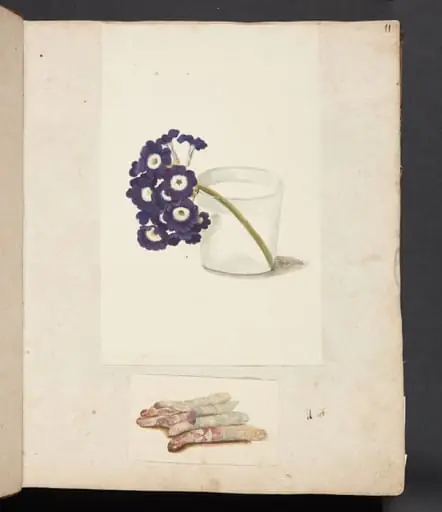
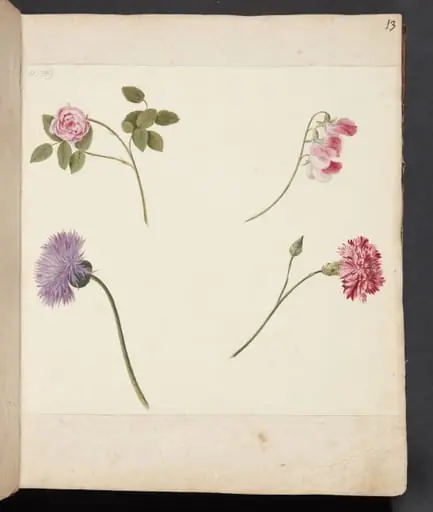
This page shows three painted flowers on a plain background. Two pink roses sit at the top—one in a small glass vase, the other loose. Below them is a single bright blue flower with a green stem. The colors are soft but clear, and the flowers look fresh.
The dates written in the corner (July 1751 and May 1752) suggest these were recorded over time. The artist focused on small details, like the tiny leaves and petal layers.
Next, look up watercolor to see how artists mix paint and water for delicate effects like these.
Overview
Studie af lyserød rose og blå blomst, executed by the artist recorded as 1342_person in the mid‑18th century, is a modestly sized composition that presents three individual blossoms against an unadorned backdrop. Two pink roses occupy the upper portion, one positioned in a diminutive glass vessel and the other free‑standing, while a solitary blue flower with a slender green stem rests below. The work is part of the collection of the Museum of Ethnography.
Subject & Meaning
The drawing isolates each flower to emphasize their distinct forms and hues, inviting close observation of botanical structure. The juxtaposition of the delicate pink roses with the vivid blue bloom creates a subtle dialogue of color and texture, suggesting an interest in the comparative study of species rather than a narrative scene.
Technique & Style
Rendered in watercolor, the piece demonstrates the medium’s capacity for translucency and fine gradation. The artist applied thin washes to achieve soft yet defined coloration, while meticulous brushwork captures the minute leaves and layered petals. The presence of two dates—July 1751 and May 1752—implies a sequential recording of observations, a practice common among natural‑history illustrators of the period.
History & Provenance
Created in 1751, the work entered the holdings of the Museum of Ethnography, where it remains catalogued. The museum’s acquisition reflects its broader interest in objects that document cultural and scientific practices, including the visual study of flora in the Enlightenment era.
Context
During the 1750s, European artists increasingly combined artistic skill with empirical observation, producing detailed studies of plants for both aesthetic and scholarly purposes. This piece aligns with that tradition, employing watercolor’s fluidity to render botanical accuracy while maintaining a decorative sensibility typical of the period’s decorative arts.
Artist & collection

 Domestic Scene
 Giacomo and Cardinal Marco, investing Andrea, Abbot of San Zeno, with his Benefice
 The Nymph of Fontainebleau
 Portrait of a Woman
 Madonna and Child with Saints in the Enclosed Garden
 Venus and Minerva
 Family Group of Four on Sofa
 Wall painting from Room H of the Villa of P. Fannius Synistor at Boscoreale