Artwork
Judith with the Head of Holofernes
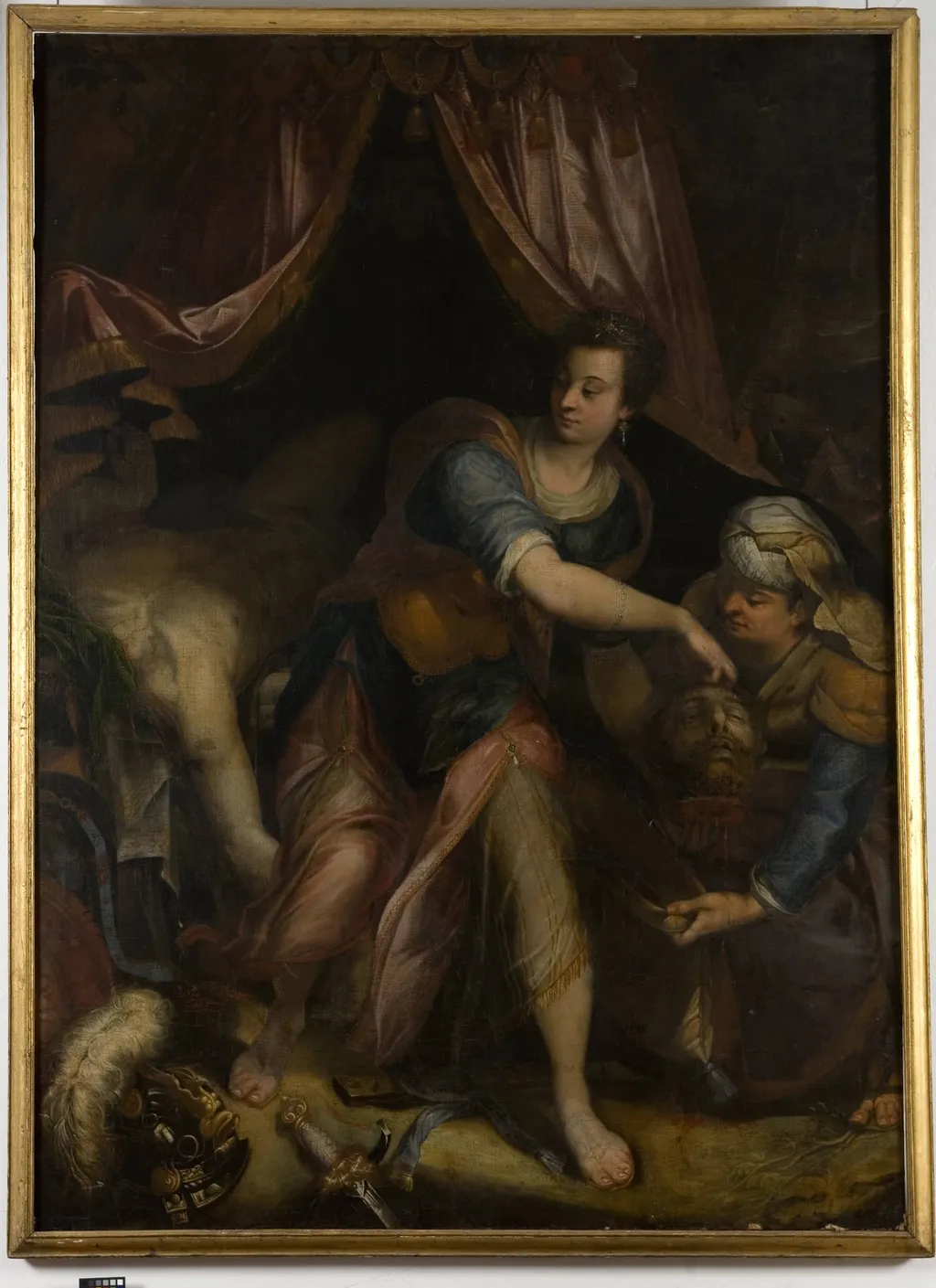
Judith with the Head of Holofernes is a photography by Unknown. It dates from 1750 and is held in the collection of the Statens Museum for Kunst.
About this work
Overview
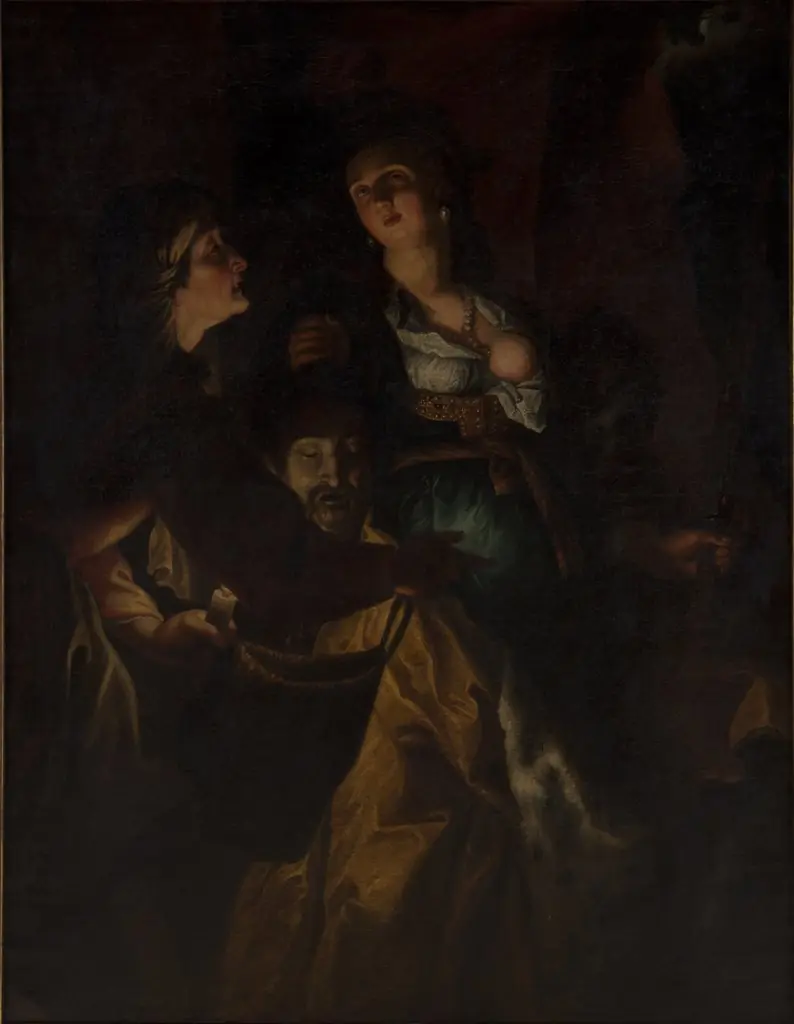
Painted around 1750, this work portrays Judith holding the severed head of Holofernes, a scene drawn from the deuterocanonical Book of Judith.
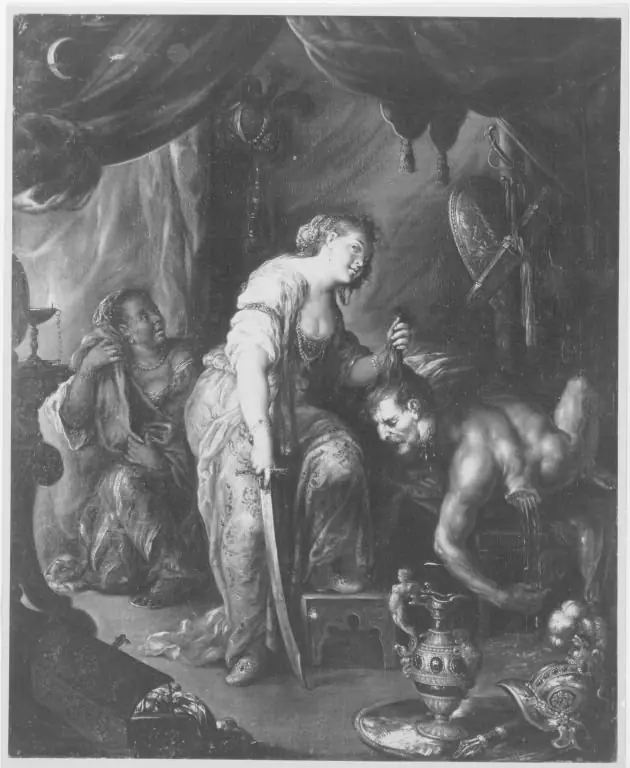
Painted around 1750, this work portrays Judith holding the severed head of Holofernes, a scene drawn from the deuterocanonical Book of Judith. The composition centers on the figure of Judith, flanked by a kneeling servant, set against a deep, shadowed backdrop. Red drapery and scattered armor elements frame the figures, reinforcing the narrative’s violent climax. The painting resides in the Museum of Ethnography, though its origin and artist remain undocumented in available records.
Subject & Meaning
Judith, a biblical heroine, is depicted moments after beheading the Assyrian general Holofernes to save her people. Her poised stance and direct gaze convey resolve, while the servant’s downward, fearful look introduces psychological tension. The severed head, held aloft, symbolizes divine justice and female agency in the face of oppression. The scene avoids glorification, instead emphasizing the weight and gravity of the act.
Technique & Style
The artist employs chiaroscuro to heighten emotional intensity, with sharp contrasts between the illuminated figures and the surrounding darkness. Judith’s dark dress and crimson cloak create a visual anchor, while the metallic glint of the sword and helmet catches the light. The servant’s posture and the folded curtains add depth, suggesting a confined, theatrical space. Brushwork is controlled, favoring clarity over detail, reinforcing the scene’s solemnity.
History & Provenance
The painting’s origin is unattributed, with no documented commission or exhibition history prior to its acquisition by the Museum of Ethnography. Its date, circa 1750, places it in a period when biblical narratives remained popular in European art, though this version diverges from more common Baroque interpretations. Its presence in an ethnographic collection suggests a later shift in contextual framing, possibly as an artifact of cultural storytelling.
Context
While Judith’s story was frequently depicted in Renaissance and Baroque art, this version lacks the ornate detail typical of those periods. Its restrained palette and minimal background reflect a more intimate, psychologically focused approach. The inclusion of an attendant servant, rather than a companion, underscores isolation and moral burden. The work may reflect regional or lesser-known artistic traditions within 18th-century Europe.
Legacy
Though not widely reproduced or studied in mainstream art history, the painting contributes to a broader corpus of Judith imagery that explores power, gender, and violence. Its preservation in an ethnographic context invites reinterpretation beyond religious iconography, positioning it as a cultural artifact of moral narrative. Its quiet intensity continues to prompt reflection on representation and agency in visual storytelling.
Artist & collection

 Domestic Scene
 Giacomo and Cardinal Marco, investing Andrea, Abbot of San Zeno, with his Benefice
 The Nymph of Fontainebleau
 Portrait of a Woman
 Madonna and Child with Saints in the Enclosed Garden
 Venus and Minerva
 Family Group of Four on Sofa
 Wall painting from Room H of the Villa of P. Fannius Synistor at Boscoreale