Artwork
Anemone coronaria (fransk anemone)
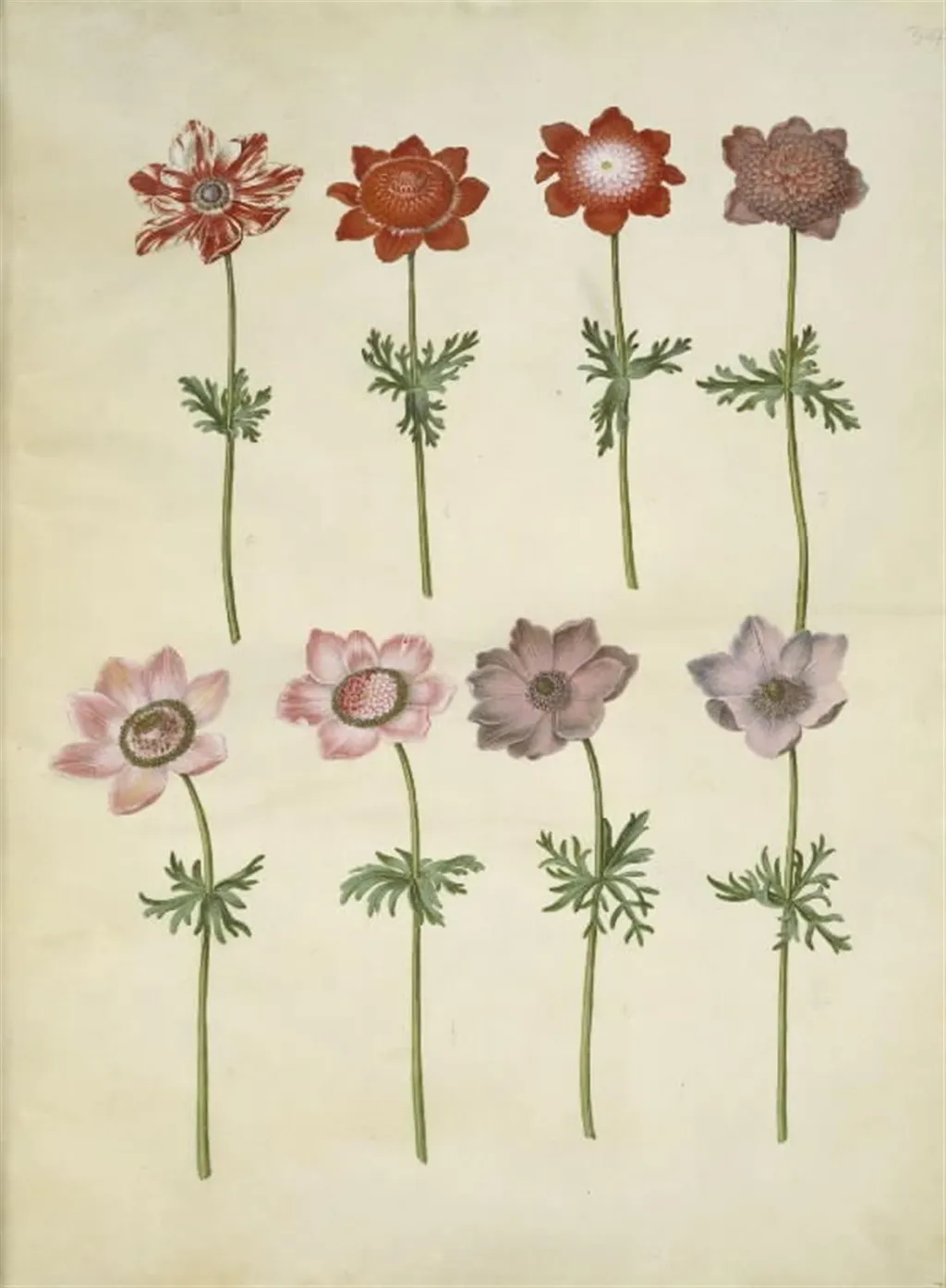
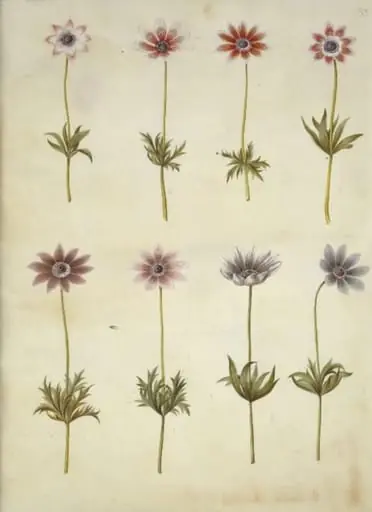
Anemone coronaria (fransk anemone) is an unspecified work on paper by Unknown. It dates from 1654 and is held in the collection of the Statens Museum for Kunst. Painted around 1654, this work depicts eight Anemone coronaria flowers rendered in watercolor on paper.
About this work
Overview
The artist’s attention to natural form and subtle tonal shifts reflects a tradition of scientific illustration common in mid-17th-century Europe.
Painted around 1654, this work depicts eight Anemone coronaria flowers rendered in watercolor on paper. The composition isolates each bloom against a neutral background, emphasizing botanical precision over narrative or setting. The artist’s attention to natural form and subtle tonal shifts reflects a tradition of scientific illustration common in mid-17th-century Europe. The piece is part of the Museum of Ethnography’s collection, where it is preserved as an example of early naturalist art.
Subject & Meaning
The subject is the French anemone, a flowering plant native to the Mediterranean. Its repeated presence in the composition suggests an interest in botanical variety and visual contrast. The pairing of deep red and soft pink blooms may reflect an awareness of natural variation within the species, or deliberate aesthetic balance. There is no symbolic or religious context evident; the focus remains on the plant’s physical presence as an object of observation.
Technique & Style
The artist employed thin, layered watercolor washes to achieve delicate gradations of color, from rich crimson to pale rose. Fine brushwork captures the texture of fuzzy stamens and the translucency of petals, while faint outlines define each leaf’s edge. Light is suggested not by shadow but by the intensity of pigment, with edges brightened to mimic natural glare. The method prioritizes accuracy over expression, aligning with contemporary botanical documentation practices.
History & Provenance
The painting’s origin is tied to a collector or naturalist active in the mid-1600s, though the artist’s identity remains unverified. It entered the Museum of Ethnography’s holdings through an acquisition of scientific or ethnographic materials, likely in the late 19th or early 20th century. Its preservation suggests it was valued for its detail rather than its artistic fame, consistent with how such works were often treated in institutional collections.
Context
Created during a period when European naturalists were systematically documenting flora, this work aligns with illustrated herbals and botanical atlases produced in the Netherlands and Germany. Artists often worked alongside scientists, producing images for study rather than display. The absence of insects, soil, or other environmental elements reflects a preference for isolated specimens, a standard practice in early botanical illustration.
Legacy
Though unsigned and unattributed to a major artist, the painting contributes to a broader archive of pre-modern plant studies. Its meticulous rendering influenced later botanical artists who sought to combine aesthetic restraint with scientific fidelity. Today, it serves as a reference for understanding how visual precision supported early botanical classification, bridging art and empirical inquiry in an age before photography.
Artist & collection

 Domestic Scene
 Giacomo and Cardinal Marco, investing Andrea, Abbot of San Zeno, with his Benefice
 The Nymph of Fontainebleau
 Portrait of a Woman
 Madonna and Child with Saints in the Enclosed Garden
 Venus and Minerva
 Family Group of Four on Sofa
 Wall painting from Room H of the Villa of P. Fannius Synistor at Boscoreale
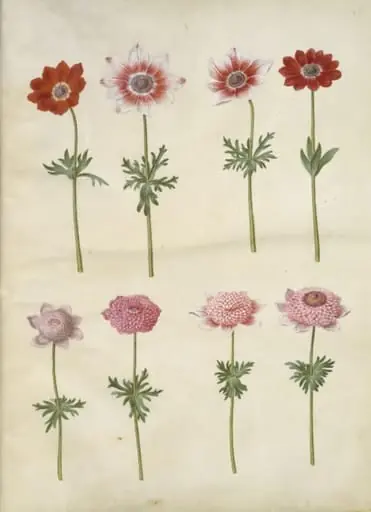 Anemone coronaria L. (fransk anemone); Anemone pavonina (påfugle-anemone)
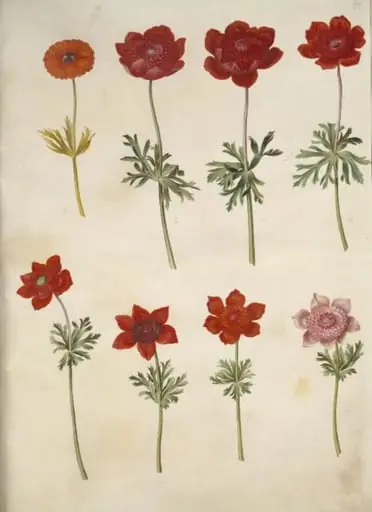 Anemone ×fulgens (skinnende anemone); Anemone coronaria (fransk anemone)
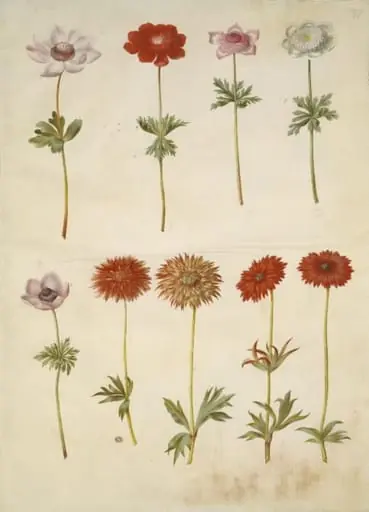 Anemone coronaria (fransk anemone); Anemone ×fulgens (skinnende anemone)
 Anemone pavonina (påfugle-anemone)
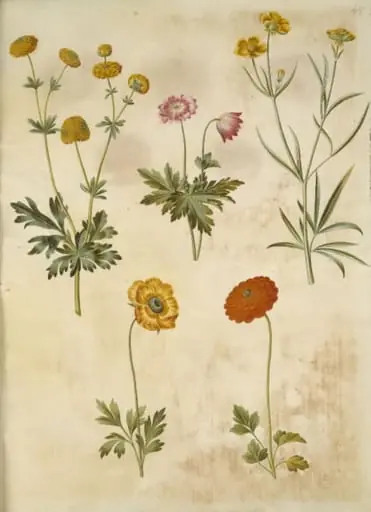 Ranunculus acris (guldknap-ranunkel); Anemone nemorosa (hvid anemone); Ranunculus illyricus (steppe-ranunkel); Ranunculus asiaticus (have-ranunkel)
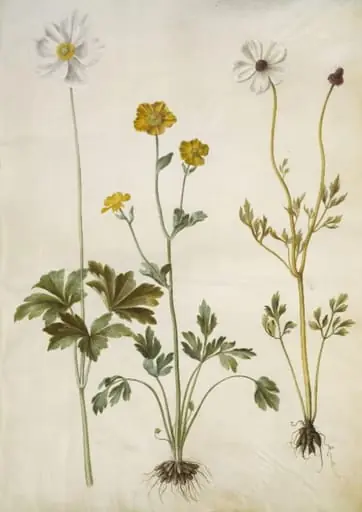 Anemone sylvestris (sommer-anemone); Ranunculus monspeliacus (silke-ranunkel); Ranunculus asiaticus (have-ranunkel)
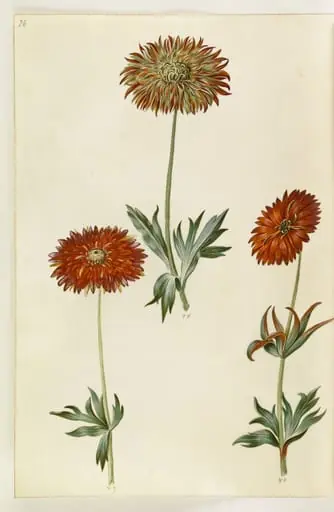 Anemone ×fulgens (skinnende anemone)
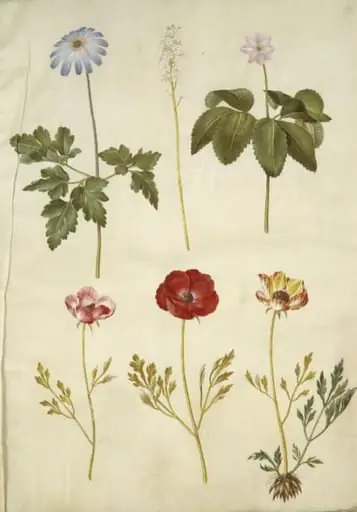 Anemone apennina (appenniner-anemone); Tiarella cordifolia (almindelig skumblomst); Anemone trifolia (trilling-anemone); Ranunculus asiaticus (have-ranunkel)
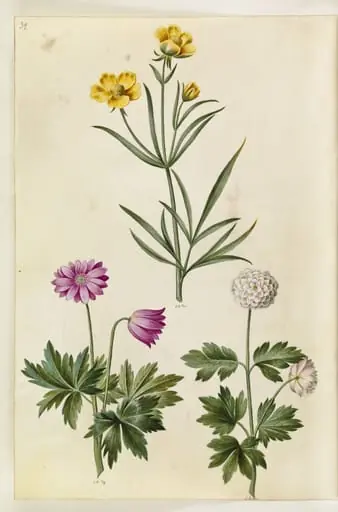 Ranunculus illyricus (steppe-ranunkel); Anemone nemorosa (hvid anemone)
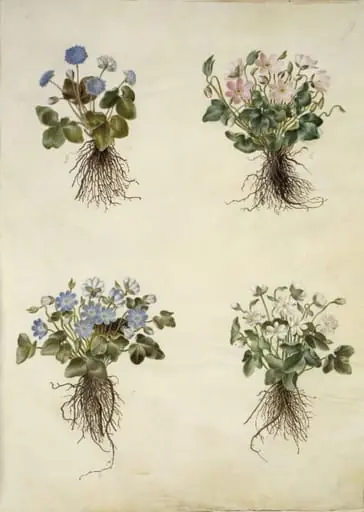 Anemone hepatica (blå anemone)
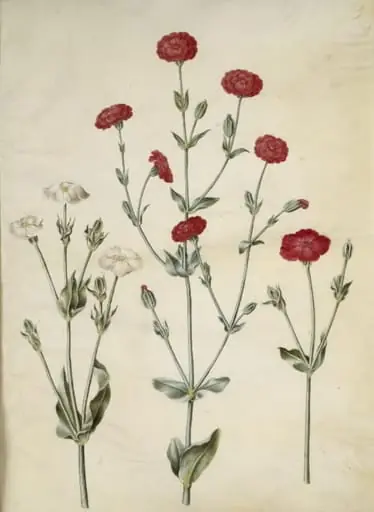 Silene coronaria (krone-limurt)