Artwork
Nordlyset, natten fra den 16. til den 17. september 1838, set fra Hellebæks kyst
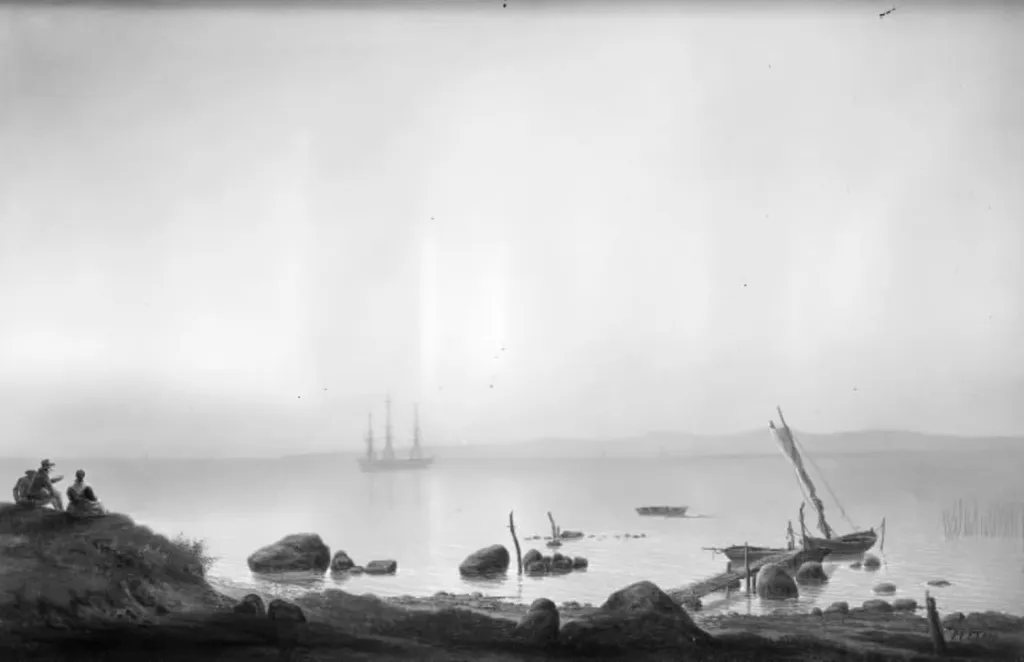
Nordlyset, natten fra den 16. til den 17. september 1838, set fra Hellebæks kyst is a photography by the Romanticist artist Unknown. It dates from 1839 and is held in the collection of the Statens Museum for Kunst. Painted in 1839, Nordlyset captures a quiet nocturnal landscape along Hellebæk’s coast, observed on the night of September 16–17, 1838.
About this work
Overview
Though titled with reference to the aurora, the painting conveys stillness more than spectacle, emphasizing atmosphere over dramatic effect.
Painted in 1839, Nordlyset captures a quiet nocturnal landscape along Hellebæk’s coast, observed on the night of September 16–17, 1838. The scene depicts still water, a few anchored boats, and a low shoreline with rocks and a modest pier. The sky transitions subtly from pale blue near the horizon to deeper indigo above, reinforcing the calm of the hour. Though titled with reference to the aurora, the painting conveys stillness more than spectacle, emphasizing atmosphere over dramatic effect.
Subject & Meaning
The work presents a moment of natural quietude rather than a dramatic celestial event. While the title references the northern lights, the visual record shows no visible aurora—only a serene night sky and undisturbed water. This suggests an interest not in spectacle, but in the emotional resonance of solitude and the passage of time. The absence of human activity heightens the sense of nature’s quiet persistence, aligning with Romantic ideals of introspection in the face of the natural world.
Technique & Style
The artist employs soft, blended brushwork to render the sky and water, creating a seamless gradient that enhances the feeling of stillness. Light is rendered subtly, with minimal contrast between shadow and highlight, allowing the surface of the water to reflect the sky’s muted tones. The foreground rocks and pier are rendered with restrained detail, grounding the composition without distracting from the horizon. The technique favors mood over precision, characteristic of early 19th-century Nordic landscape sensibilities.
History & Provenance
Created in 1839, the painting entered the collection of the Museum of Ethnography, an institution more commonly associated with cultural artifacts than fine art. Its presence there suggests an early interest in documenting regional visual culture as part of broader ethnographic study. The work’s journey into this collection reflects 19th-century efforts to preserve local scenes as expressions of national identity, even when they lacked overt historical or religious themes.
Context
In the late 1830s, Scandinavian artists increasingly turned to domestic landscapes as subjects worthy of serious attention, moving away from classical or mythological themes. This painting emerges within that shift, capturing a specific, observed moment rather than an idealized scene. Though influenced by Romanticism’s reverence for nature, it avoids theatricality, reflecting a quieter, more personal strain of the movement prevalent in Nordic regions during this period.
Legacy
The painting remains a quiet example of early Norwegian landscape observation, valued for its restraint and atmospheric precision. While not widely exhibited or reproduced, it contributes to the understanding of how local artists engaged with their environment during a formative period of national artistic identity. Its preservation in an ethnographic museum underscores its role as a cultural document as much as an aesthetic object.
Artist & collection

 Domestic Scene
 Giacomo and Cardinal Marco, investing Andrea, Abbot of San Zeno, with his Benefice
 The Nymph of Fontainebleau
 Portrait of a Woman
 Madonna and Child with Saints in the Enclosed Garden
 Venus and Minerva
 Family Group of Four on Sofa
 Wall painting from Room H of the Villa of P. Fannius Synistor at Boscoreale
 The Ship of the Line "Dronning Marie" (Queen Marie) and the Corvette "Najaden" Weigh Anchor in Faxa Bay, near Reykjavik, Iceland
 Klippekyst, Kullen
 Klippekyst, Kullen
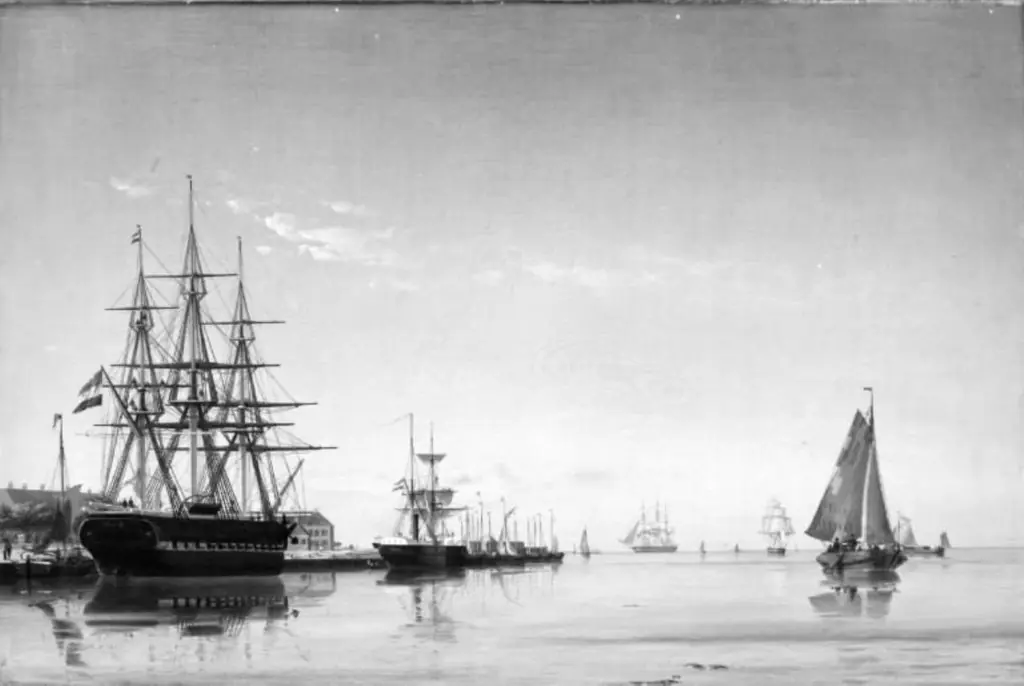 The Harbour at Nieuwe Diep in North Holland
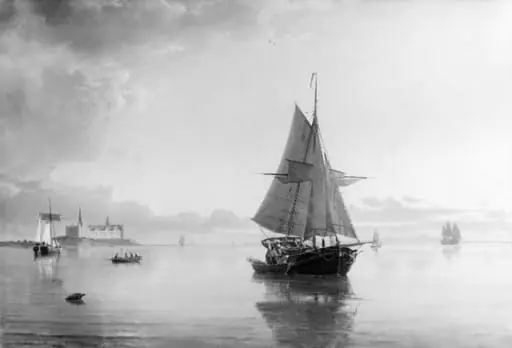 An Early Summer Morning in the Roads of Elsinore
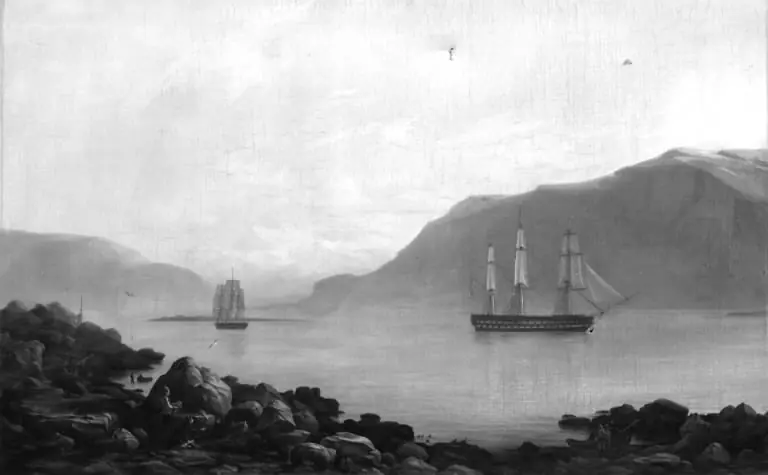 The Ship of the Line "Dronning Marie" (Queen Marie) and the Corvette "Najaden" Weigh Anchor in Faxa Bay, near Reykjavik, Iceland
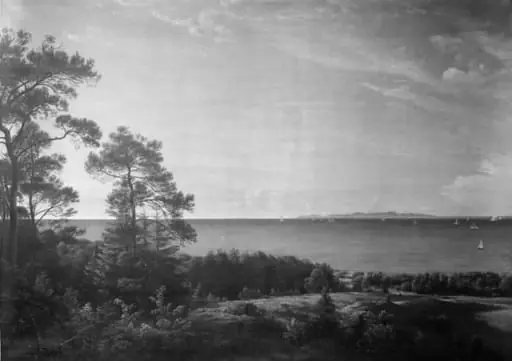 View from the North Coast of Sealand towards Kullen in Sweden. Summer Evening
 The Harbour at Nieuwe Diep in North Holland
 A Seascape. Moonlight
 Landskab fra bjergene ved Verona