Artwork
Portrait of Carl XII of Sweden
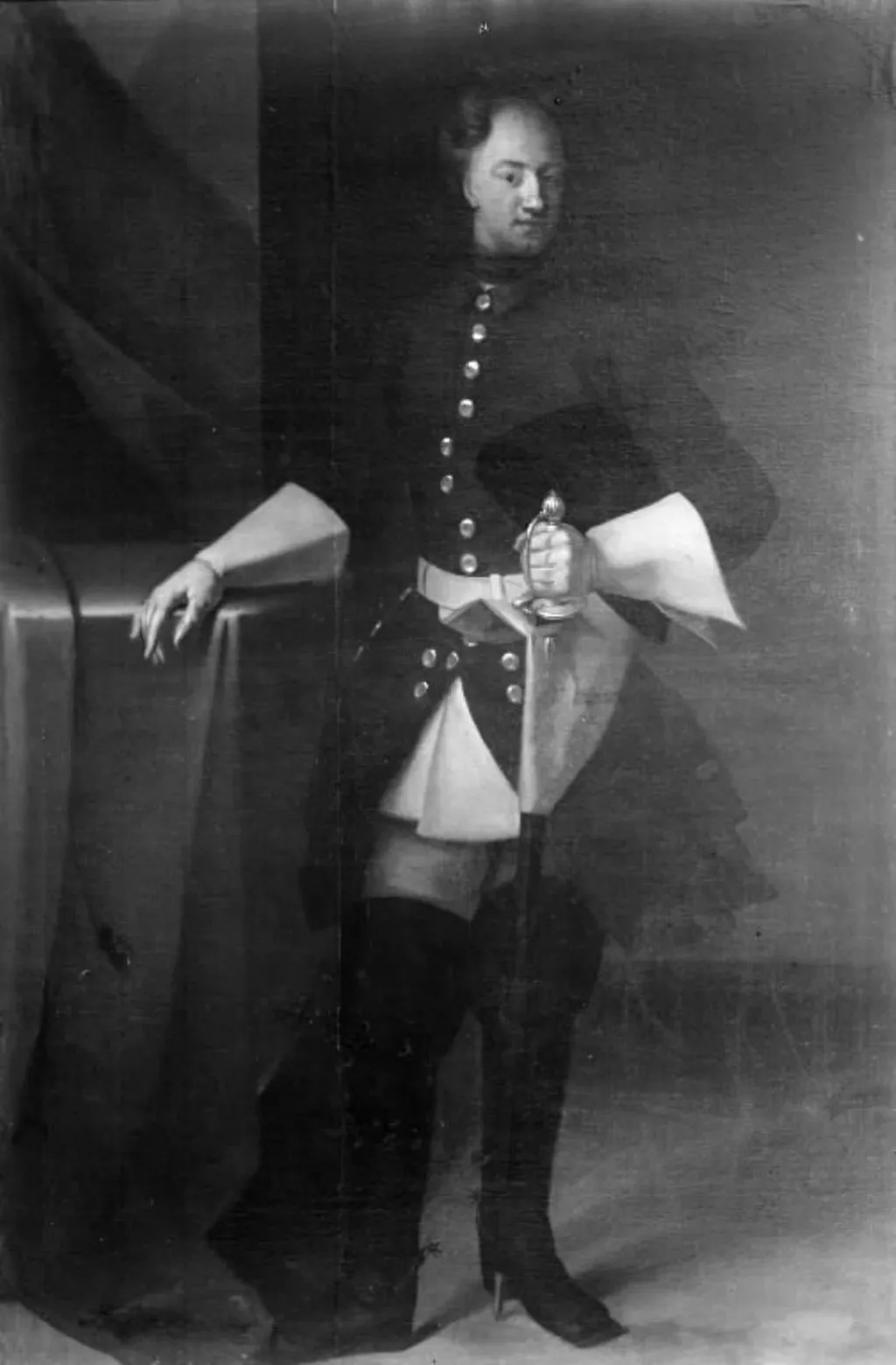
Portrait of Carl XII of Sweden is an unspecified painting by Unknown. It dates from 1750 and is held in the collection of the Statens Museum for Kunst. This portrait depicts Charles XII of Sweden, painted around 1750, likely long after his death in 1718.
About this work
Overview
This portrait depicts Charles XII of Sweden, painted around 1750, likely long after his death in 1718. It is part of the collection at the Museum of Ethnography. The composition centers on the monarch in full military attire, rendered with deliberate solemnity. The dark background and controlled lighting isolate the figure, emphasizing his presence without narrative distraction.
Subject & Meaning
The sword held at his side and the restrained gaze suggest composure under pressure, aligning with his historical reputation as a warrior-king.
Charles XII is portrayed not as a living ruler but as a remembered sovereign, his posture and attire evoking military authority. The sword held at his side and the restrained gaze suggest composure under pressure, aligning with his historical reputation as a warrior-king. The image functions as a symbolic representation rather than a personal likeness, reinforcing his legacy through formal iconography.
Technique & Style
The artist employs chiaroscuro to model the figure with strong contrasts between light and shadow, drawing attention to the texture of the uniform and the solidity of the form. The dark cloth draped over the table anchors the composition, while the white accents on the coat stand out sharply. Brushwork is precise but unadorned, favoring clarity over flourish, consistent with 18th-century portraiture conventions.
History & Provenance
Though painted circa 1750, the portrait was not created during Charles XII’s lifetime. It likely stems from a later effort to commemorate his reign, possibly commissioned for institutional or royal collections. Its current home in the Museum of Ethnography suggests it was acquired as part of a broader collection of historical figures, valued for its symbolic rather than biographical accuracy.
Context
In mid-18th-century Sweden, depictions of Charles XII were used to reinforce national identity following the decline of the Swedish Empire. This portrait reflects a trend of retrospective glorification, where military leaders were idealized through standardized imagery. The absence of regalia or heraldic elements indicates a focus on personal resolve rather than institutional power.
Legacy
The portrait contributes to the visual memory of Charles XII in Swedish cultural history. Its restrained aesthetic and formal composition distinguish it from more ornate royal portraits of the period, reflecting a shift toward sober, dignified representation. It remains a reference point in studies of how historical figures are visually reconstructed after their deaths.
Artist & collection

 Domestic Scene
 Giacomo and Cardinal Marco, investing Andrea, Abbot of San Zeno, with his Benefice
 The Nymph of Fontainebleau
 Portrait of a Woman
 Madonna and Child with Saints in the Enclosed Garden
 Venus and Minerva
 Family Group of Four on Sofa
 Wall painting from Room H of the Villa of P. Fannius Synistor at Boscoreale
 Portrait of King Ferdinand IV of the Two Sicilies
 Karl III., Herzog von Lothringen
 Franz II., Herzog von Lothringen
 Boy with a Lace Collar (dummy board)
 Erzherzog Wenzeslaus von Österreich (Kopie nach)
 Silhouette of Lieutenant Philip Kearney, Jr.
 Guy Little Theatrical Photograph
 Radu Fărcășanu
 Portrait of Prince Rupert
 Joseph Crying in his Chamber after Having Seen his Brother Benjamin Again