Artwork
Our Lady of the Seven Sorrows (left wing of diptych: Joris van de Velde, his wife Barbara Le Maire and their children with Saints George and Barbara)
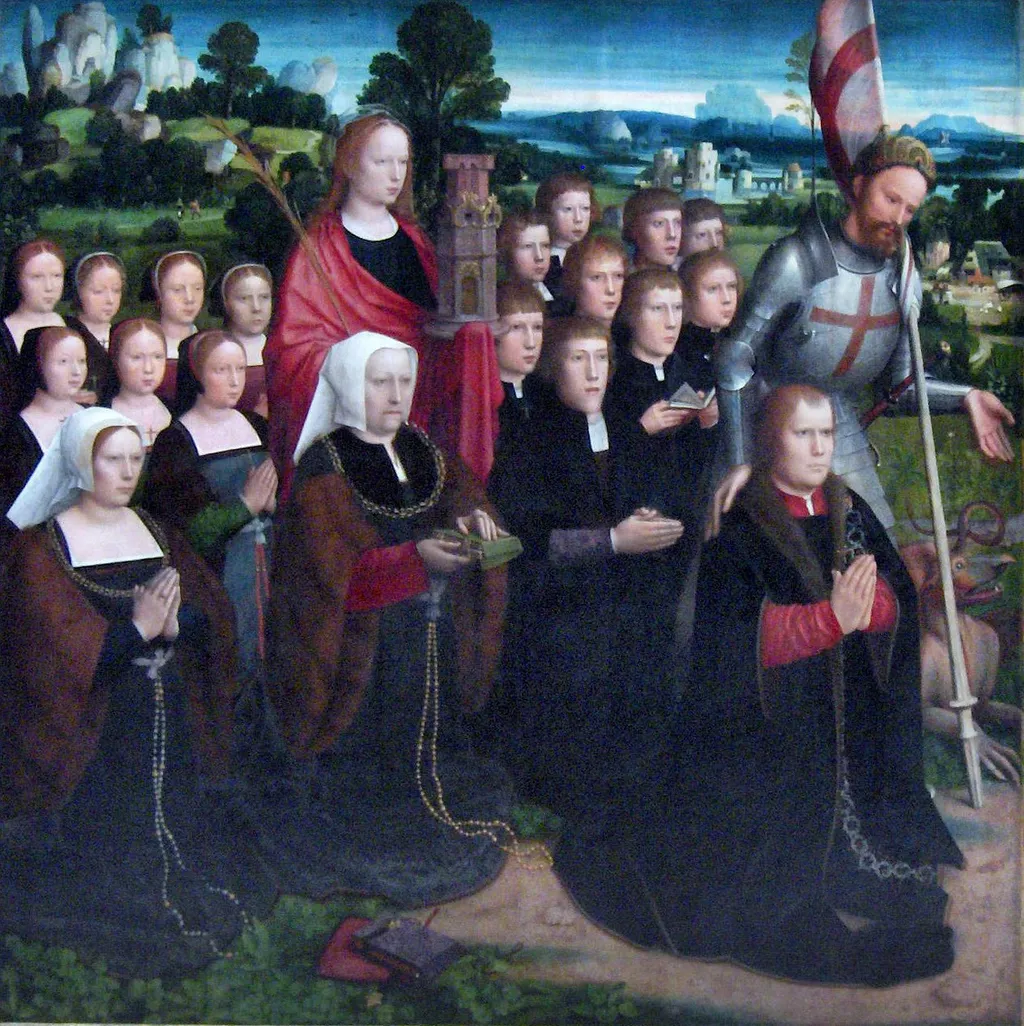
Our Lady of the Seven Sorrows (left wing of diptych: Joris van de Velde, his wife Barbara Le Maire and their children with Saints George and Barbara) is an oil painting by the Northern Renaissance artist Adriaen Isenbrandt. It dates from 1520 and is held in the collection of the Royal Museums of Fine Arts of Belgium. Created around 1520, this oil painting forms the left panel of a devotional diptych.
About this work
Overview
Created around 1520, this oil painting forms the left panel of a devotional diptych. It presents a small group gathered in an open, grassy landscape, anchored by a woman in a red dress who holds a modest wooden shrine. To her right stands a figure in armor bearing a flag, while several children and adults observe the scene against a backdrop of distant hills, a town, and a clear sky.
Subject & Meaning
The central female figure is identified as the donor, Joris van de Velde’s wife, Barbara Le Maire, portrayed with her family. Flanking them are Saints George and Barbara, invoked for protection and intercession. The composition underscores the family’s piety, linking their earthly lineage with the spiritual aid of the saints, a common motif in early sixteenth‑century devotional art.
Technique & Style
The figures are rendered with careful modeling and fine brushwork, while the landscape recedes through layered atmospheric perspective.
Executed in oil on panel, the work displays the meticulous detail and subdued palette characteristic of the Northern Renaissance. The figures are rendered with careful modeling and fine brushwork, while the landscape recedes through layered atmospheric perspective. The overall approach remains conservative, adhering to the established conventions of early Netherlandish religious painting while incorporating subtle Renaissance spatial cues.
History & Provenance
Attributed to Adriaen Isenbrandt, a Bruges‑based painter active during the shift from Early Netherlandish to Northern Renaissance styles, the panel has been part of the Royal Museums of Fine Arts of Belgium’s collection. Its provenance traces back to the original devotional diptych commissioned by the van de Velde family, though the companion right wing is presently unaccounted for.
Context
The painting reflects the early sixteenth‑century Flemish practice of integrating donor portraits within sacred narratives. By situating the van de Velde family alongside saints, the work serves both as a personal act of devotion and a visual assertion of social status. Its modest setting and restrained iconography align with contemporary religious sensibilities that favored intimate, contemplative representations over grandiose spectacle.
Artist & collection
Artist
Adriaen Isenbrandt or Adriaen Ysenbrandt (between 1480 and 1490 – July 1551) was a painter in Bruges, in the final years of Early Netherlandish painting, and the first of the Dutch and Flemish Renaissance painting of the Northern…

Museum
Royal Museums of Fine Arts of Belgium
Continue through works from the same source collection.
 Knights (after The Ghent Altarpiece)
 The Gift of Kalmthout
 Memorial Panel with Nine Female Portraits, inner right wing of an altarpiece
 Diptych of Munich
 Abner's Messenger before David (?); The Queen of Sheba Bringing Gifts to Solomon; (The Annunciation, on the reverse)
 Sermon of St. Ambrose Outside: Two standing holy bishops
 The Virgin and Child with St Anne, donors and Sts Francis and Lidwina
 Justice of Emperor Otto III: The Trial by Fire
 Virgin of the Councillors
 The Life and Miracles of Saint Godelieve