Artwork
Arabische ruiters in de woestijn
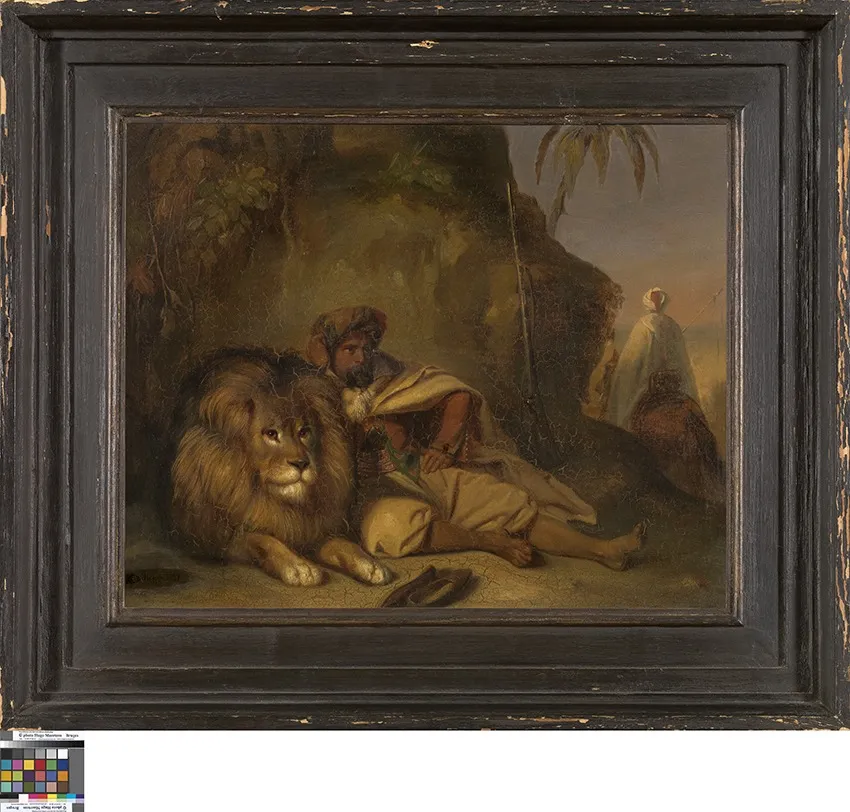
Arabische ruiters in de woestijn is an oil painting by the Impressionist artist Albert Dillens. It dates from 1895 and is held in the collection of the Groeningemuseum.
About this work
The man leaning on the lion wears a turban and a white robe, while the horseman is dressed in a white cloak.
This painting depicts a man reclining against a lion, with another man on horseback in the background. The man leaning on the lion wears a turban and a white robe, while the horseman is dressed in a white cloak. The scene is set against a backdrop of trees and a cloudy sky.
The painting features a mix of warm and cool tones, with the lion's fur rendered in shades of golden brown. The artist's use of chiaroscuro creates a sense of depth and volume in the scene.
The Groeningemuseum holds this artwork, offering a glimpse into the artistic style of the late 19th century. To explore more works from this period, consider visiting the Groeningemuseum.
Overview
Albert Dillens’ 1895 oil on canvas presents a desert tableau in which a reclining figure leans against a lion while a horseman rides in the distance. The central figure is wrapped in a white robe and turban, and the rider wears a flowing white cloak. A sparse landscape of trees under a clouded sky frames the scene, creating a quiet yet dramatic composition.
Subject & Meaning
The work juxtaposes human authority and animal power, with the seated man’s relaxed pose suggesting dominance over the lion, while the distant rider adds a narrative of travel or conflict. Elements such as the rifle held by the rider hint at a militaristic or exploratory context, inviting viewers to consider themes of conquest, exoticism, and the relationship between civilization and the wild.
Technique & Style
Dillens employs a balanced palette of warm golden browns for the lion’s fur and cooler blues in the sky, achieving depth through chiaroscuro that models forms and separates planes. The brushwork is smooth in the figures’ garments, contrasting with looser handling of foliage and clouds, reflecting late‑19th‑century academic painting infused with a subtle impressionistic touch.
History & Provenance
Created in 1895, the painting entered the collection of the Groeningemuseum in Bruges, where it remains on display. Its acquisition reflects the museum’s focus on Belgian art of the period, and the piece offers insight into Dillens’ oeuvre and the broader interest in Orientalist subjects among European artists of the era.
Context
During the late 1800s, European painters often turned to exotic themes, drawing on imagined Middle‑Eastern or North‑African settings. Dillens’ composition aligns with this Orientalist trend, employing familiar visual tropes—turbaned figures, desert fauna, and dramatic lighting—to evoke a romanticized view of distant lands for a Western audience.
Artist & collection