Artwork
Desiderius Erasmus of Rotterdam
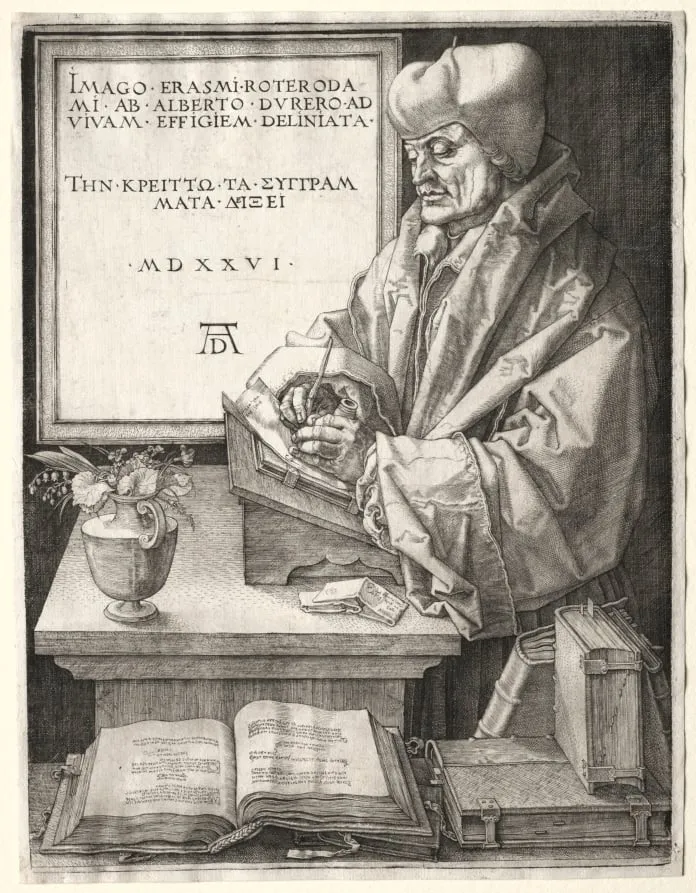
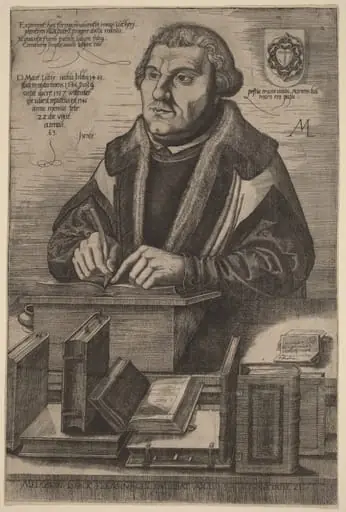
Desiderius Erasmus of Rotterdam is a print by the Renaissance artist Albrecht Dürer. It dates from 1526 and is held in the collection of the Cleveland Museum of Art.
About this work
He’s holding an open book and pointing at it with one hand, while his other hand rests on a small box.
This engraving shows a man in a dark robe and hat, leaning over a desk. He’s holding an open book and pointing at it with one hand, while his other hand rests on a small box. Behind him, a framed portrait hangs on the wall, and a vase with flowers sits on the desk. The scene looks like a quiet study, with papers and a few objects scattered around.
The text above the man’s head is in Latin and includes the year 1526. This suggests the image was made as a portrait of a well-known thinker.
Look up Renaissance to see how this style shaped art and ideas.
Overview
Created in 1526, this engraving by Albrecht Dürer portrays the Dutch scholar Desiderius Erasmus of Rotterdam. Dürer, a Nuremberg-born artist renowned for his graphic work, produced this piece during a period of intense intellectual exchange across Europe. The portrait captures Erasmus in a private study, emphasizing his identity as a thinker rather than a noble or religious figure. The work is part of the Cleveland Museum of Art’s collection and reflects Dürer’s mastery of fine line and detail in printmaking.
Subject & Meaning
Erasmus, a central voice of Northern humanism, is depicted engaged with a book, his finger resting on the page as if pausing to reflect. The open volume, the scattered papers, and the modest desk suggest a life devoted to study and writing. The framed image behind him and the vase of flowers imply quiet dignity and intellectual cultivation. The Latin inscription confirms the date and identifies the sitter, reinforcing the portrait’s purpose: to honor a scholar whose ideas shaped religious and educational discourse.
Technique & Style
Dürer employed fine, controlled lines typical of his engraving technique, using cross-hatching to model form and texture. The dark robe, the texture of the book’s pages, and the grain of the wooden desk are rendered with precision. The composition is tightly framed, focusing attention on Erasmus’s hands and face. The background is minimally detailed, avoiding distraction and reinforcing the intimacy of the moment. The work exemplifies Dürer’s ability to convey character through subtle tonal variation and meticulous draftsmanship.
History & Provenance
The engraving was made during Dürer’s visit to the Low Countries, where he met Erasmus and other humanist figures. It was likely produced as a gift or for dissemination among scholars, reflecting the growing market for portraits of intellectuals. The print circulated widely, contributing to Erasmus’s public image. It entered the Cleveland Museum of Art’s collection in the 20th century, where it remains a key example of Renaissance print culture and the intersection of art and ideas.
Context
In the early 16th century, printmaking enabled the rapid spread of humanist thought. Erasmus’s writings, critical of Church corruption and advocating classical learning, found audiences through books and images like this one. Dürer’s portrait aligns with a broader trend: depicting thinkers not as clergy or rulers, but as individuals immersed in study. This shift mirrored changing views of knowledge, authority, and the role of the individual in society during the Northern Renaissance.
Legacy
This engraving helped define the visual identity of the intellectual in early modern Europe. It influenced later portraits of scholars, emphasizing quiet concentration over ceremonial grandeur. Dürer’s ability to merge technical precision with psychological depth set a standard for print portraiture. The work endures as a testament to the alliance between visual art and textual culture, illustrating how images could sustain and transmit ideas beyond the written word.
Artist & collection
Artist
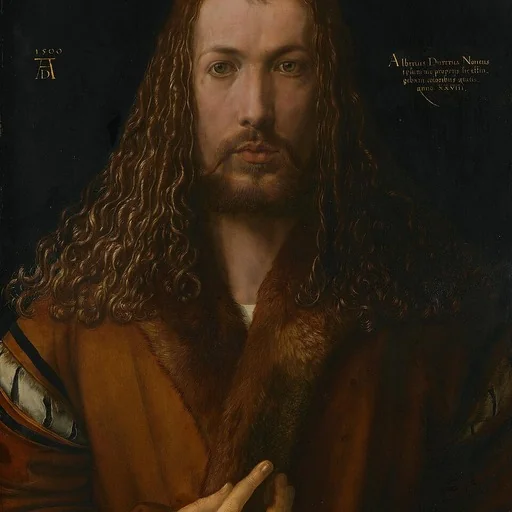
Albrecht Dürer spent his life in Nuremberg, a busy German city where artists traded prints like currency.

![Madonna and Child [obverse], by Albrecht Dürer](https://artifactworldgallery.com/img/albrecht-durer--madonna-and-child-obverse--d7b8ebf05d22ebe5-w320.webp)
![Lot and His Daughters [reverse], by Albrecht Dürer](https://artifactworldgallery.com/img/albrecht-durer--lot-and-his-daughters-reverse--b4ebf9b282faa17a-w320.webp)