Artwork
The Two Elders Convicted by the Testimony of Daniel
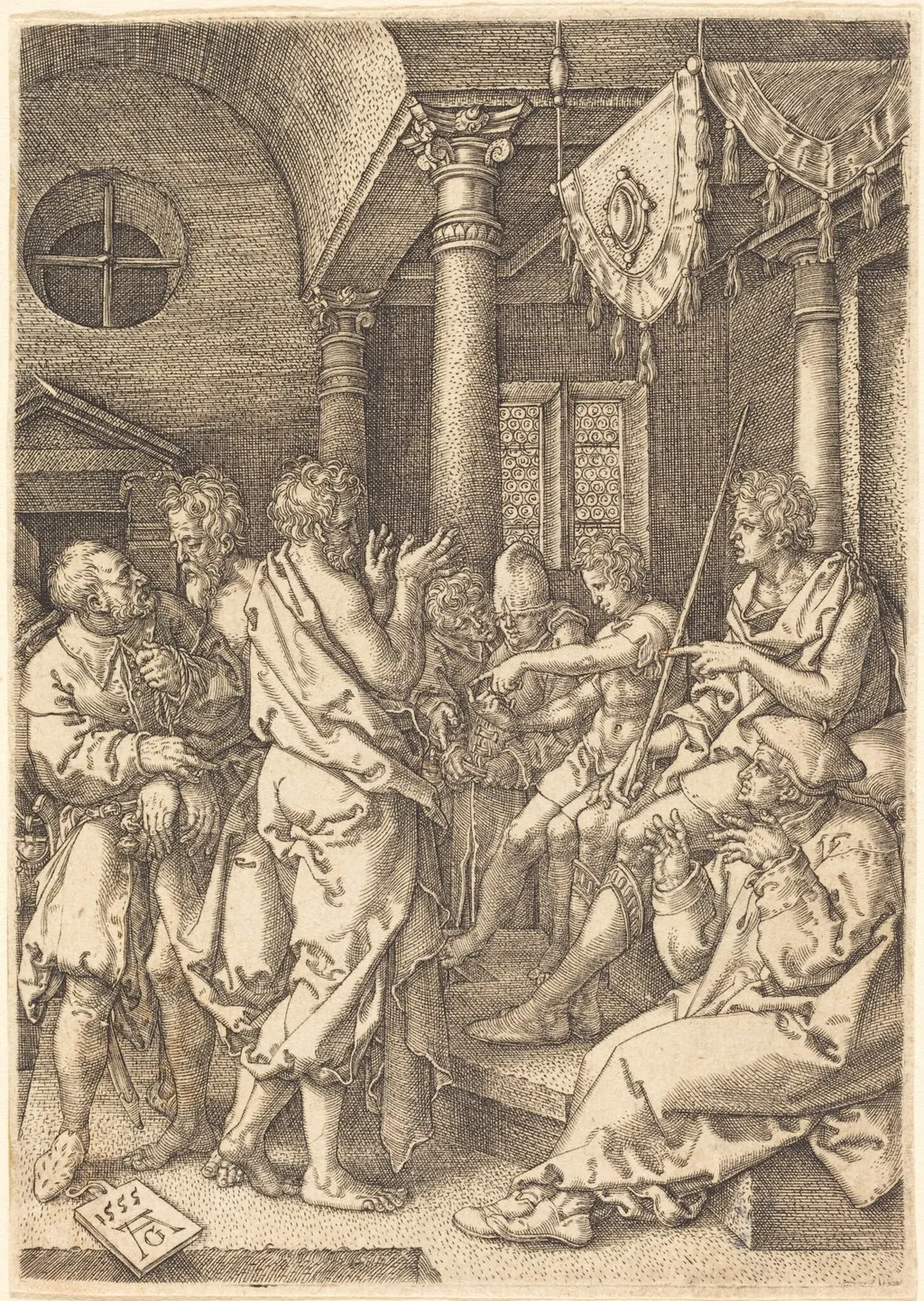
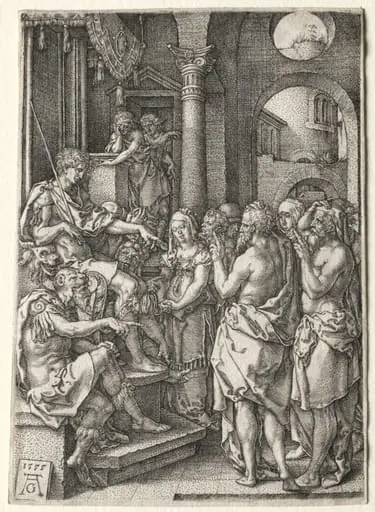
The Two Elders Convicted by the Testimony of Daniel is an ink print by the Northern Renaissance artist Heinrich Aldegrever. It dates from 1555 and is held in the collection of the National Gallery of Art.
About this work
Overview
A German artist associated with the 'Little Masters,' he specialized in intricate prints that demanded close viewing.
Heinrich Aldegrever produced this etching in 1555 as part of a series of small-scale biblical scenes. A German artist associated with the 'Little Masters,' he specialized in intricate prints that demanded close viewing. The work illustrates a moment from the Book of Daniel, where false accusers are unmasked. Aldegrever’s precision and control over the etching needle allowed him to render complex narratives in miniature, aligning with the Northern Renaissance tradition of detailed graphic art.
Subject & Meaning
The scene captures Daniel confronting two elderly men accused of falsely testifying against Susanna. One elder clutches a book, perhaps symbolizing his claim to authority, while the other gestures in futile defense. Daniel, younger and assertive, points accusingly, embodying divine justice. The crumbling architecture and shield bearing a cross in the background suggest moral decay and the presence of divine judgment, reinforcing the narrative’s theme of truth prevailing over deceit.
Technique & Style
Aldegrever employed fine, controlled etching lines to build texture and motion. The folds of fabric, the roughness of stone, and the tension in gestures are rendered with meticulous hatching and cross-contouring. The absence of color heightens the drama through contrast and line alone. His technique reflects mastery of the etching process, using acid to bite precise grooves into a metal plate, enabling intricate detail uncommon in larger-scale prints of the period.
History & Provenance
Created in 1555, the print emerged during Aldegrever’s most active period as a printmaker in Westphalia. It was likely produced for a devotional or educational audience, circulating among collectors and clergy familiar with biblical stories. Though no specific early ownership is documented, its survival in multiple museum collections suggests it was widely reproduced and valued for its narrative clarity and technical refinement.
Context
Aldegrever worked in the decades after Albrecht Dürer, when demand for small, portable religious prints was high among Protestant audiences. His work responded to the Reformation’s emphasis on personal scripture and moral instruction. The choice of Daniel’s intervention reflects a broader cultural interest in justice and truth, themes resonant in post-Reformation Germany where religious authority was being reexamined.
Legacy
Aldegrever’s etchings, including this one, influenced later Northern printmakers through their compact storytelling and technical discipline. Though less celebrated than Dürer, his ability to convey psychological depth in miniature helped sustain the tradition of narrative engraving. The print remains a key example of how religious subjects were visually adapted for intimate, reflective viewing in 16th-century Europe.
Artist & collection

Artist
Heinrich Aldegrever or Aldegraf was a German painter and engraver. He was one of the "Little Masters", the group of German artists making small old master prints in the generation after Albrecht Dürer.