Artwork
Untitled
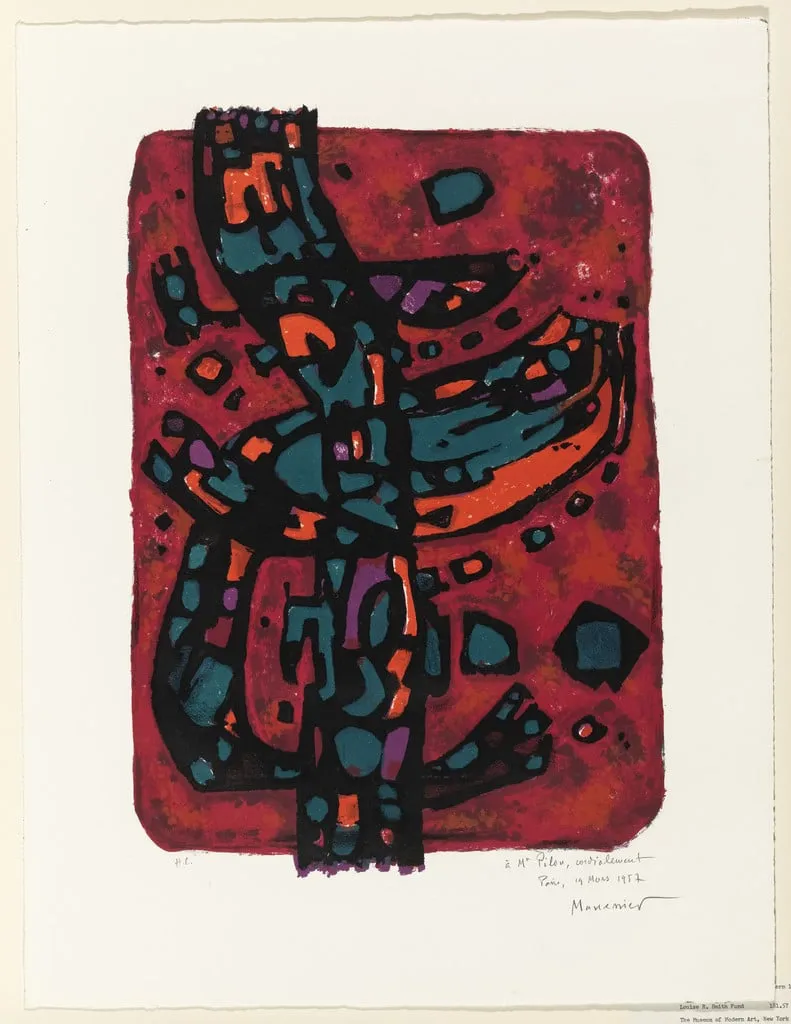
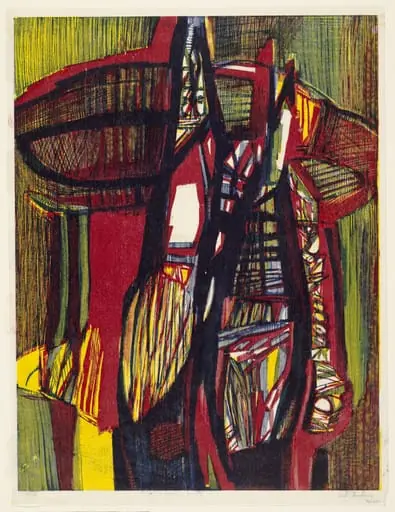
Untitled is an ink print by Alfred Manessier. It dates from 1954 and is held in the collection of the Museum of Modern Art.
About this work
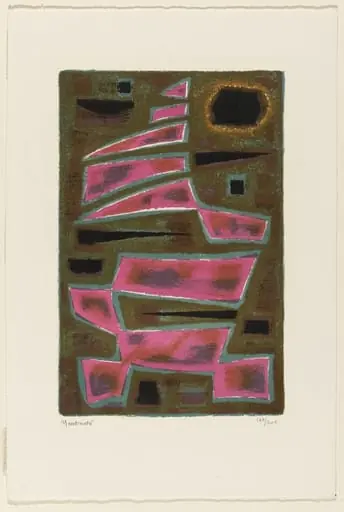
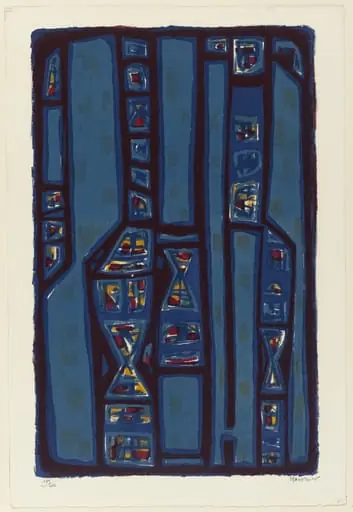
Deep reds, teal blues, and black shapes fill the space, overlapping in a way that feels both messy and controlled.
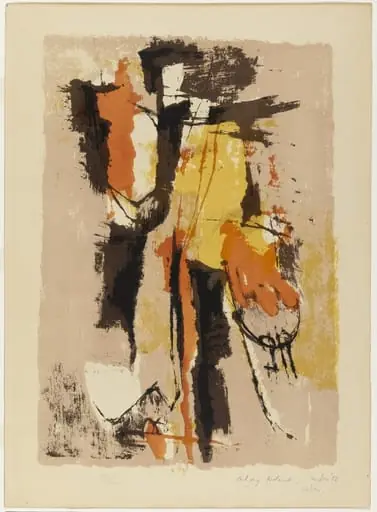
This painting is a wild mix of bold colors and sharp lines. Deep reds, teal blues, and black shapes fill the space, overlapping in a way that feels both messy and controlled. There’s no clear subject—just jagged forms and splotches that don’t quite match anything in the real world.
The artist signed it in the corner with the date "14 Mars 1954," which means this was made in March 1954. The brushstrokes (or print strokes) look rough, like the ink was applied thickly in some spots.
If you like this kind of abstract work, look up lithography to see how it’s made.
Overview
Created in March 1954, this lithograph by Alfred Manessier is part of The Museum of Modern Art’s collection. It belongs to a series of abstract works produced during a period when the artist moved away from figurative representation. The print bears his signature and the date '14 Mars 1954,' confirming its origin. Its non-representational composition reflects Manessier’s interest in emotional expression through form and color rather than narrative.
Subject & Meaning
The work avoids recognizable imagery, instead presenting a dynamic arrangement of irregular shapes and gestural marks. Deep reds, teal blues, and black forms intersect without clear hierarchy or spatial logic. These elements suggest inner states or spiritual resonances rather than external reality. The absence of a central subject invites viewers to engage with the piece as an emotional field, consistent with Manessier’s post-war artistic philosophy.
Technique & Style
Executed in lithography, the print captures the spontaneity of hand-drawn marks transferred onto stone. Ink is applied unevenly, creating areas of dense pigment and translucent washes. The rough, textured strokes convey urgency and physicality, while the layered shapes maintain a sense of compositional balance. Manessier exploited the medium’s capacity for both precision and fluidity, blending control with expressive chaos.
History & Provenance
The lithograph was produced in 1954 during Manessier’s active engagement with the abstract movement in post-war France. It entered The Museum of Modern Art’s collection through established acquisition channels, likely as part of broader efforts to document European abstraction. Its preservation in a major institution reflects its significance within the artist’s oeuvre and the period’s printmaking practices.
Context
Manessier’s work from this period emerged alongside other European artists seeking new visual languages after the trauma of war. Influenced by religious symbolism and natural rhythms, he rejected traditional representation in favor of emotive abstraction. This print aligns with contemporaneous efforts in France to redefine art through non-objective forms, paralleling developments in Tachisme and Art Informel.
Legacy
This lithograph contributes to the recognition of printmaking as a legitimate medium for abstract expression in mid-20th-century Europe. Manessier’s integration of spiritual themes with gestural abstraction influenced later generations of printmakers. Its presence in MoMA’s collection ensures continued scholarly attention, anchoring it within the broader narrative of post-war modernism.
Artist & collection

Artist
Alfred Manessier was a non-figurative French painter, stained glass artist, and tapestry designer, part of the new School of Paris and the Salon de Mai.