Artwork
Untitled
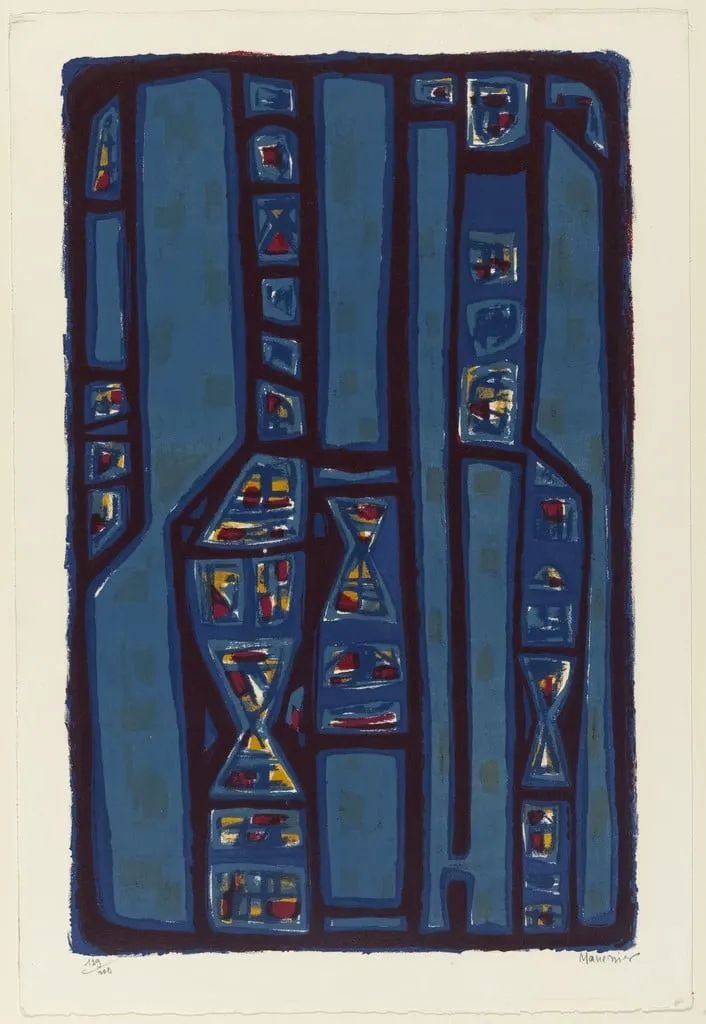
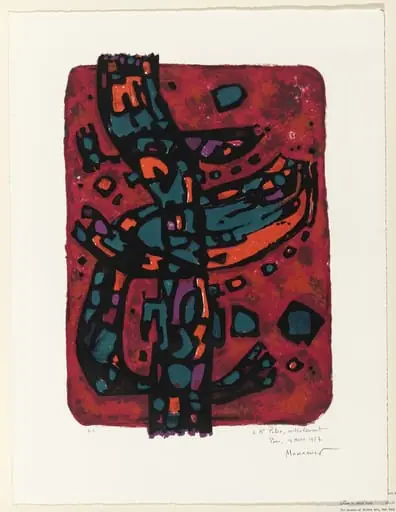
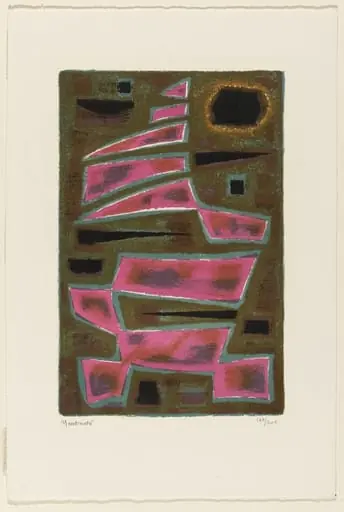
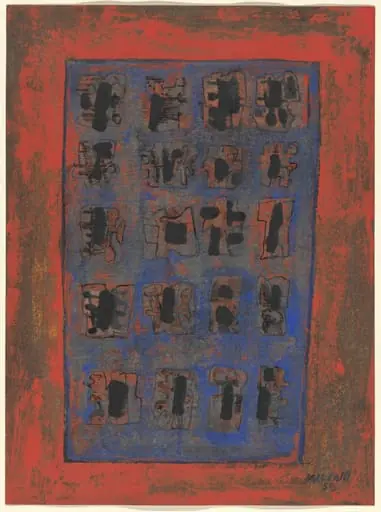
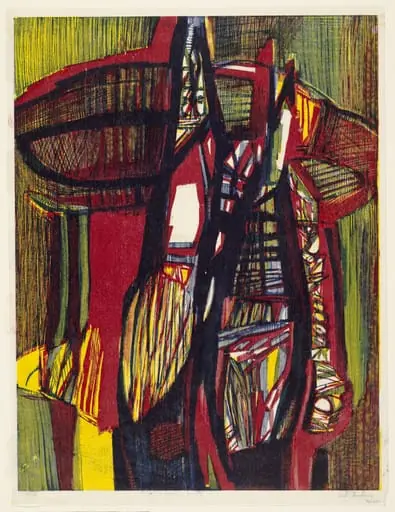
Untitled is an ink print by Alfred Manessier. It dates from 1952 and is held in the collection of the Museum of Modern Art.
About this work
Overview
It belongs to a series of abstract prints made during a period when the artist was exploring non-representational forms.
Created in 1952, this lithograph by Alfred Manessier is part of The Museum of Modern Art’s collection. It belongs to a series of abstract prints made during a period when the artist was exploring non-representational forms. The work is defined by its stark, vertical compositions and vivid color accents, achieved through the lithographic process, which allowed for precise ink transfer and bold tonal contrasts.
Subject & Meaning
The composition suggests an abstracted urban landscape, with tall, stacked forms resembling simplified architecture. These vertical elements are pierced by small, brightly colored rectangles—red, yellow, and white—that evoke windows or light sources. The image does not depict a specific place but rather conveys a sense of structure and luminosity, reflecting Manessier’s interest in spiritual and architectural harmony.
Technique & Style
Manessier employed lithography, a printmaking method using a greasy medium on stone to transfer ink. This technique enabled sharp, clean lines and intense color saturation. The forms are reduced to essential shapes, with minimal detail, emphasizing rhythm and contrast over realism. The flat planes and deliberate color placement reflect a move toward abstraction rooted in emotional resonance rather than literal representation.
History & Provenance
The work was produced in 1952 during Manessier’s active engagement with postwar European abstraction. It entered The Museum of Modern Art’s collection shortly after its creation, reflecting the institution’s early interest in European printmakers. Its acquisition aligned with broader efforts to document the evolution of abstract expression in mid-century art beyond American circles.
Context
In the early 1950s, Manessier was influenced by religious architecture and the stained-glass windows of medieval cathedrals, which informed his use of light and color. His work during this period moved away from figurative subjects toward symbolic forms. This lithograph shares affinities with contemporaneous European abstract movements, particularly those emphasizing spiritual abstraction and material simplicity.
Legacy
This print exemplifies Manessier’s contribution to postwar printmaking, demonstrating how traditional techniques could be adapted to abstract expression. It remains a key example of how European artists reimagined form and light without recourse to figuration. The work continues to be studied for its balance between structural rigor and emotional tone within the broader context of mid-century abstraction.
Artist & collection

Artist
Alfred Manessier was a non-figurative French painter, stained glass artist, and tapestry designer, part of the new School of Paris and the Salon de Mai.