Artwork
A Valley in Burgundy (Une Vallée en Bourgogne)
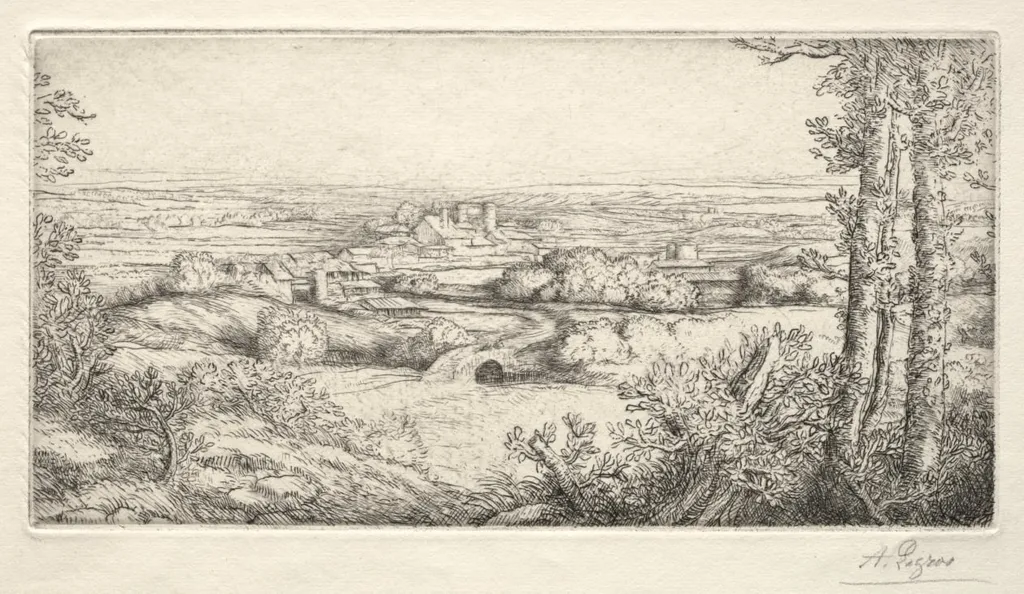
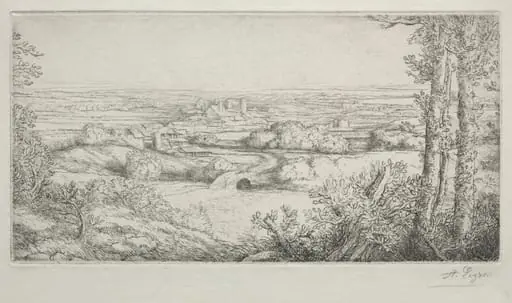
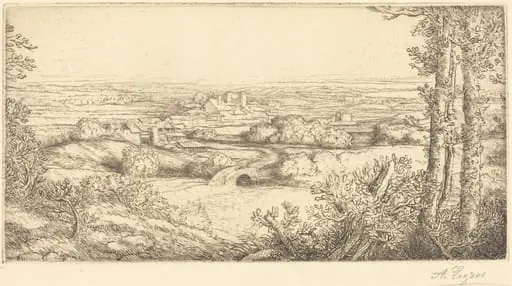
A Valley in Burgundy (Une Vallée en Bourgogne) is a print by the Impressionist artist Alphonse Legros. It dates from 1884 and is held in the collection of the Cleveland Museum of Art.
About this work
Overview
A Valley in Burgundy, created in 1884 by Alphonse Legros, is a drypoint print depicting a tranquil rural landscape in eastern France. The work is part of the collection at The Cleveland Museum of Art. Unlike grand historical or mythological subjects common in earlier art, this piece captures an unadorned stretch of countryside, emphasizing quiet observation over dramatic effect.
Subject & Meaning
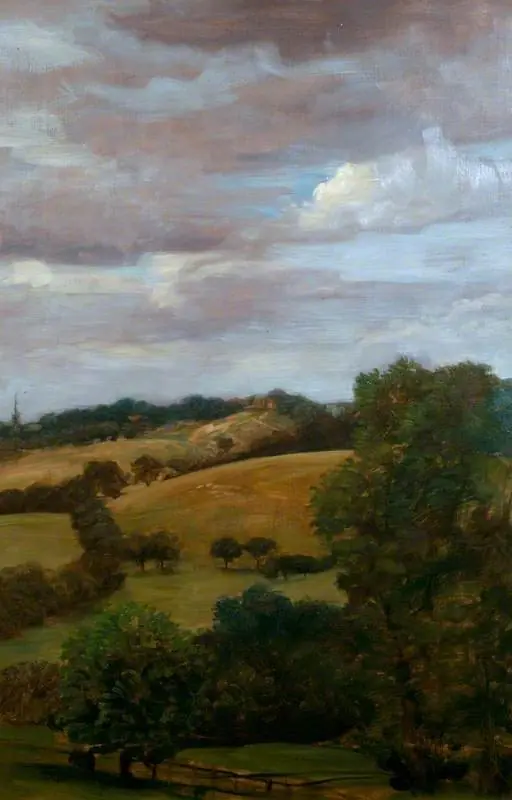
The scene portrays a gentle valley with a meandering river, low hills, scattered trees, and distant farm buildings connected by a bridge. There are no human figures, and the absence of activity enhances the sense of stillness. The composition reflects a quiet reverence for ordinary rural life, aligning with Realist principles that valued authenticity over romanticized landscapes.
Technique & Style
Legros employed drypoint, a printmaking method that produces soft, velvety lines by scratching directly into a metal plate. The delicate, uneven strokes create subtle tonal gradations, suggesting atmosphere and depth without sharp definition. This technique mirrors the hazy, contemplative mood of the scene, reinforcing its intimate, sketch-like quality and rejecting polished finish.
History & Provenance
The print was made during Legros’s time in England, where he taught at the Slade School of Art, though the subject remains rooted in his native Burgundy. It entered the Cleveland Museum of Art’s collection in the 20th century, likely through acquisitions focused on European graphic art. Its provenance reflects growing interest in 19th-century printmaking as a serious artistic medium.
Context
His prints, like this one, contributed to a broader revival of printmaking as a vehicle for personal expression rather than mere reproduction.
In the 1880s, European artists increasingly turned to everyday landscapes as subjects, moving away from academic traditions. Legros, influenced by French Realism and the Barbizon painters, sought to convey the dignity of rural life through direct observation. His prints, like this one, contributed to a broader revival of printmaking as a vehicle for personal expression rather than mere reproduction.
Legacy
Legros’s work in printmaking helped elevate the status of etching and drypoint in Britain and France. A Valley in Burgundy exemplifies his quiet, methodical approach, influencing later generations of printmakers who valued subtlety over spectacle. Though not widely known today, his contributions remain significant in the history of modern graphic art.
Artist & collection

Artist
Alphonse Legros (French pronunciation: ; 8 May 1837 – 8 December 1911) was a French, later British, painter, etcher, sculptor, and medallist.