Artwork
Les Ramasseurs des Champignons
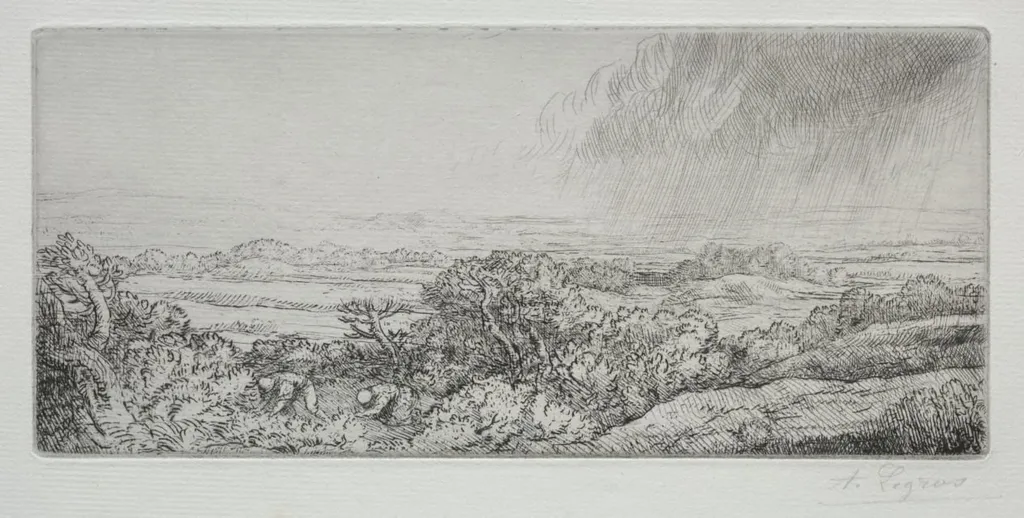
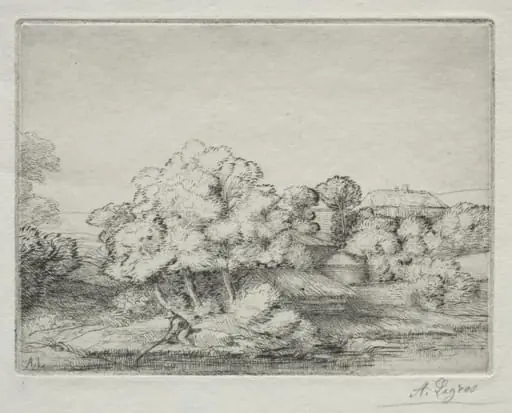
Les Ramasseurs des Champignons is a print by the Impressionist artist Alphonse Legros. It dates from 1884 and is held in the collection of the Cleveland Museum of Art.
About this work
Overview
Created in 1884 by Alphonse Legros, this print captures a rural scene during inclement weather. Executed in a drypoint technique, it belongs to the collection of The Cleveland Museum of Art. The composition conveys a moment of quiet labor amid nature’s turbulence, rendered with minimal detail and a focus on atmospheric effect rather than polished finish.
Subject & Meaning
The scene depicts figures gathering mushrooms in a hilly countryside, their forms subtly integrated into the landscape. The emphasis is not on individual identity but on the quiet persistence of rural labor under adverse conditions. The stormy sky and driving rain suggest hardship, yet the figures move with unremarkable routine, reflecting a sober view of peasant life.
Technique & Style
Legros employed drypoint to create dense, textured surfaces using rough, overlapping lines that mimic the look of rapid sketching. The storm is rendered in vertical strokes of rain, while foliage and terrain are built from agitated, irregular marks. This method rejects smooth finishes, favoring a tactile immediacy that evokes the physicality of the environment and the artist’s direct hand.
History & Provenance
The print was made during Legros’s time in England, where he taught at Slade School and engaged with British printmaking circles. It entered The Cleveland Museum of Art’s collection in the 20th century, likely through acquisitions focused on 19th-century European graphic works. Its preservation reflects growing institutional interest in lesser-known realist prints of the period.
Context
This work aligns with the Realist movement’s interest in everyday rural life, avoiding idealization in favor of observed truth.
This work aligns with the Realist movement’s interest in everyday rural life, avoiding idealization in favor of observed truth. Legros’s approach echoes the tonal experiments of Daumier and the atmospheric concerns of French landscape printmakers. Unlike academic traditions, his technique prioritizes emotional resonance over finish, reflecting broader shifts in artistic values during the late 19th century.
Legacy
Legros’s drypoint prints, including this one, influenced later generations of printmakers who valued expressive mark-making over technical polish. While not widely exhibited today, the work remains a quiet example of how 19th-century artists used print media to explore mood, labor, and nature with restraint and sincerity.
Artist & collection

Artist
Alphonse Legros (French pronunciation: ; 8 May 1837 – 8 December 1911) was a French, later British, painter, etcher, sculptor, and medallist.

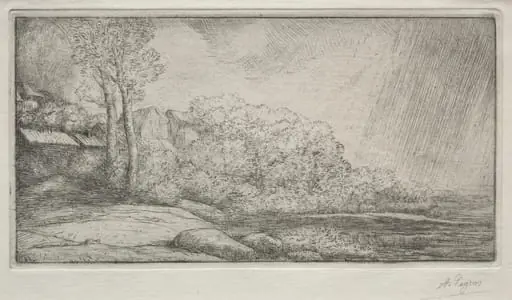 Landscape with Two Trees (Paysage aux deux Arbres)
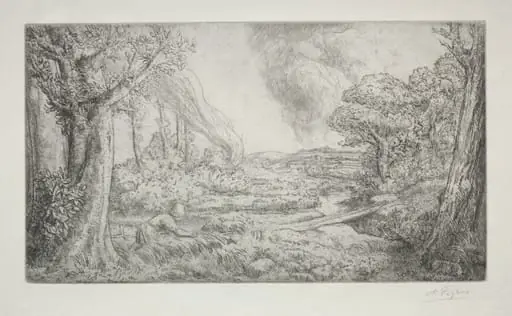 Landscape (Paysage)
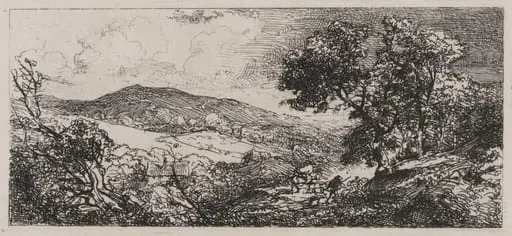 Valley View, Man with a Donkey and a Dog
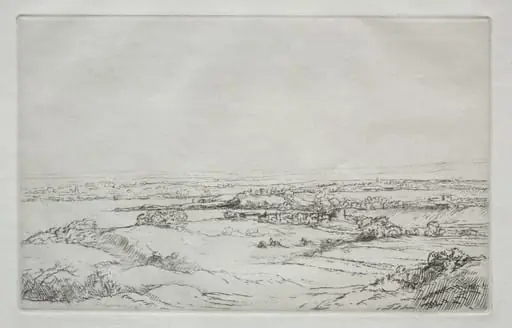 The Meadow near the Lake (La Plaine Près Du Lac)
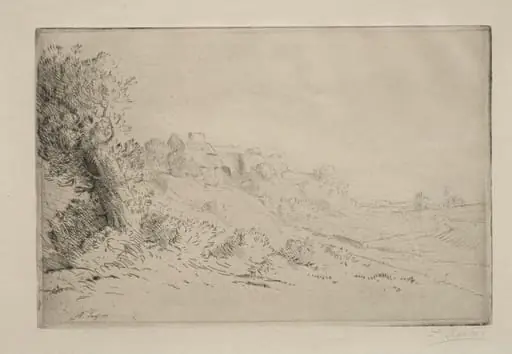 My Farm
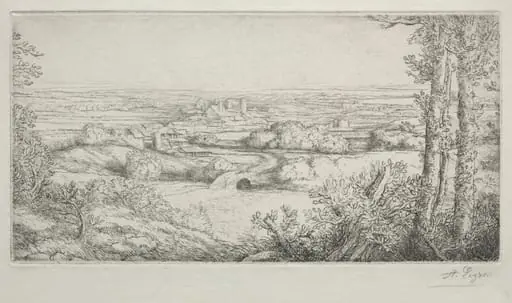 A Valley in Burgundy
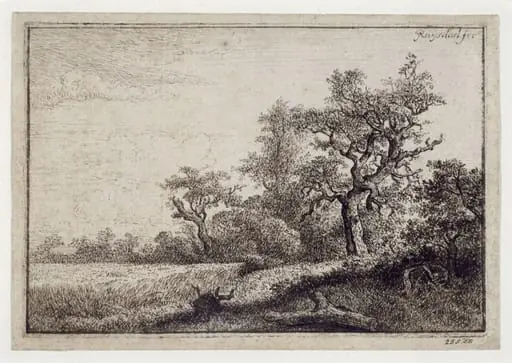 The Wheatfield. After Jacob Ruysdael
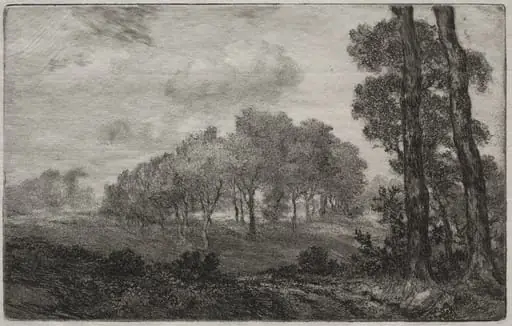 Landscape, after Français
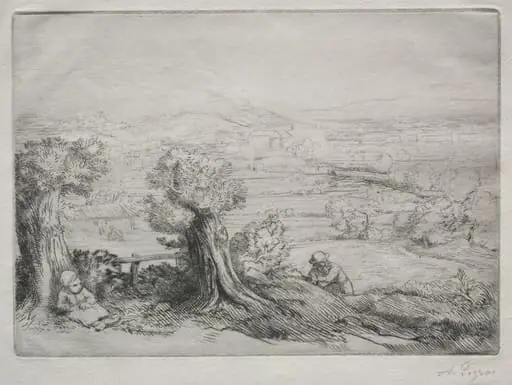 Souvenir d'un Vallée en Bourgogne
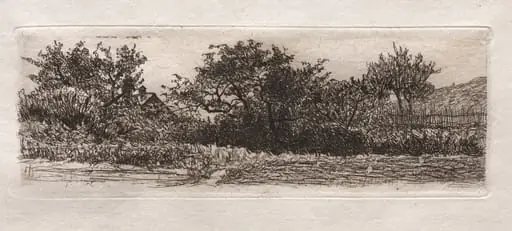 Roofs and Trees
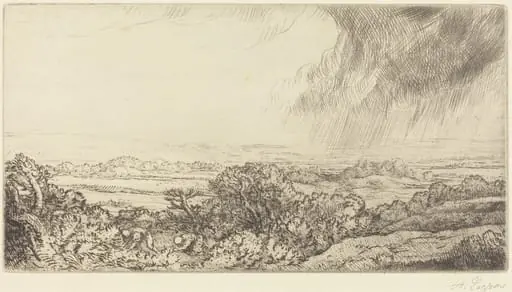 Mushroom Gatherers (Les ramasseurs de champignons)
 Hamlet near the Lake (Hameau près du Lac)