Artwork
The Egg Merchants (1st Plate)
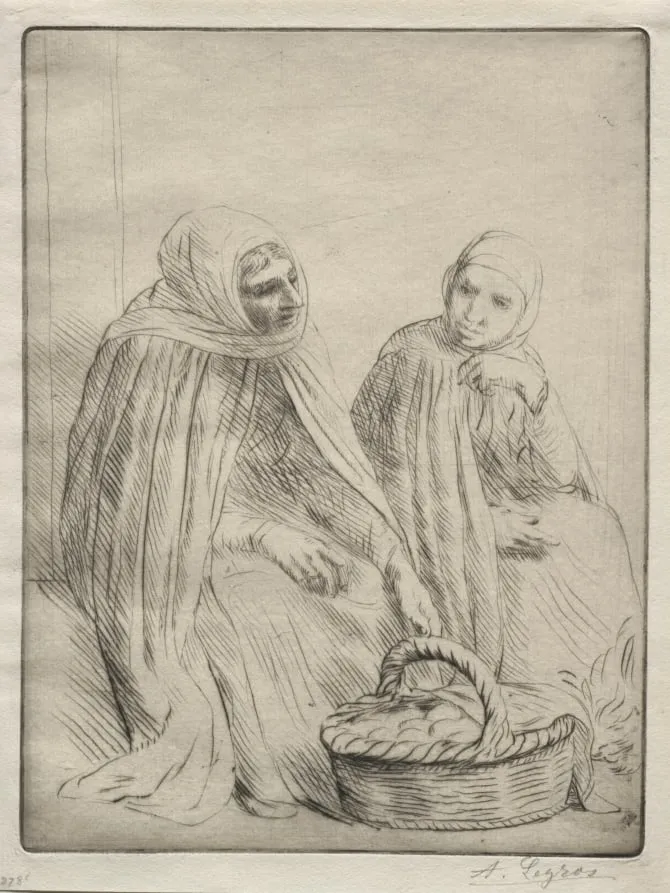
The Egg Merchants (1st Plate) is a print by the Impressionist artist Alphonse Legros. It dates from 1884 and is held in the collection of the Cleveland Museum of Art.
About this work
Overview
Created in 1884 by Alphonse Legros, this print is the first of a series depicting egg vendors. Executed in a drypoint technique, it captures a moment of quiet stillness between two women. The work is part of the collection at The Cleveland Museum of Art, where it is valued for its intimate portrayal of labor and its restrained aesthetic.
Subject & Meaning
Two women, one elderly and one younger, sit together in a modest setting, their focus centered on a basket of eggs. Their headscarves and draped garments suggest rural or working-class life. The gravity in their expressions and the deliberate positioning of hands imply a shared, unspoken understanding—perhaps of routine, endurance, or quiet dignity in daily toil.
Technique & Style
Legros employed drypoint to create a textured, linear surface with soft, dark tones. The sketchy, deliberate strokes define form through shadow rather than outline, emphasizing volume through chiaroscuro. The background remains minimal and unadorned, directing attention to the figures and their interaction, while the roughness of the lines enhances the sense of realism and immediacy.
History & Provenance
The print was produced during Legros’s time in England, where he taught at Slade School and engaged with British printmaking circles.
The print was produced during Legros’s time in England, where he taught at Slade School and engaged with British printmaking circles. It entered The Cleveland Museum of Art’s collection in the 20th century, likely through a donation or acquisition focused on 19th-century European graphic works. Its provenance reflects Legros’s influence beyond France and his role in transnational artistic exchange.
Context
In the late 19th century, Legros was part of a movement that elevated everyday labor as worthy artistic subject matter. This print aligns with broader European trends favoring realism over idealism, particularly in print media. Unlike grand historical scenes, it finds significance in the quiet dignity of ordinary women, reflecting social observation over narrative drama.
Legacy
Though not widely exhibited, The Egg Merchants exemplifies Legros’s commitment to quiet, unembellished observation. His drypoint technique influenced a generation of British printmakers, and this work remains a subtle example of how modest subjects could convey emotional depth through disciplined draftsmanship and tonal control.
Artist & collection

Artist
Alphonse Legros (French pronunciation: ; 8 May 1837 – 8 December 1911) was a French, later British, painter, etcher, sculptor, and medallist.


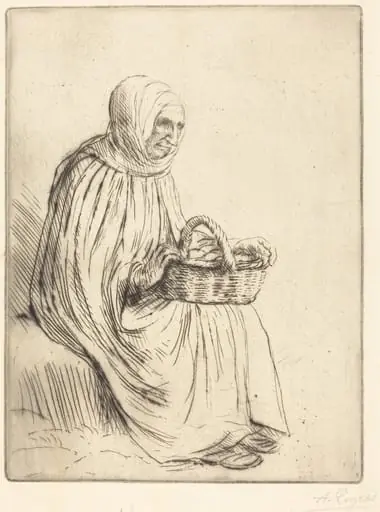 Woman of the Marketplace (Femme du marche)
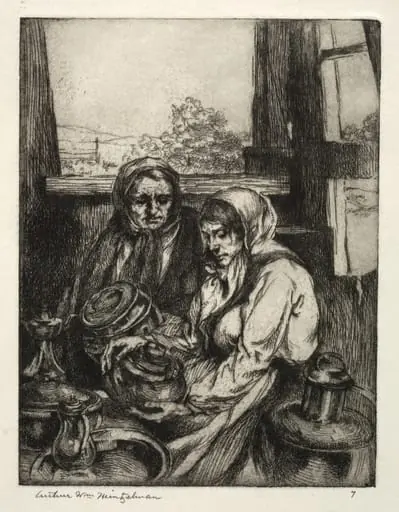 Old Brass
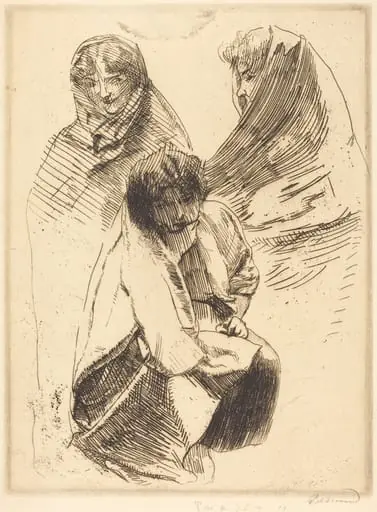 Three Veiled Women (Trois femmes voilées)
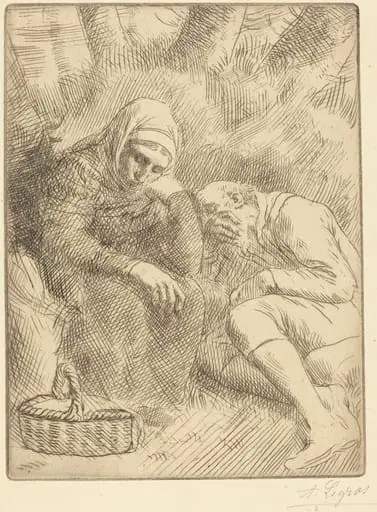 Man and Wife Seated by the Road with a Basket(Homme et femme assis au bord de la rou te aven un panier)
![Oui, madame Chaboulard... vingt-quatre épiciers... [recto], by Honoré Daumier](https://artifactworldgallery.com/img/honore-daumier--oui-madame-chaboulard-vingt-quatre-epiciers-recto--e54ef32ef25a1625-w320.webp) Oui, madame Chaboulard... vingt-quatre épiciers... [recto]
Oui, madame Chaboulard... vingt-quatre épiciers... [recto]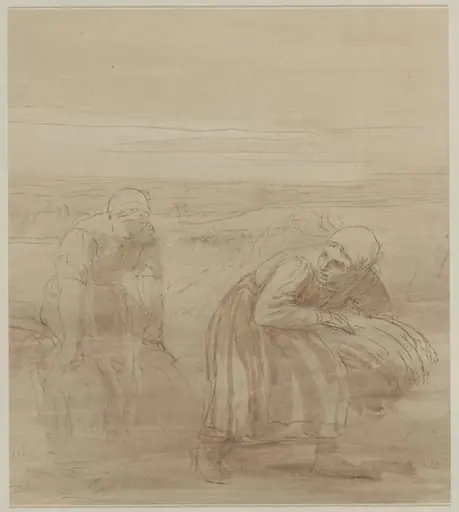 Les Glaneuses
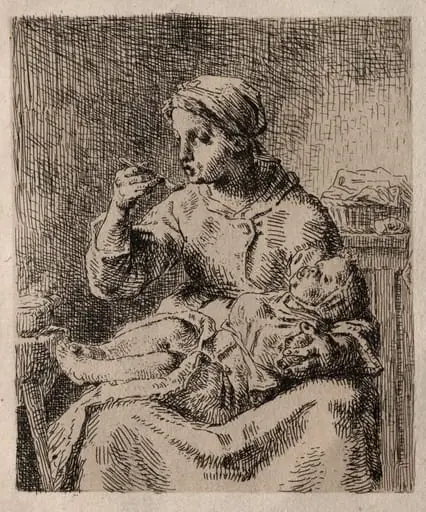 La Bouillée
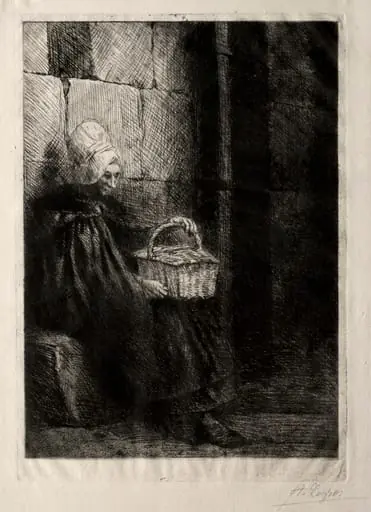 Landscape in the Vicinity of Boulogne, called Woman with a Basket
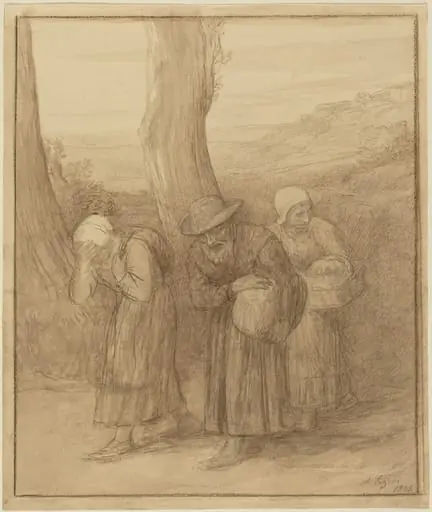 The Departure