Artwork
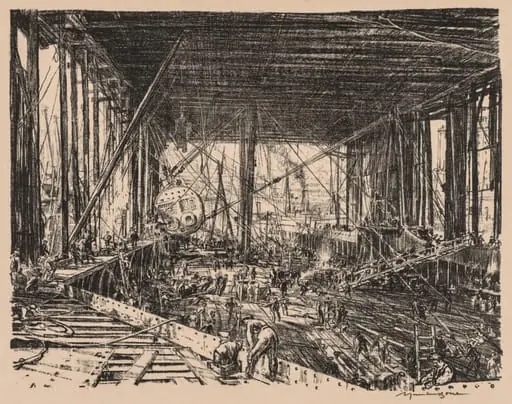
Ship-Building, Gloucester Harbor
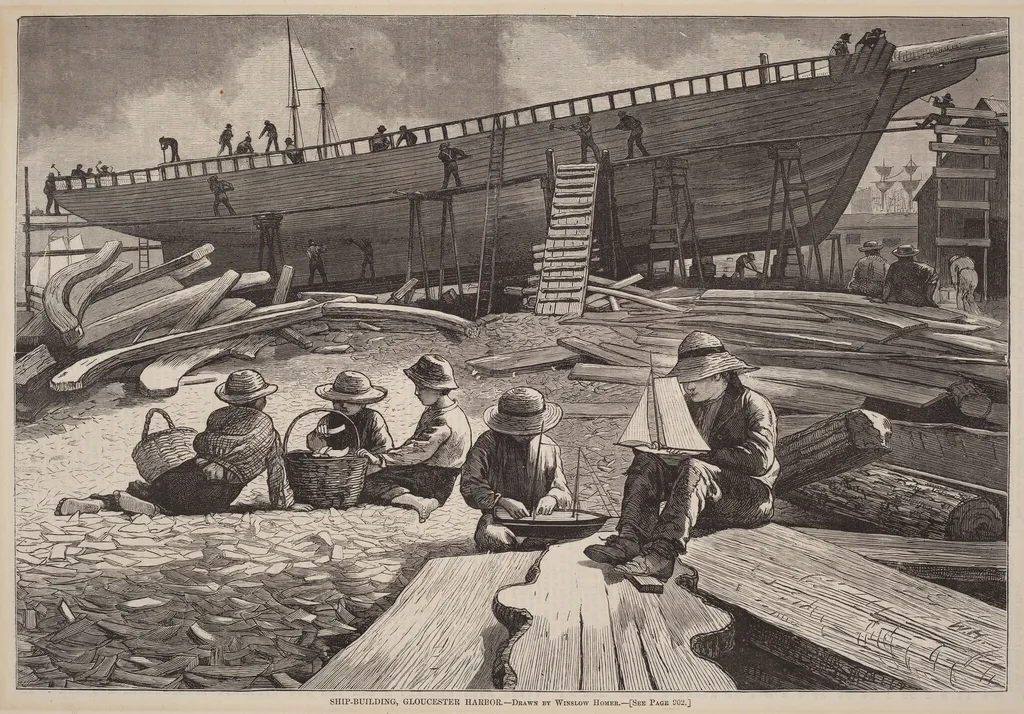
Ship-Building, Gloucester Harbor is an ink print by the Impressionist artist American 19th Century. It dates from 1873 and is held in the collection of the National Gallery of Art.
About this work
Overview
Unlike painting, the image was produced by carving into a hardwood block, then inked and pressed onto paper to create a detailed print.
This black-and-white wood engraving depicts an active shipyard in Gloucester Harbor, capturing the labor and structure of maritime construction in the 19th century. The scene is rendered with precision through fine, incised lines, characteristic of the wood engraving process. Unlike painting, the image was produced by carving into a hardwood block, then inked and pressed onto paper to create a detailed print.
Subject & Meaning
The composition focuses on the daily rhythms of shipbuilding, showing workers engaged in varied tasks: hammering on scaffolding, resting on the ground, and sharpening tools. The half-built vessel dominates the background, emphasizing the scale and physicality of the work. No grand narrative is present—instead, the image honors the quiet, collective effort behind maritime industry.
Technique & Style
The artist employed fine cross-hatching to model form and texture, using tightly spaced lines to suggest shadow, wood grain, and fabric. The precision of the engraving reveals the artist’s control over the burin tool, carving directly into the end grain of a hardwood block. This method allowed for intricate detail and sharp contrast, typical of high-quality 19th-century printmaking.
History & Provenance
Created as a reproductive print, likely for publication in a periodical or illustrated book, this work reflects the demand for realistic depictions of American industry during the mid-1800s. Though the artist’s name is not provided, the style aligns with commercial engravers working in New England at the time, who documented local trades for a broad audience.
Context
Gloucester Harbor was a major center for shipbuilding and fishing in the 19th century, and its shipyards were common subjects in illustrated media. This engraving emerged during a period when printed images helped shape public understanding of labor and industry, offering visual records of craftsmanship before photography became widespread.
Legacy
As a product of pre-photographic documentation, the engraving preserves a snapshot of working-class life and maritime technology. Its technical rigor and observational clarity make it a representative example of how printmakers translated real-world scenes into durable, reproducible images for public consumption.
Artist & collection

Artist
This artist painted everyday American life in the 1800s. Look at *Farmhouse in Mahantango Valley*—a quiet, sunlit scene of rural Pennsylvania. *Boy and Girl* shows two children standing close, their faces turned toward…