Artwork
Head Studies
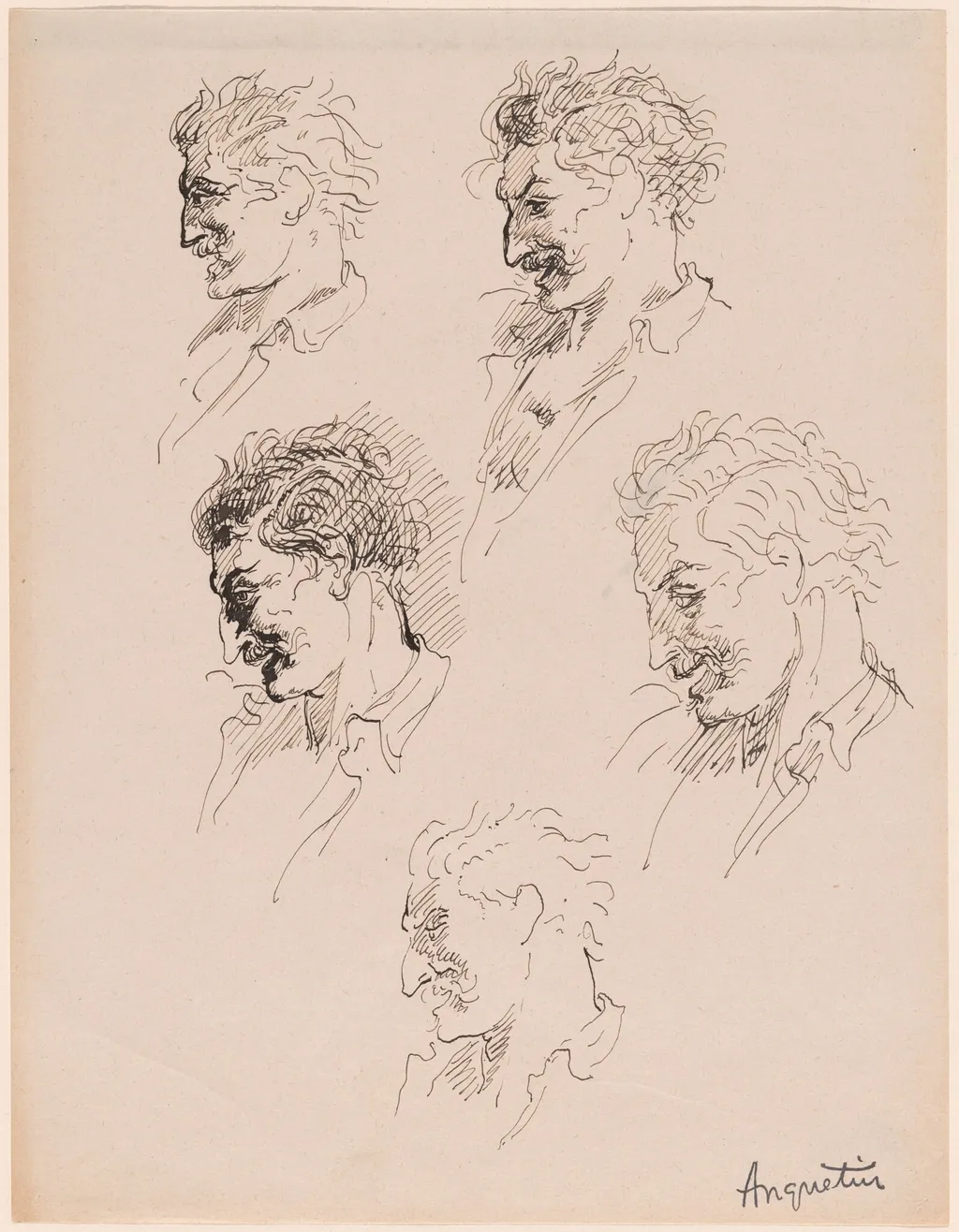
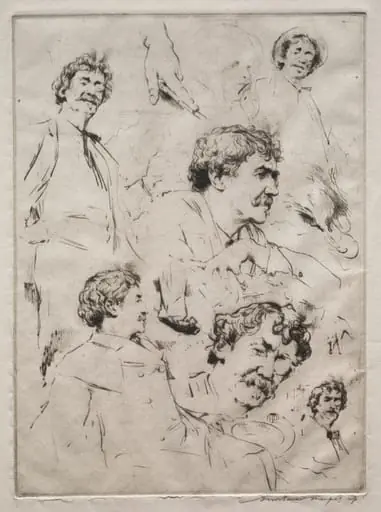
Head Studies is an ink drawing by the Impressionist artist Louis Anquetin. It dates from 1894 and is held in the collection of the National Gallery of Art.
About this work
Overview
The neutral beige background isolates the heads, directing attention to subtle shifts in posture and expression.
Louis Anquetin created this group of five ink drawings around 1894, using pen and black ink on wove paper. Each sketch presents a male profile, arranged in a loose sequence that suggests sequential observation. The figures share similar facial features and hairstyles, indicating a focused study of a single model. The neutral beige background isolates the heads, directing attention to subtle shifts in posture and expression.
Subject & Meaning
The drawings depict a man with curly hair and a mustache, viewed exclusively from the side. Repeated variations in brow position, lip tension, and head angle imply an exploration of transient expression rather than a fixed portrait. These are not formal likenesses but intimate observations—moments of stillness or quiet contemplation captured in rapid strokes, revealing the artist’s interest in the psychology of the human face.
Technique & Style
Anquetin employed fine pen lines and controlled cross-hatching to model volume and texture. The shading is deliberate but restrained, avoiding heavy contrast in favor of nuanced gradations. Hair is rendered with clustered strokes, while the mustache and jawline are defined with minimal, confident lines. The economy of means underscores a Post-Impressionist sensitivity to form, where simplicity serves expressive clarity.
History & Provenance
Created during Anquetin’s mature period, these studies likely originated from his private sketchbook practice. They were not intended for public display but as preparatory exercises, possibly linked to larger compositions or figure studies. Their survival suggests they were valued by the artist or later collectors for their observational rigor, though no documented exhibition history exists prior to the 20th century.
Context
Anquetin was associated with the Pont-Aven School and briefly with Cloisonnism, yet these drawings reflect a quieter, more introspective phase. In the mid-1890s, he moved away from bold color and symbolic form toward direct observation. This series aligns with broader late-19th-century trends in artist-led figure studies, where the head became a site for psychological and formal inquiry outside academic conventions.
Legacy
Though not widely exhibited, these studies exemplify Anquetin’s shift toward disciplined draftsmanship in his later career. They offer insight into an artist refining his eye beyond the decorative styles of his youth. Their quiet intensity has influenced later collectors and scholars interested in the evolution of French drawing practices, particularly the transition from Symbolist abstraction to observational realism.
Artist & collection

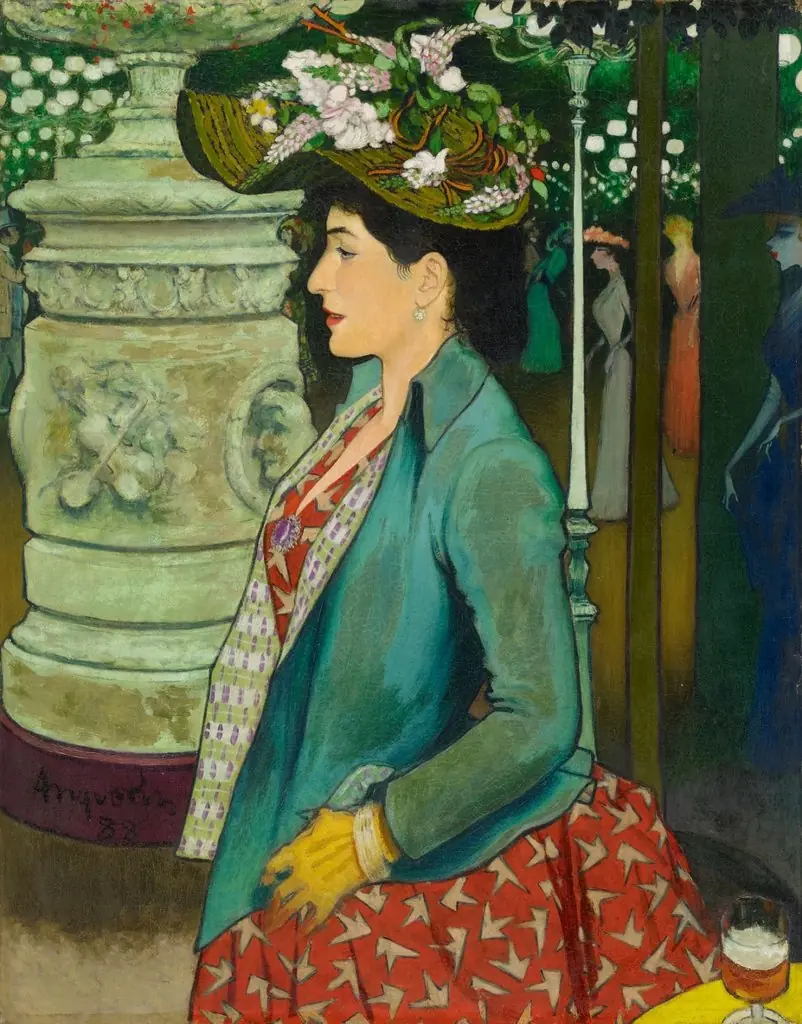 An Elegant Woman at the Élysée Montmartre
![Dancing Nude and Advertisement for Eugène Verneau's "Estampes décoratives" [verso], by Louis Anquetin](https://artifactworldgallery.com/img/louis-anquetin--dancing-nude-and-advertisement-for-eugene-verneau-s-estampes--204685aaf2d4110c-w320.webp) Dancing Nude and Advertisement for Eugène Verneau's "Estampes décoratives" [verso]
Dancing Nude and Advertisement for Eugène Verneau's "Estampes décoratives" [verso]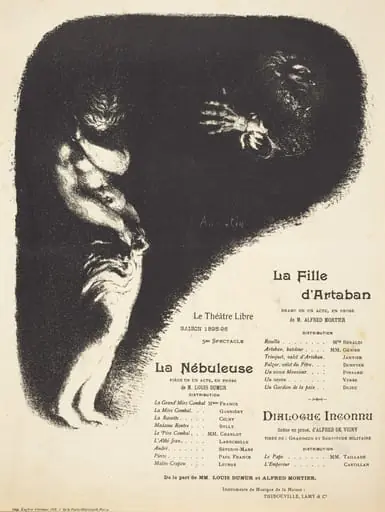 La Fille d'Artaban; La Nébuleuse; Dialogue inconnu
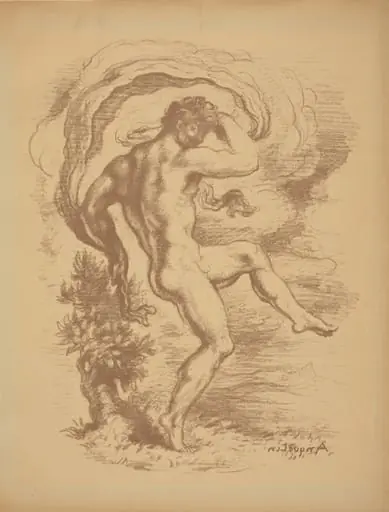 Dancing Nude
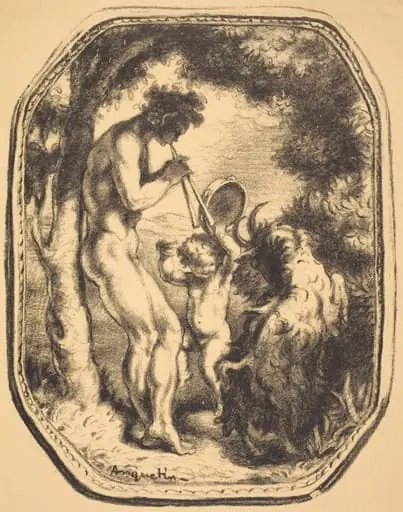 Le Talion; La Cage; Ceux qui restent; Fortune
![Dancing Nude and Advertisement for Eugène Verneau's "Estampes décoratives" [verso], by Louis Anquetin](https://artifactworldgallery.com/img/louis-anquetin--dancing-nude-and-advertisement-for-eugene-verneau-s-estampes--bdc50cd2c4746c6c-w320.webp) Dancing Nude and Advertisement for Eugène Verneau's "Estampes décoratives" [verso]
Dancing Nude and Advertisement for Eugène Verneau's "Estampes décoratives" [verso]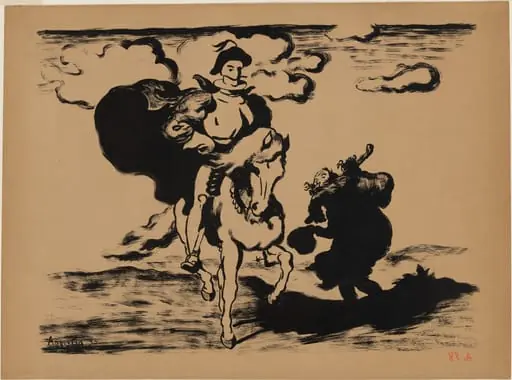 The Horseman and the Beggar (Le Cavalier et le mendiant)
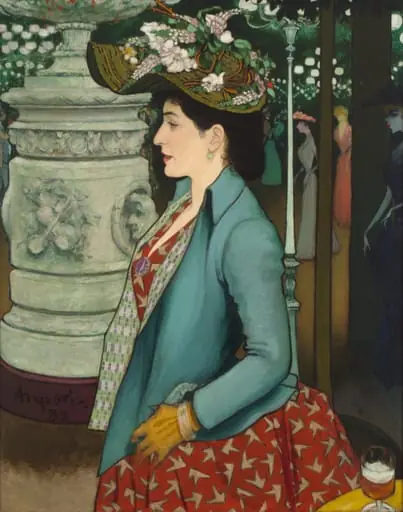 A Woman at the Élysée Montmartre (Femme à l’Élysée Montmartre)
![Two Head Studies and a Crouching Nude Woman; Two Women's Heads and a Head of Child [recto], by Paul Gauguin](https://artifactworldgallery.com/img/paul-gauguin--two-head-studies-and-a-crouching-nude-woman-two-women-s-head--fe3fee334eaa34d1-w320.webp)
![Studies of Dogs and Men [verso], by James Goodwyn Clonney](https://artifactworldgallery.com/img/james-goodwyn-clonney--studies-of-dogs-and-men-verso--b7671b05c83592d2-w320.webp)