Artwork
The Dead Christ Supported by an Angel
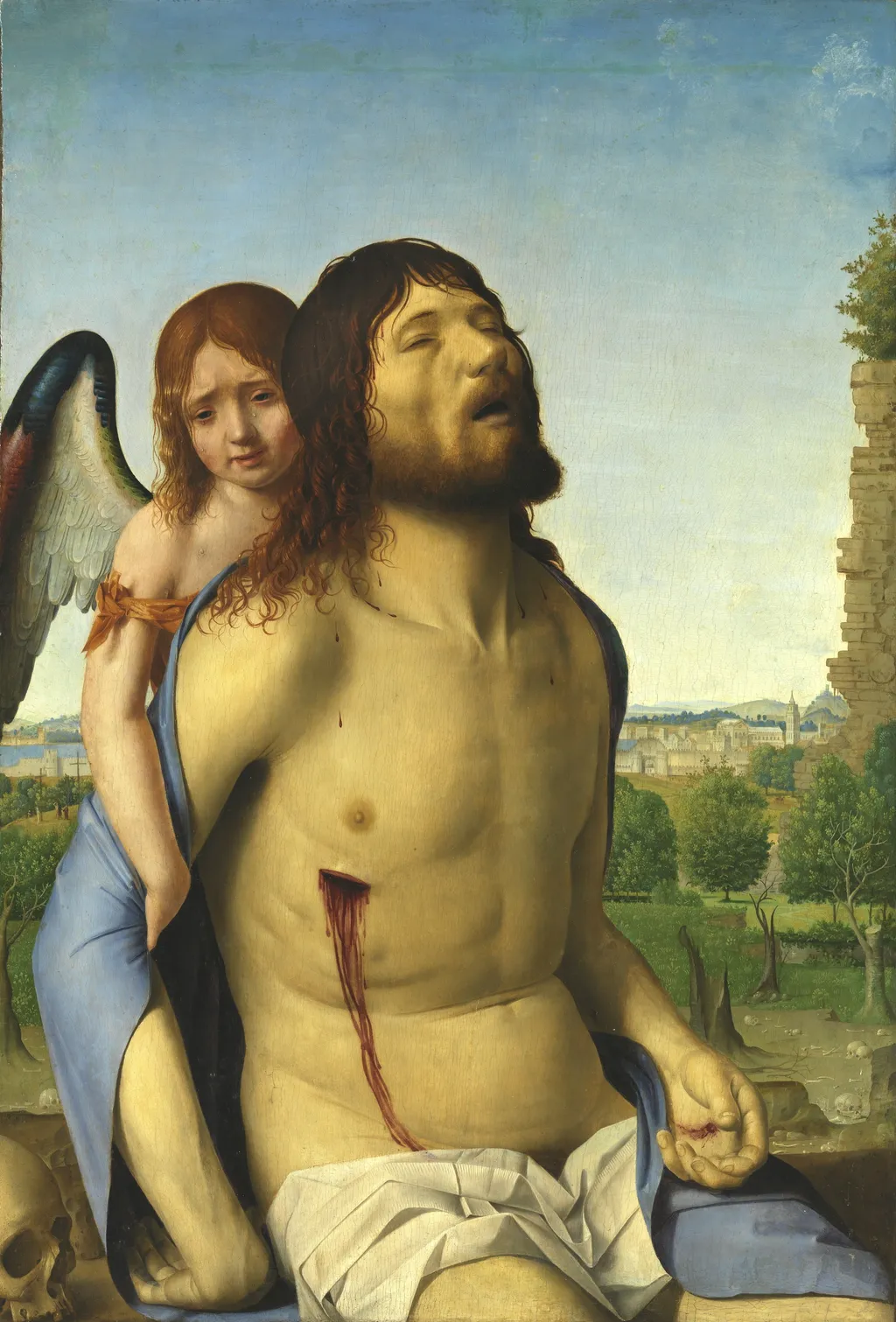
The Dead Christ Supported by an Angel is a mixed painting by the Early Renaissance artist Antonello da Messina. It dates from 1475 and is held in the collection of the Museo del Prado.
About this work
Overview
The composition presents a poignant Lamentation scene, focusing on the lifeless body of Christ, whose torso is exposed to reveal the wound in his side.
Painted in 1475, The Dead Christ Supported by an Angel is a late work by the Sicilian master Antonello da Messina, created shortly before his death. The composition presents a poignant Lamentation scene, focusing on the lifeless body of Christ, whose torso is exposed to reveal the wound in his side. His hands are bound with a white cloth, and his head lolls forward in death. He is physically supported by a solitary angel with reddish hair and expansive wings, who gazes upward in sorrow. The figures are set against a landscape featuring a distant city, trees, and a stone wall beneath a pale, atmospheric sky. Antonello employs his characteristic mixed technique, likely oil on panel, to achieve a sculptural solidity in the figures and a nuanced, hazy depth in the background. This work exemplifies the artist's synthesis of Northern European attention to detail and light with Italian Renaissance spatial clarity and emotional restraint. As one of his final productions, it reflects a mature mastery of form and a profound, quiet meditation on mortality, standing as a significant example of 15th-century religious painting in Italy.
Subject & Meaning
The composition centers on a lifeless, shirtless figure of Christ, eyes closed and body slumped, his side marked by a vivid wound. An angel with striking red hair lifts him, the figure’s wings rendered with meticulous detail. The juxtaposition of the divine messenger and the fallen savior underscores themes of sacrifice and compassion.
Technique & Style
Antonello employs a delicate chiaroscuro, allowing a gentle illumination to model Christ’s torso and suggest a faint inner glow. Subtle gradations of tone give the figures a three‑dimensional presence, while the background—distant city, trees, and stone wall—recedes under a pale sky, enhancing spatial depth.
History & Provenance
The painting has been documented in the Prado’s inventory since the early 19th century, having entered the Spanish royal collection before being transferred to the museum. Its attribution to Antonello da Messina has been consistently affirmed by scholars based on stylistic and technical analysis.
Context
Produced during the Italian Quattrocento, the work reflects the period’s growing interest in naturalistic representation and emotional expression. Antonello’s exposure to Northern European oil techniques informs the nuanced handling of light, while the subject aligns with contemporary devotional imagery intended for private contemplation.
Own this work as a print
Artist & collection


![The Crucifixion with the Virgin, Saint John, Saint Jerome, and Saint Mary Magdalene [middle panel], by Pietro Perugino](https://artifactworldgallery.com/img/pietro-perugino--the-crucifixion-with-the-virgin-saint-john-saint-jerome-and--a9b4c312771e3f71-w320.webp)