Artwork
Martirio de San Andrés
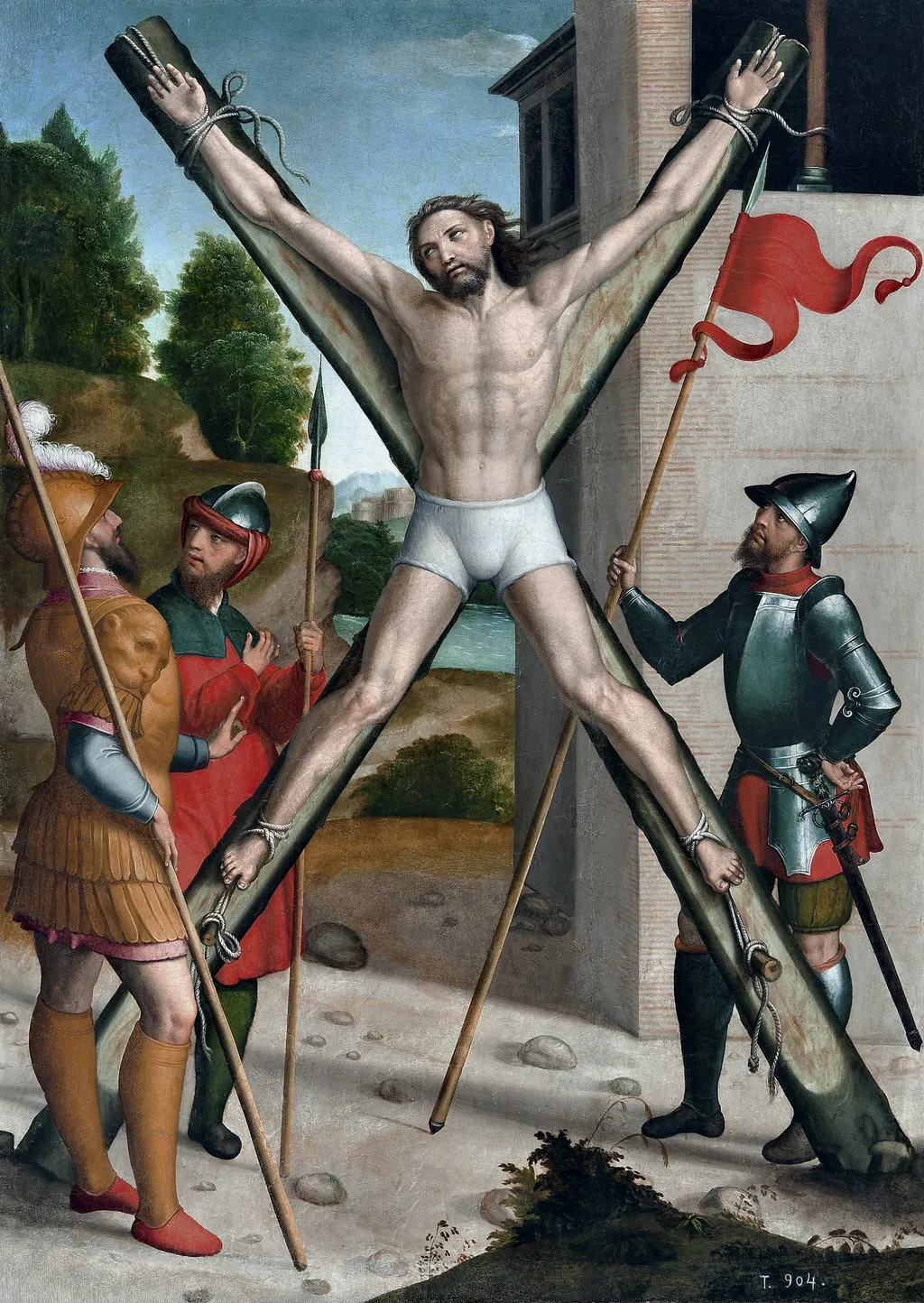
Martirio de San Andrés is an oil painting by the Mannerist artist Juan Correa de Vivar. It dates from 1540 and is held in the collection of the Museo del Prado.
About this work
Overview
Juan Correa de Vivar’s oil on canvas, dated to 1540, portrays the martyrdom of the apostle Andrew. The work is part of the collection of the Museo del Prado and belongs to the religious painting genre of mid‑16th‑century Spanish art.
Subject & Meaning
At the centre of the composition stands a bearded figure nailed to an X‑shaped cross, the traditional “true cross” associated with Saint Andrew. Flanking him are three onlookers: a man in a red robe, a soldier in armor bearing a red flag with a white cross, and a third figure dressed in brown and gold, all witnessing the saint’s suffering.
Technique & Style
Correa de Vivar employs a realistic handling of flesh and metal, rendering the saint’s exposed body and the gleaming armor with careful attention to light. The landscape background—rocky ground, distant architecture, and sparse trees—provides a stark setting that heightens the drama of the scene.
History & Provenance
The painting was created in 1540 and has remained in Spain, eventually entering the holdings of the Museo del Prado. Its provenance before acquisition by the museum is not extensively documented, but it has been recognized as a representative example of the artist’s devotional output.
Context
The depiction of Saint Andrew on his diagonal cross reflects the Counter‑Reformation emphasis on martyrdom as a model of faith. The inclusion of military attire and a flag bearing a cross underscores the intertwining of religious and martial symbolism common in Spanish ecclesiastical art of the period.
Own this work as a print
Artist & collection