Artwork
Odalisca
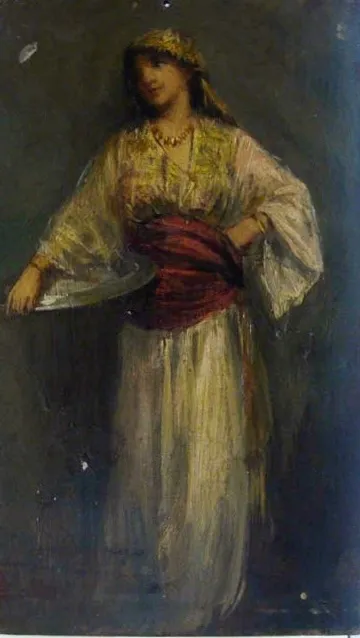
Odalisca is an oil painting by the Orientalist artist Antoni Coll i Pi. It dates from 1943 and is held in the collection of the Chilean National Museum of Fine Arts.
About this work
Overview
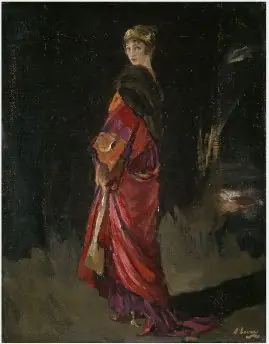
Odalisca is a 1943 oil painting by Catalan artist Antoni Coll i Pi, currently held in the collection of the National Museum of Fine Arts in Santiago. The work presents a solitary female figure in a dramatic, low-lit setting. Its composition centers on a poised woman whose attire and posture evoke both elegance and tension, blending elements of classical form with symbolic intensity.
Subject & Meaning
The juxtaposition of delicate adornment with a weapon implies a complex identity—perhaps a guardian, a symbol of authority, or a metaphor for inner strength.
The figure, dressed in a white robe with a red sash, wears ornamental headwear and a necklace, suggesting status or ritual significance. She holds a sword in her extended left arm while her right hand rests on her hip, a stance that conveys both readiness and composure. The juxtaposition of delicate adornment with a weapon implies a complex identity—perhaps a guardian, a symbol of authority, or a metaphor for inner strength.
Technique & Style
Coll i Pi employs chiaroscuro to heighten the figure’s presence against a deep, undefined background. The contrast between the illuminated skin and fabric and the surrounding shadows creates a sculptural effect, emphasizing volume and form. Brushwork is controlled yet expressive, with subtle gradations in tone that lend the figure a quiet monumentality without overt realism.
History & Provenance
Painted in 1943 during Coll i Pi’s later career, Odalisca entered the collection of Chile’s National Museum of Fine Arts in Santiago, where it remains today. While the painting’s early ownership is undocumented, its inclusion in the museum’s permanent holdings reflects its recognition as a significant work within the artist’s oeuvre and within mid-20th-century Latin American art circles.
Context
Created during a period of political and cultural redefinition in Latin America, the painting diverges from overt nationalism or social realism common at the time. Instead, it engages with universal themes of power and femininity through symbolic imagery, aligning with broader European modernist tendencies that Coll i Pi absorbed during his training and travels.
Legacy
Odalisca stands as a quiet but persistent example of Coll i Pi’s interest in psychological depth and formal harmony. Though not widely reproduced, it continues to be studied for its synthesis of symbolic content and restrained technique. The work contributes to a nuanced understanding of Catalan artists working outside Spain during the mid-20th century.
Artist & collection