Artwork
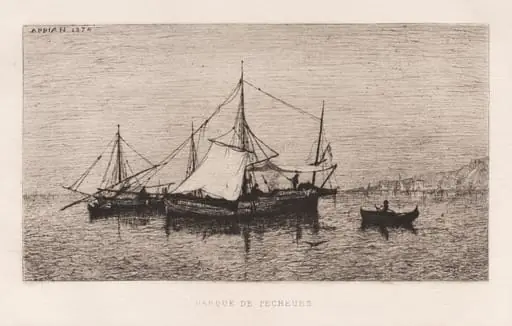
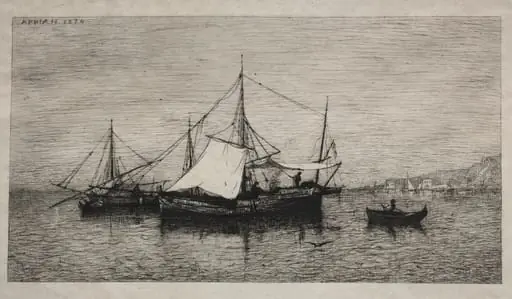
Barque de Pecheurs
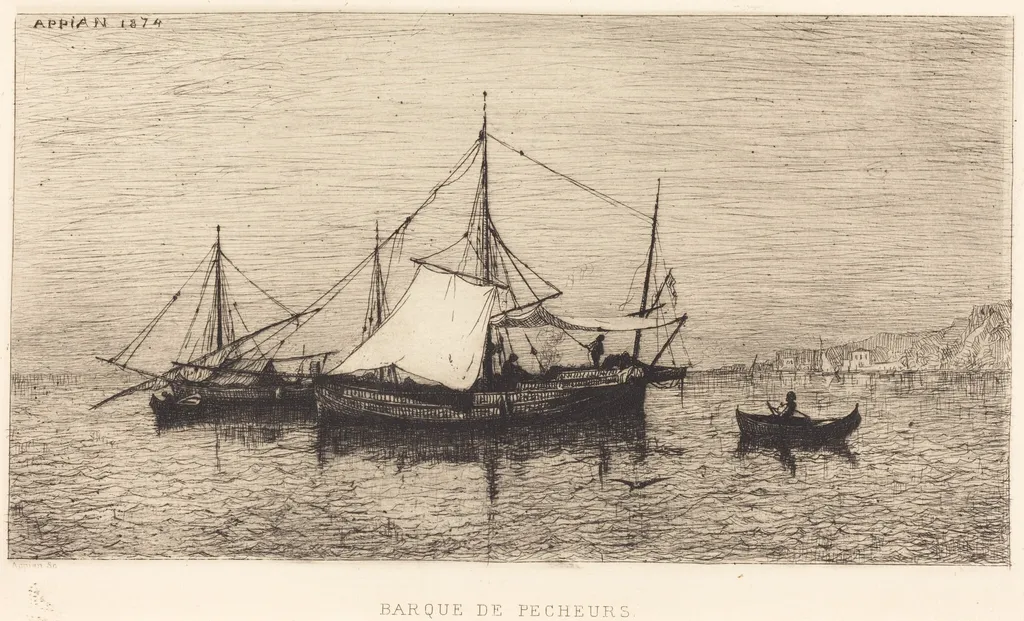
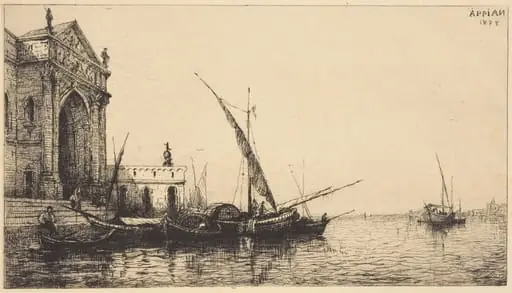
Barque de Pecheurs is an ink print by the Impressionist artist Adolphe Appian. It dates from 1874 and is held in the collection of the National Gallery of Art.
About this work
Overview
Unlike painted works, this piece relies on ink lines and tonal variation to convey depth and atmosphere, characteristic of his printmaking practice.
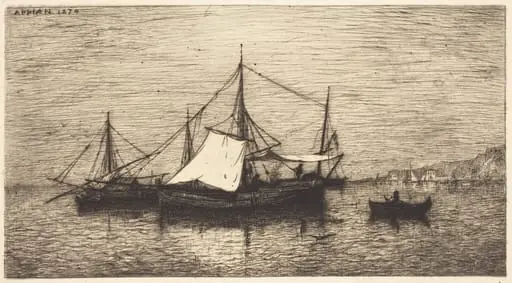
Adolphe Appian produced *Barque de Pecheurs* in 1874 as an etching on laid paper, part of a broader 19th-century French revival in printmaking. The work captures a quiet maritime scene with precision, reflecting Appian’s dedication to landscape and coastal subjects. Unlike painted works, this piece relies on ink lines and tonal variation to convey depth and atmosphere, characteristic of his printmaking practice.
Subject & Meaning
The scene portrays a fishing vessel with a large white sail at center, flanked by two smaller boats in the distance. A solitary figure rows a tiny skiff to the right, suggesting daily labor on the water. No narrative is overt; instead, the image conveys the rhythm of coastal life through stillness and isolation. The absence of human figures on the main boat emphasizes the vessel’s quiet endurance against the elements.
Technique & Style
Appian employed fine, controlled etching lines to render texture in the water’s surface and the boat’s rigging. The dark, inked areas contrast with the pale sail and sky, creating a tonal balance that suggests dawn or dusk. Laid paper’s subtle grain enhances the atmospheric quality, while minimal background detail focuses attention on the boats and their interaction with the water’s reflective surface.
History & Provenance
Created during Appian’s mature period, *Barque de Pecheurs* emerged amid renewed interest in etching as an independent art form in France. Though not widely exhibited at the time, it aligns with the aesthetic priorities of artists seeking to elevate printmaking beyond reproductive functions. Its survival in private and institutional collections attests to its quiet resonance among collectors of 19th-century graphic art.
Context
Appian worked alongside contemporaries who turned to nature and rural labor as subjects, rejecting academic grandeur for intimate observation. In the 1870s, etching was being reclaimed by artists as a medium for personal expression, not just illustration. This piece reflects that shift—its modest scale and quiet subject matter mirror broader cultural movements valuing authenticity over spectacle.
Legacy
Though not among Appian’s most famous works, *Barque de Pecheurs* exemplifies his contribution to the French etching revival. Its restrained composition and technical finesse influenced later printmakers who valued subtlety over drama. The work remains a quiet testament to the dignity of everyday maritime life, preserved through the enduring medium of hand-inked line.
Artist & collection
Artist
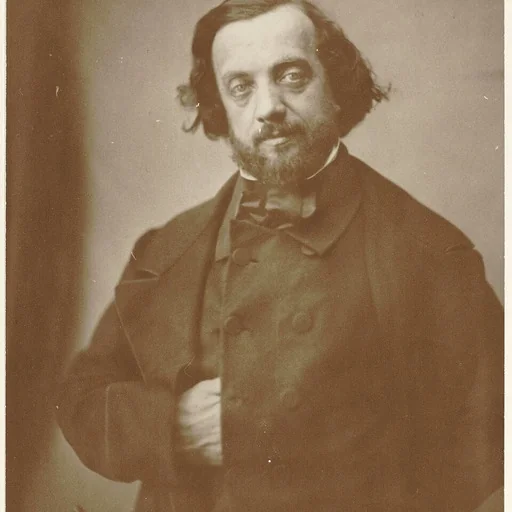
Adolphe Appian (born as Jacques Barthelemy Adolphe Appian; 28 August 1819 – 29 April 1898) was a French landscape painter and etcher.