Artwork
Wady Firan, Sinai
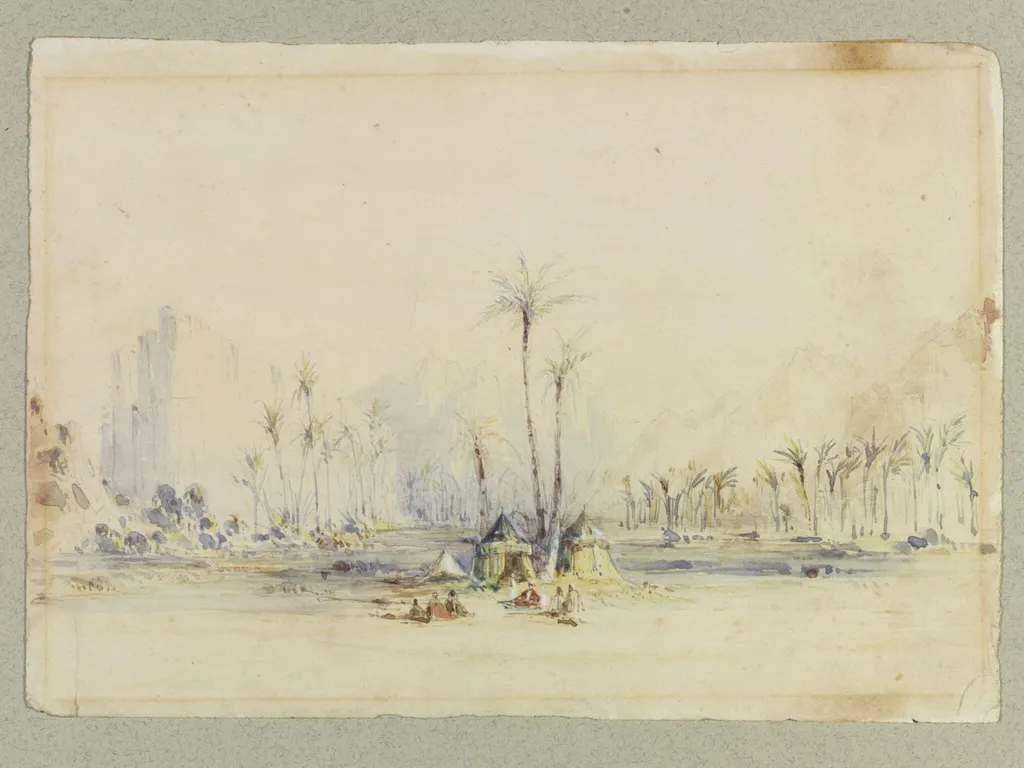
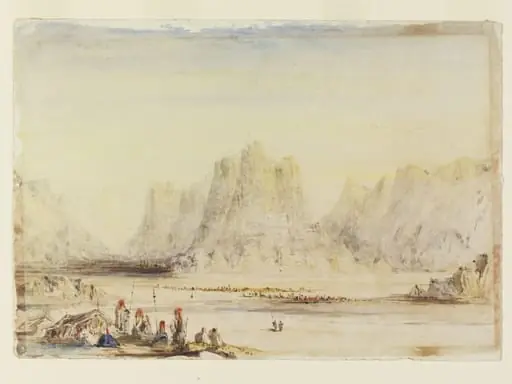
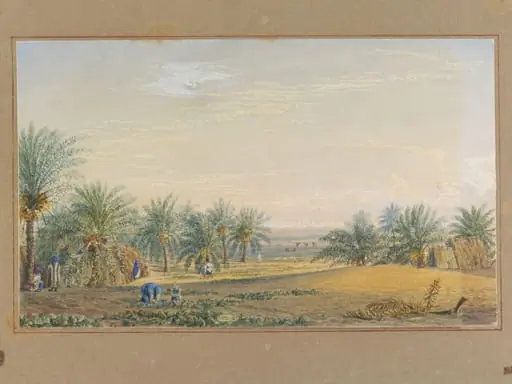
Wady Firan, Sinai is a watercolor work on paper by the British Romanticist artist Francis Arundale. It dates from 1834 and is held in the collection of the Victoria and Albert Museum.
About this work
Overview
Though once misattributed to William Henry Bartlett at a 1973 auction, its authorship has since been clarified.
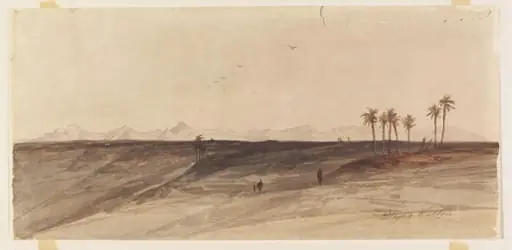
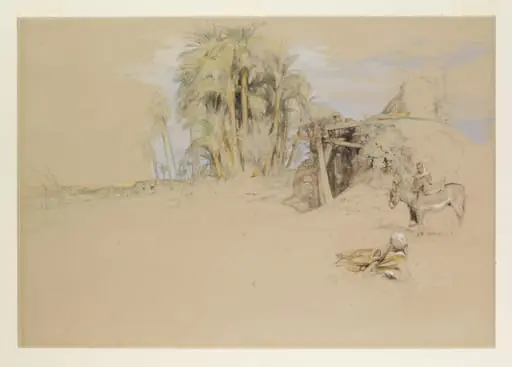
Created in 1834, *Wady Firan, Sinai* is a watercolour by Francis Arundale, documenting a landscape encountered during his 1833 expedition through the Sinai Peninsula. The work belongs to a series of sketches made alongside fellow travelers John Bonomi and Frederick Catherwood. Though once misattributed to William Henry Bartlett at a 1973 auction, its authorship has since been clarified. The piece captures a moment of quiet observation in a remote desert valley.
Subject & Meaning
The scene depicts a narrow desert wadi lined with tall palm trees, a slender watercourse, and scattered tents where figures rest near the stream. The presence of human activity amid arid terrain suggests a transient encampment, possibly Bedouin, emphasizing survival in a harsh environment. Arundale’s focus on water as a lifeline underscores the region’s ecological fragility and the rhythm of nomadic life.
Technique & Style
Arundale employed light, fluid washes and delicate brushwork to convey the intensity of desert light and dryness. Soft browns, muted greens, and pale blues dominate, avoiding dramatic contrasts in favor of atmospheric subtlety. The paper’s yellowed tone and faint wear reflect its age and handling, reinforcing the sketch’s function as a field record rather than a polished studio piece.
History & Provenance
The watercolour was produced during Arundale’s 1833 journey through Sinai, later exhibited or circulated among his circle. It remained in private hands until its 1973 sale at Phillips, where it was incorrectly grouped under William Henry Bartlett’s name. Subsequent research corrected the attribution, anchoring it firmly within Arundale’s body of travel sketches from the early 1830s.
Context
Arundale’s work emerged during a period of heightened European interest in the Near East, fueled by archaeological exploration and religious tourism. His sketches, like those of contemporaries such as Catherwood, served as visual documentation for scholarly and public audiences. Unlike romanticized Orientalist imagery, his approach leaned toward topographical accuracy and restrained observation.
Legacy
Though not widely exhibited today, *Wady Firan, Sinai* contributes to a broader archive of 19th-century travel drawings that shaped Western perceptions of the Middle East. Its value lies in its unembellished record of place and condition, offering insight into the methods and intentions of early field artists who prioritized observation over embellishment.
Artist & collection

![Egyptological studies [6], by Francis Arundale](https://artifactworldgallery.com/img/francis-arundale--egyptological-studies-6--7bac01af5e28ea58-w320.webp)