Artwork
Group of Seven Horses
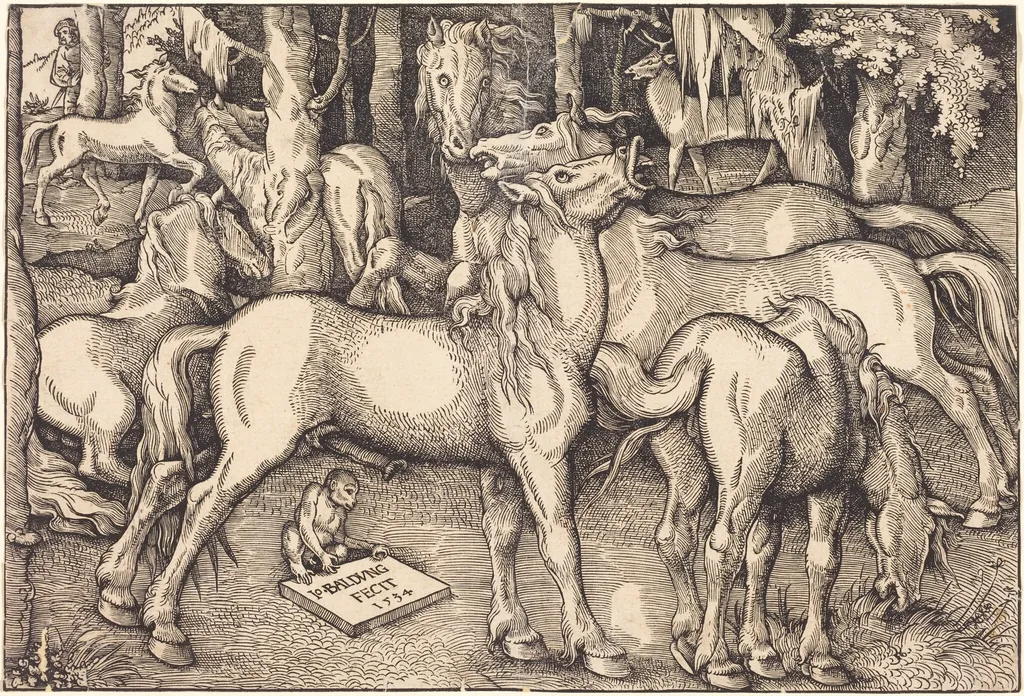
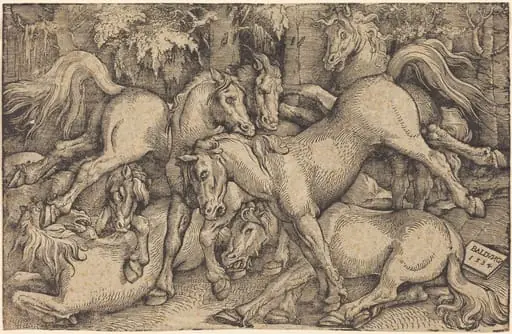
Group of Seven Horses is an ink print by the Renaissance artist Hans Baldung Grien. It dates from 1534 and is held in the collection of the National Gallery of Art.
About this work
The background is packed with small, swirling figures and trees, making it look like a stormy forest.
This woodcut shows seven horses tangled in a chaotic knot. Their legs and bodies twist together in a wild mess, with some rearing up and others lying flat. The background is packed with small, swirling figures and trees, making it look like a stormy forest.
The artist signed it with the year 1534 in the bottom corner. The horses’ tangled forms might be showing how nature or fate can trap even strong animals.
Next, look into woodcut to see how artists like this made prints from carved blocks.
Overview
Group of Seven Horses is a 1534 woodcut by Hans Baldung Grien, showcasing the artist's experimentation with dynamic composition and bold expression.
Subject & Meaning
The print depicts seven horses entangled in a chaotic knot, possibly symbolizing the power of nature or fate to ensnare even strong creatures. The background is dense with swirling figures and trees, evoking a stormy forest atmosphere.
Technique & Style
As a woodcut, the work demonstrates Baldung Grien's ability to create complex, detailed scenes through the carved block medium, characteristic of his varied output that included painting, engraving, and stained glass.
History & Provenance
The artist signed the work with the date 1534 in the bottom corner, confirming its creation during the German Renaissance and Mannerist periods.
Artist & collection
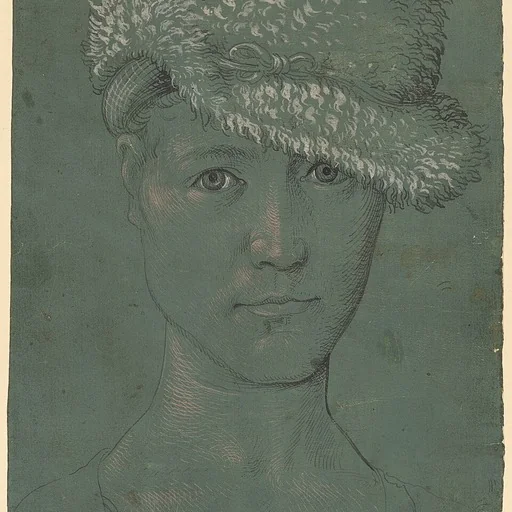
Artist
Hans Baldung (1484 or 1485 – September 1545), called Hans Baldung Grien, (being an early nickname, because of his predilection for the colour green), was a painter, printer, engraver, draftsman, and stained glass…

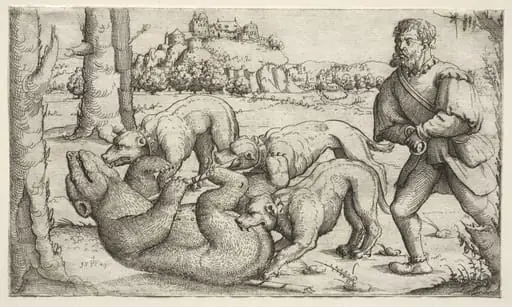 A Bear Hunt
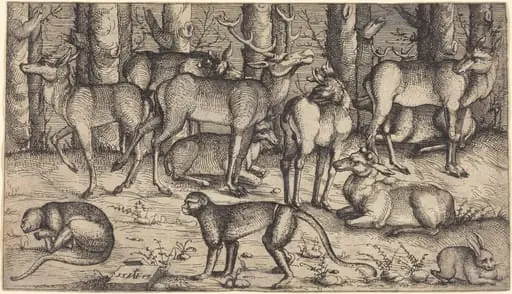 Stags in the Forest
 The Unicorn Purifies the Water with Its Horn
 Combats and Triumphs No. 6
 The Unicorn Purifies the Water with Its Horn
 Saint Eustace
 Reynard the Fox: Reynard Asks Permission to Confess
 Saint Eustace
 Hercules and the Nemean Lion
 Bear Hunt
 Group of Seven Horses in Woods
 The Flight into Egypt