Artwork
Stags in the Forest
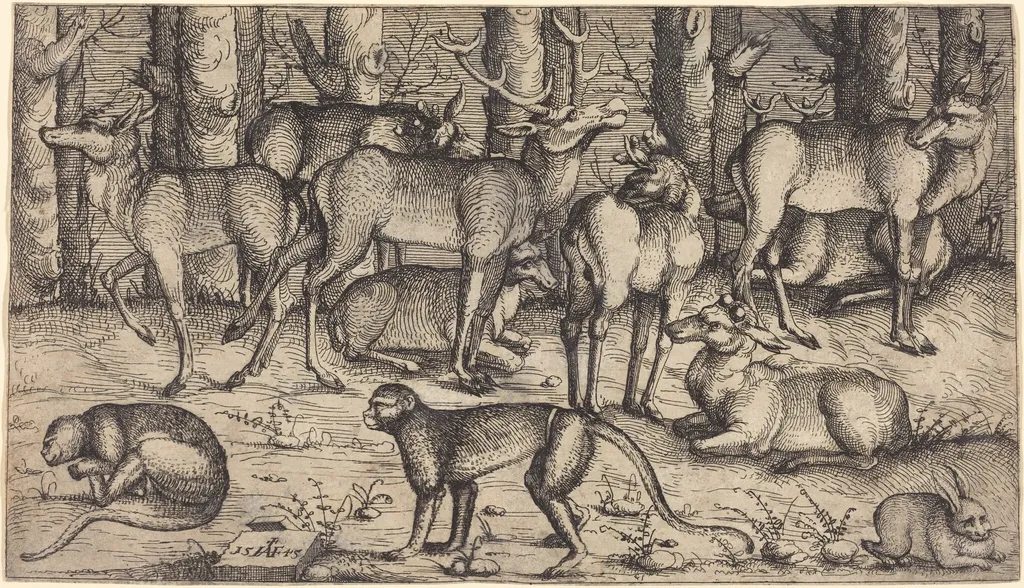
Stags in the Forest is an ink print by the Renaissance artist Augustin Hirschvogel. It dates from 1545 and is held in the collection of the National Gallery of Art.
About this work
Overview
Created in 1545 by the German artist Augustin Hirschvogel, *Stags in the Forest* is a black-and-white etching depicting a dense woodland teeming with wildlife.
Created in 1545 by the German artist Augustin Hirschvogel, *Stags in the Forest* is a black-and-white etching depicting a dense woodland teeming with wildlife. Hirschvogel, known for his precise small-scale landscapes, employed the etching technique to render intricate details in ink on paper. The scene unfolds with no clear horizon, as trees and creatures overlap in a tightly packed composition, characteristic of Northern Renaissance naturalism.
Subject & Meaning
The print portrays deer, monkeys, and ambiguous human-like figures interwoven within an untamed forest. Animals are rendered with anthropomorphic postures—monkeys seated like humans, stags moving with deliberate grace—suggesting a contemplation of nature’s parallels to human behavior. This blending of species reflects a 16th-century fascination with the natural world as both observable reality and symbolic realm.
Technique & Style
Hirschvogel used etching to incise fine lines into a metal plate, allowing for delicate textures and layered shadows. The dense foliage and overlapping forms are achieved through cross-hatching and fine stippling, creating depth without perspective. The absence of color emphasizes line and tone, aligning with the Danube School’s preference for atmospheric, monochromatic landscapes over narrative clarity.
History & Provenance
Hirschvogel, active in Nuremberg and associated with the Danube School, produced this print during a period when printmaking flourished as a medium for landscape studies. While the exact early ownership of *Stags in the Forest* is undocumented, its survival in multiple museum collections suggests it was widely circulated among collectors and artists interested in naturalistic printmaking in mid-16th-century Central Europe.
Context
In the 1540s, artists in southern Germany and Austria increasingly turned to nature as a subject independent of religious or mythological themes. Hirschvogel’s work reflects this shift, influenced by direct observation and the humanist interest in the natural world. His etchings, though small, contributed to a growing genre of landscape prints that valued detail over grandeur.
Legacy
Hirschvogel’s *Stags in the Forest* exemplifies the transition from medieval symbolic nature to Renaissance observational realism. Though not widely known today, his precise etchings influenced later generations of printmakers who sought to capture the complexity of wild environments. The work remains a quiet testament to early modern efforts to map the unseen rhythms of the forest.
Artist & collection
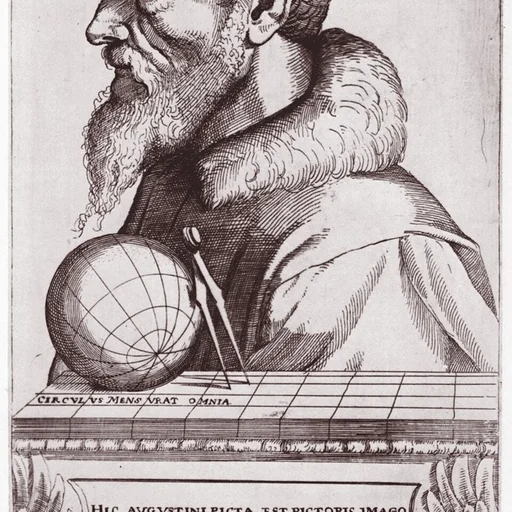
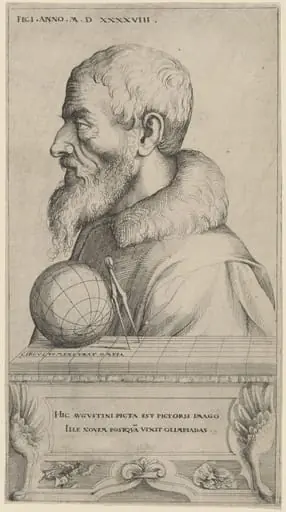
Artist
Augustin Hirschvogel (1503 – February 1553) was a German artist, mathematician, and cartographer known primarily for his etchings.

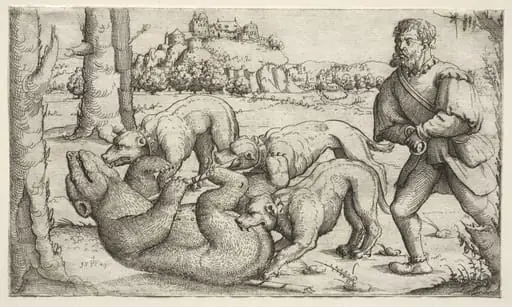 A Bear Hunt
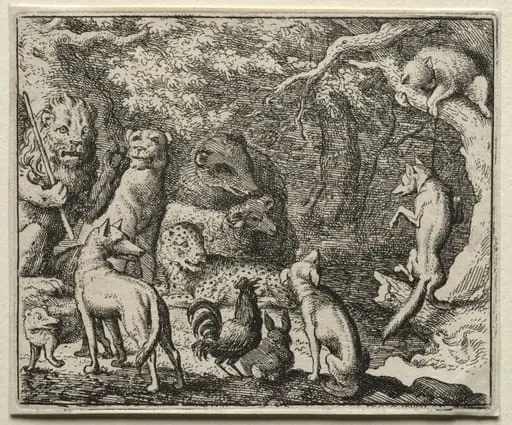 Reynard the Fox: Reynard Asks Permission to Confess
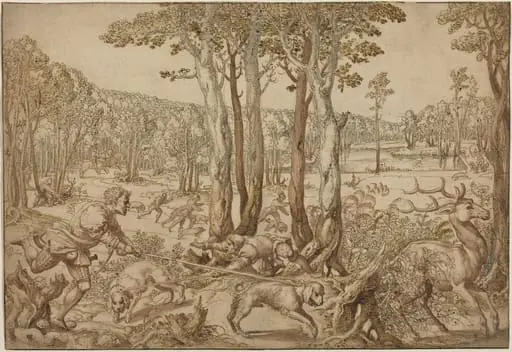 The Hunts of Maximilian: The Stag Hunt (August)
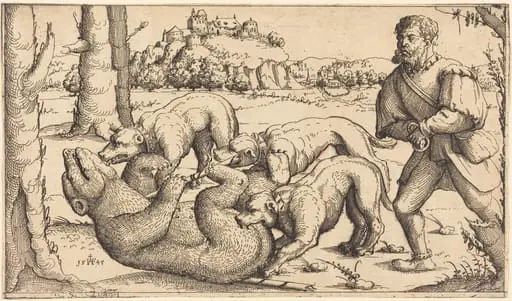 Bear Hunt
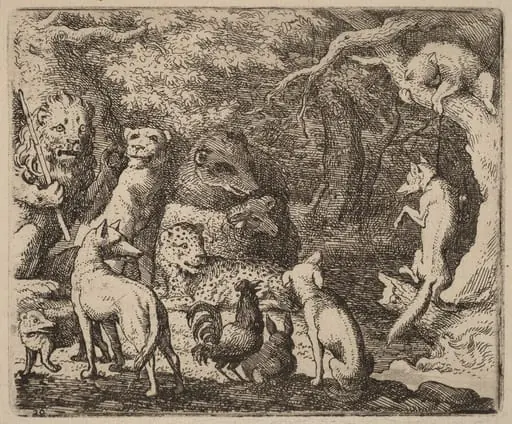 Reynard Asks Permission to Speak
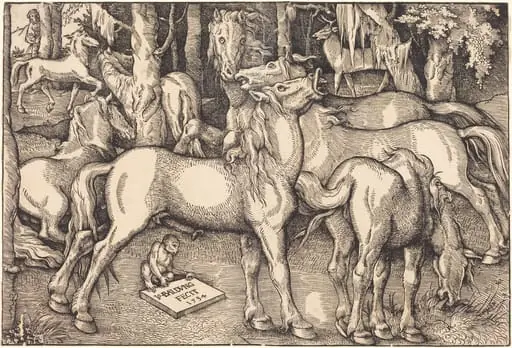 Group of Seven Horses
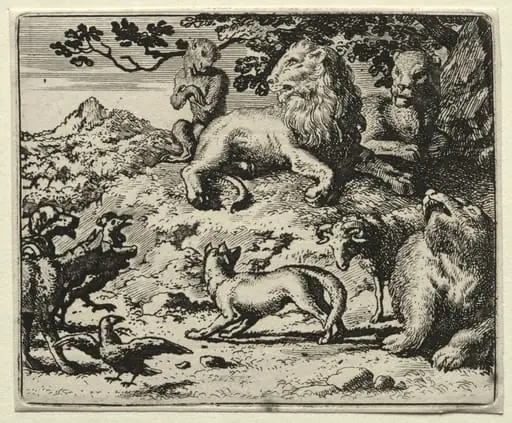 Reynard the Fox: The Animals Complain of Reynard's Pardon
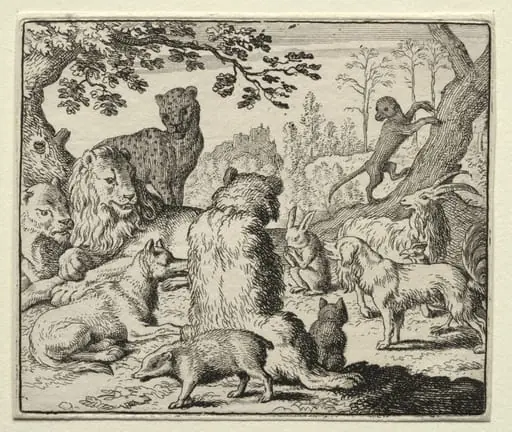 Reynard the Fox: Lion Orders Search for Reynard
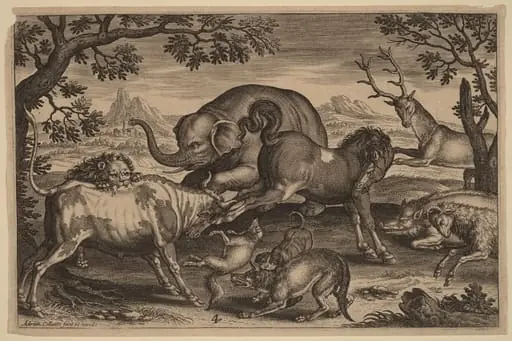 Lion, Bull, Fox, Wolf, Dog, Boar, Goat, Horse, Elephant and Deer
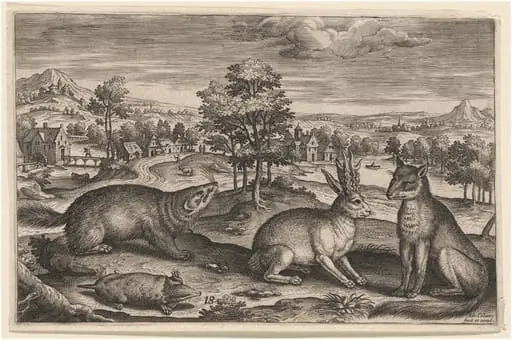 A Mole, a Badger, a Horned Hare and a Fox
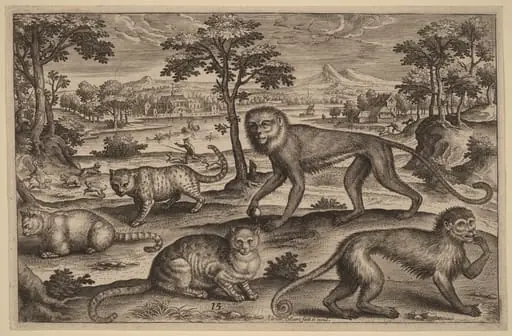 Three Cats and Two Monkeys
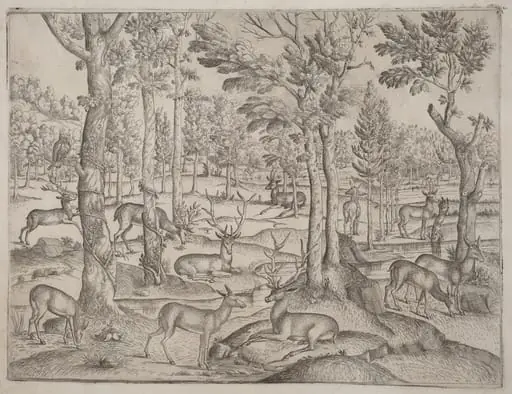 Deer in the Forest