Artwork
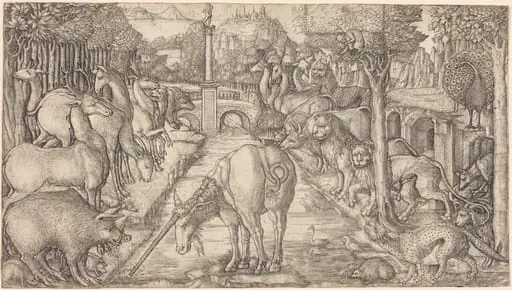
The Unicorn Purifies the Water with Its Horn
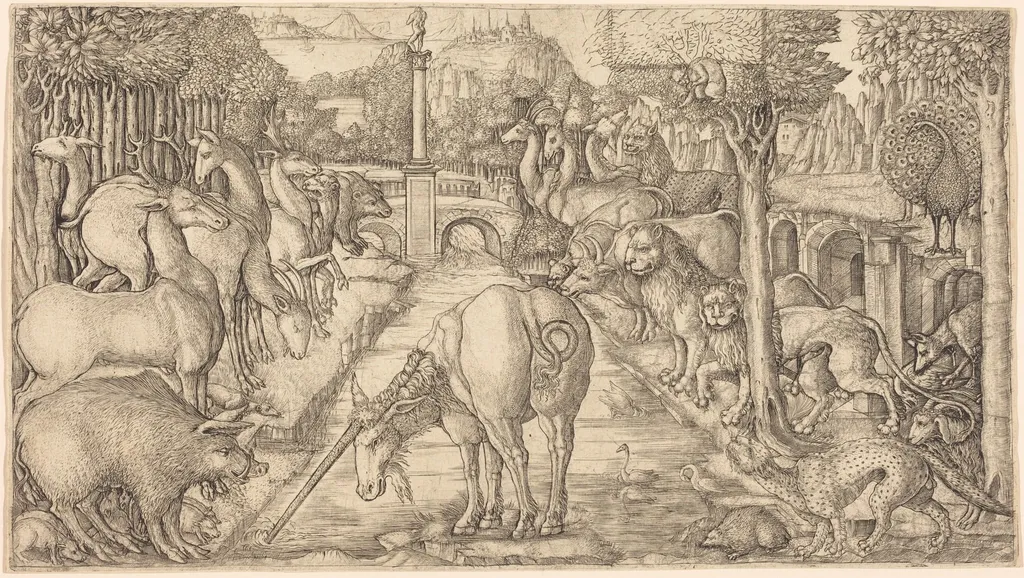
The Unicorn Purifies the Water with Its Horn is an ink print by the Renaissance artist Jean Duvet. It dates from 1558 and is held in the collection of the National Gallery of Art.
About this work
Overview
Created around 1558 by Jean Duvet, this engraving on laid paper is one of approximately 73 known plates by the French Renaissance artist.
Created around 1558 by Jean Duvet, this engraving on laid paper is one of approximately 73 known plates by the French Renaissance artist. Duvet, primarily trained as a goldsmith, turned to printmaking late in life, producing works distinguished by dense compositions and intense spiritual symbolism. His technique relied heavily on fine, intersecting lines to model form and depth, a method known as cross-hatching, which gave his images a tactile, intricate quality uncommon in contemporary French prints.
Subject & Meaning
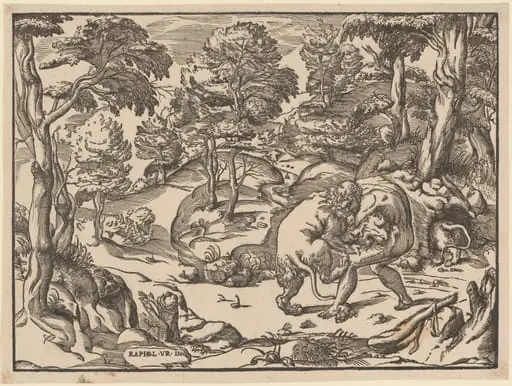
The scene portrays a unicorn standing at the edge of a stream, its horn gently touching the water—a reference to medieval legends in which the unicorn’s horn could cleanse poisoned water. Surrounding it, a lion and deer rest peacefully, symbolizing harmony between predator and prey under divine order. A distant city on a hill, framed by trees, suggests a spiritual or idealized realm, reinforcing the allegorical nature of the image as a metaphor for purity and divine intervention.
Technique & Style
Duvet employed meticulous cross-hatching to build texture and shadow across the forest floor, animal fur, and architectural details. His lines are dense and irregular, avoiding the smooth precision typical of Italian engravers. The composition is crowded yet deliberately unbalanced, with figures arranged in a loose, almost improvisational manner. This approach, often described as naive, lends the image a raw, visionary character that diverges from classical Renaissance ideals.
History & Provenance
Duvet produced this print during his later years, after establishing himself as a goldsmith in Paris. Few of his prints were widely distributed in his lifetime, and many survived only in private collections. The engraving was likely made for a limited audience of connoisseurs or religious patrons. Its survival in multiple impressions suggests modest circulation, though it remained obscure until later scholarly interest in Northern Mannerist printmaking revived attention to his work.
Context
In mid-16th century France, printmaking was still developing as an independent art form, overshadowed by painting and sculpture. Duvet’s work stood apart from the dominant Italianate styles, drawing instead on Gothic traditions and apocryphal bestiaries. His imagery resonated with Catholic devotional culture during the Reformation, offering visual meditations on purity and divine power at a time of religious upheaval.
Legacy
Though largely forgotten after his death, Duvet’s prints were rediscovered in the 19th century for their emotional intensity and idiosyncratic vision. His use of symbolic narrative and expressive line work drew comparisons to later Romantic artists like William Blake. Today, his engravings are studied for their unique fusion of medieval symbolism and early modern technique, offering insight into the margins of Renaissance artistic expression in France.
Artist & collection

Artist
Jean Duvet (1485 – after 1562) was a French Renaissance goldsmith and engraver, now best known for his engravings.