Artwork
Judith Holding the Head of Holofernes
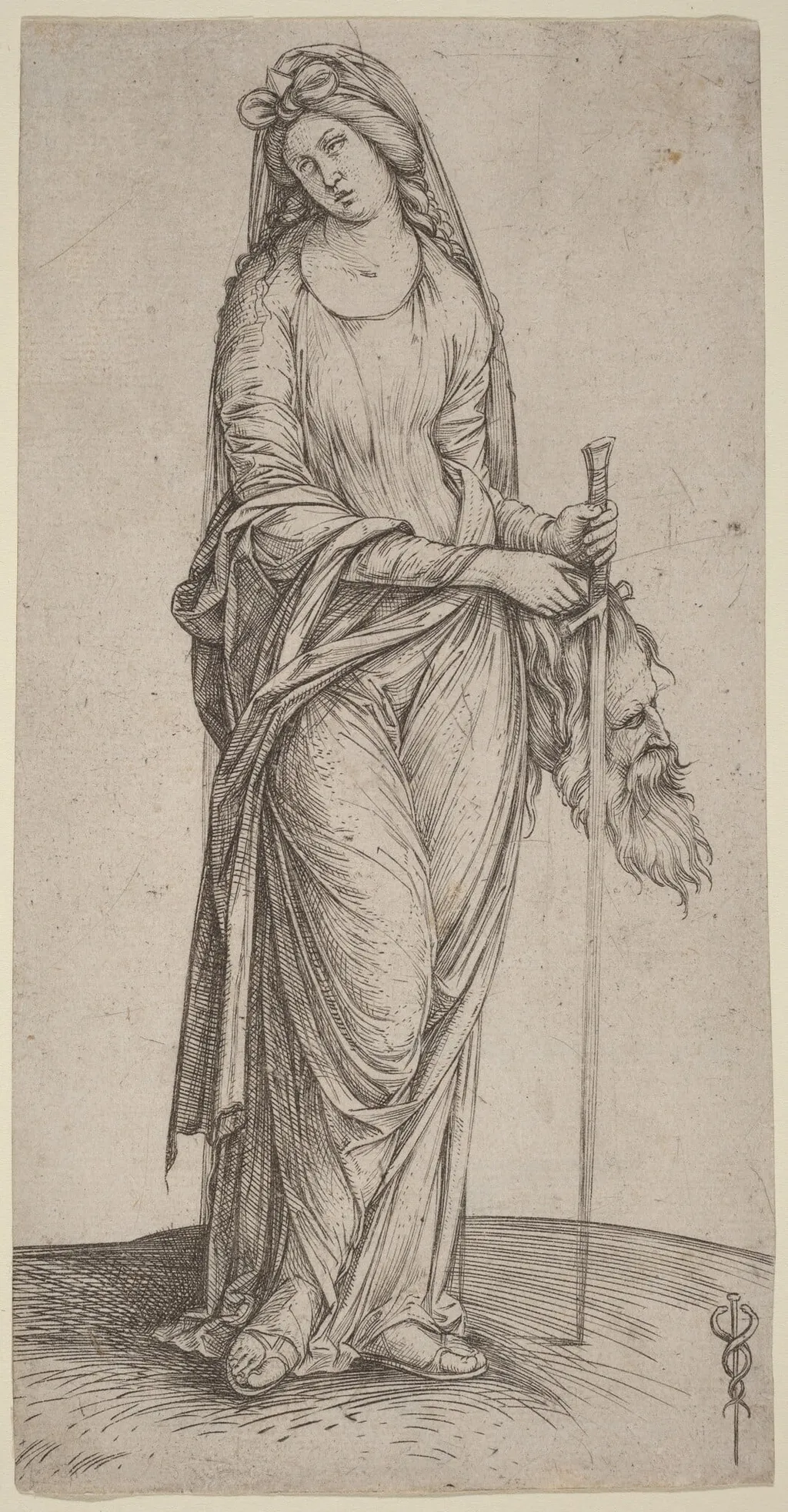
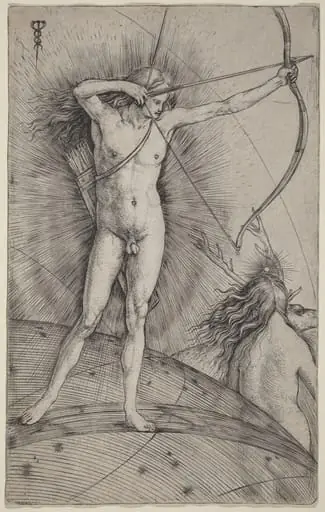
Judith Holding the Head of Holofernes is an ink print by the Renaissance artist Jacopo de' Barbari. It dates from 1502 and is held in the collection of the National Gallery of Art.
About this work
Overview
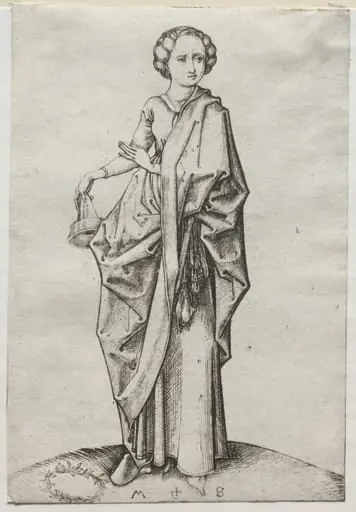
Jacopo de’ Barbari’s engraving *Judith Holding the Head of Holofernes* dates to roughly 1502. Executed in a compact format, the print shows Judith on a circular base, her serene expression turned downward as she presents the severed head of Holofernes. The composition balances the drama of the biblical episode with a calm, contemplative mood, characteristic of early Renaissance printmaking.
Subject & Meaning
The work illustrates the Old Testament story of Judith, who saves her people by beheading the Assyrian commander Holofernes. Barbari emphasizes Judith’s dignity rather than the violence; she holds the head gently by the hair while a sword rests in her left hand. The subdued gaze and poised stance suggest moral triumph and the virtue of restraint.
Technique & Style
Barbari employs fine, tightly controlled linework and dense cross‑hatching to model flesh, fabric, and the metallic sheen of the sword. The engraving’s delicate hatching creates subtle tonal gradations, giving depth to the draped dress and the circular platform. This precision reflects the artist’s mastery of Northern European print techniques, merged with his Italian Renaissance sensibility.
History & Provenance
Born in Venice, Barbari relocated to Germany around 1500, becoming one of the first Italian Renaissance artists to work north of the Alps. The *Judith* engraving belongs to a modest corpus of his prints that circulated widely in early sixteenth‑century Europe, helping to disseminate Italian compositional ideas across the continent.
Context
At a time when printmaking was emerging as a vehicle for artistic exchange, Barbari’s *Judith* contributed to the cross‑cultural flow of Renaissance aesthetics. The image’s blend of Italian narrative clarity and Northern attention to detail influenced contemporaneous German engravers, marking an early step in the broader diffusion of Renaissance visual language.
Artist & collection
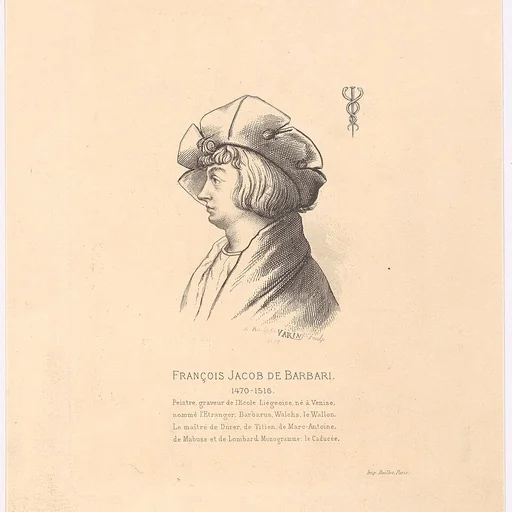
Artist
Jacopo de' Barbari, sometimes known or referred to as de'Barbari, de Barberi, de Barbari, Barbaro, Barberino, Barbarigo or Barberigo (c.

![View of Venice [lower right block], by Jacopo de' Barbari](https://artifactworldgallery.com/img/jacopo-de-barbari--view-of-venice-lower-right-block--371460ae957995b9-w320.webp)