Artwork
Lieden ääressä, pohjalainen kosintakohtaus
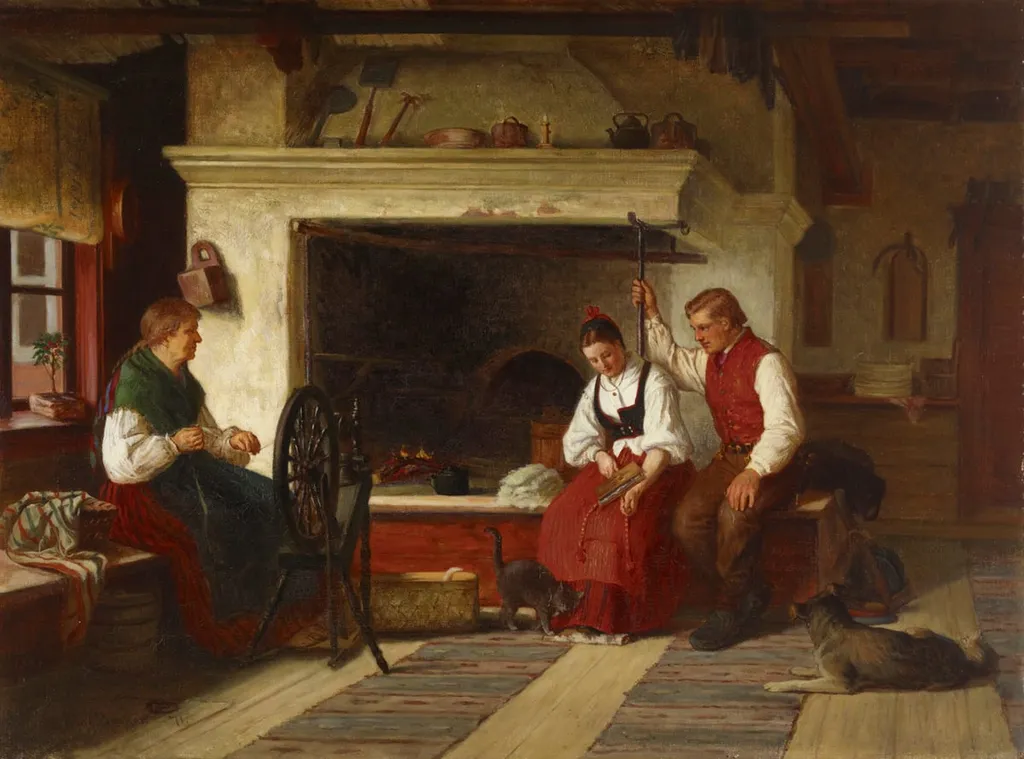
Lieden ääressä, pohjalainen kosintakohtaus is an unspecified painting by Adolf von Becker. It dates from 1880 and is held in the collection of the Finnish National Gallery.
About this work
Overview
Painted around 1880 by Adolf von Becker, this work captures a quiet domestic moment in a Finnish rural interior. Three figures and two dogs occupy a warmly lit room, their stillness suggesting a pause in daily life. The composition balances activity and repose, anchored by the spinning wheel, the axe, and the open book, each object hinting at different aspects of domestic existence.
Subject & Meaning
The scene portrays a moment of subdued intimacy: a woman spins yarn by the window, a man holds an axe while seated beside a woman reading.
The scene portrays a moment of subdued intimacy: a woman spins yarn by the window, a man holds an axe while seated beside a woman reading. Their proximity implies a shared, unspoken bond. The axe, not in use, and the book, untouched beyond its open pages, suggest contemplation rather than labor. The dogs, resting nearby, reinforce the calm, private atmosphere of home life in late 19th-century Pohjanmaa.
Technique & Style
Becker employs soft, warm tones and gentle chiaroscuro to model forms and deepen spatial depth. Light filters through the window, illuminating the spinner and the mantle’s objects, while shadows cradle the couple on the bench. Brushwork is restrained, favoring texture over detail—wool, wood, and woolen fabric are rendered with quiet precision, enhancing the scene’s tactile realism.
History & Provenance
Created during Becker’s period of focus on Finnish rural life, the painting reflects his interest in regional customs and domestic interiors. It remained in private Finnish collections after its completion, with no public exhibition record until the 20th century. Its preservation suggests it was valued as a personal, rather than public, representation of cultural identity.
Context
In late 19th-century Finland, artists increasingly turned to rural scenes as symbols of national identity amid rising cultural self-awareness. Becker’s depiction avoids idealization, instead presenting ordinary life with unembellished detail. The spinning wheel, axe, and book reflect practical and intellectual elements of peasant households, aligning with broader Nordic trends in realist art.
Legacy
The painting contributes to a modest but significant body of Finnish genre work from the period, offering insight into domestic rhythms before industrialization. While not widely reproduced, it remains referenced in studies of Finnish realism and regional identity. Its quiet composition continues to be studied for its understated emotional resonance and technical restraint.
Artist & collection

Artist
Adolf von Becker was a Finnish genre painter and art professor of German descent. He was one of the first Finnish artists to study in Paris, who taught many of the young artists of the Golden Age of Finnish Art.

 Sunshine
 Kreeta Haapasalo soittaa kannelta talonpoikaistuvassa
 The Irish Piper
 Reservesoldatens afsked med sin familie
 Talonpoikaistupa Nauvossa (Sotaveteraani kertoo)
 Reservesoldatens afsked med sin familie
 En fattig kone der venter på et krus øl i en bondestue
 Kosinta Ahvenanmaalla
 Kreeta Haapasalo Playing the Kantele in a Peasant Cottage
 An Offer of Marriage
 The Ghost Story
 At a Coppersmith’s Workshop