Artwork
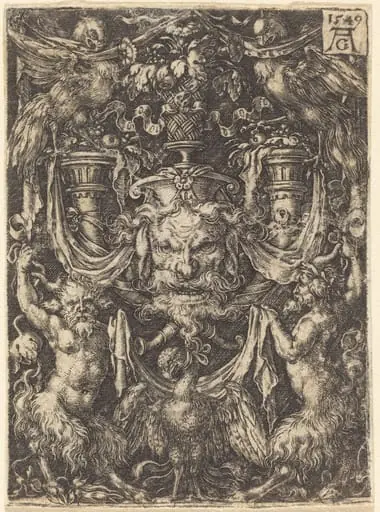
Ornament with Eagle and Two Genii
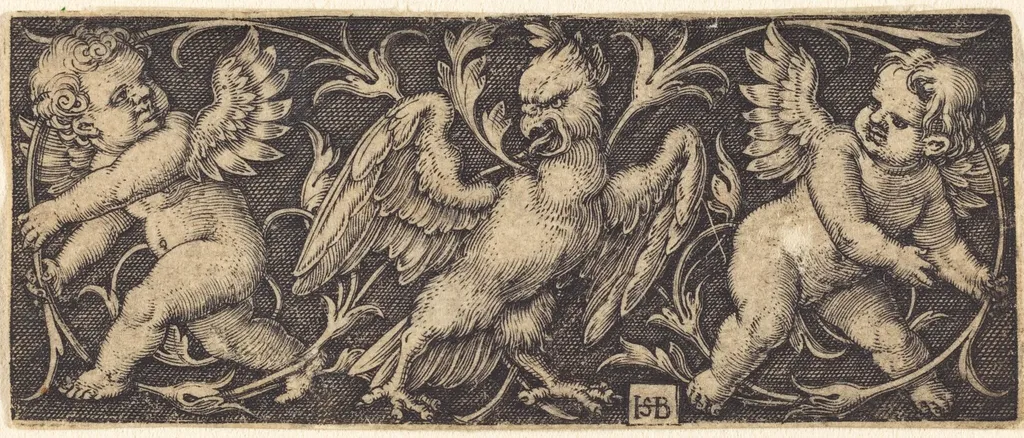
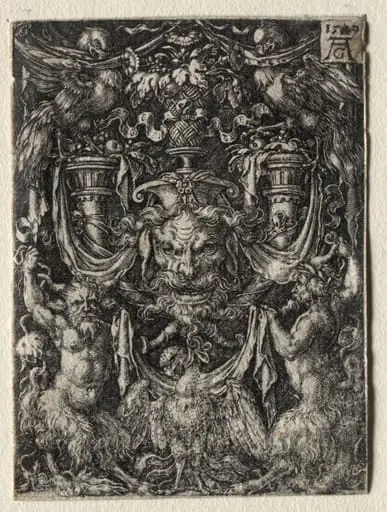
Ornament with Eagle and Two Genii is an ink print by the Renaissance artist Sebald Beham. It dates from 1544 and is held in the collection of the National Gallery of Art.
About this work
Overview
Sebald Beham’s 1544 engraving, titled Ornament with Eagle and Two Genii, presents a compact yet intricate composition typical of the German “Little Masters.” Executed on a metal plate, the print measures only a few inches across, yet it delivers a densely populated scene of mythic and natural elements rendered in fine incised lines.
Subject & Meaning
At the center of the image a powerful eagle spreads its wings, clutching a struggling creature in its talons. Flanking the bird are two winged, curly‑haired figures whose foliage‑like wings suggest a hybrid of human and nature spirits, perhaps serving as guardians or attendants to the central animal motif.
Technique & Style
Beham employs a network of delicate hatching and cross‑hatching to model volume and generate deep shadows, a hallmark of mid‑16th‑century German engraving. The intricate vegetal background of twisting vines and sharp leaves is rendered through precise line work, creating a dense, ornamental surface that contrasts with the darker negative space.
History & Provenance
The print originates from Beham’s productive period in Nuremberg, where he worked alongside his brother and other printmakers. As a member of the “Little Masters,” he produced numerous small-scale engravings for the burgeoning market of collectors and book illustrators, and this work exemplifies that commercial and artistic context.
Context
Created during the German Renaissance, the engraving reflects contemporary interests in classical mythology, allegorical figures, and the decorative potential of print media. The combination of a predatory bird with genii—figures drawn from classical tradition—mirrors the era’s fascination with merging natural observation and learned symbolism.
Artist & collection
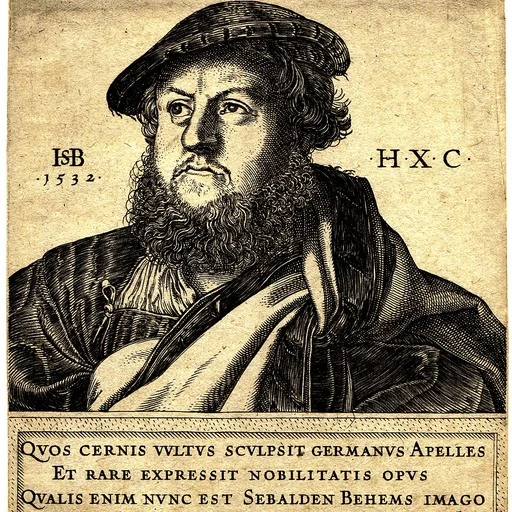
Artist
Sebald Beham (1500–1550) was a German painter and printmaker, mainly known for his very small engravings.