Artwork
Ornament
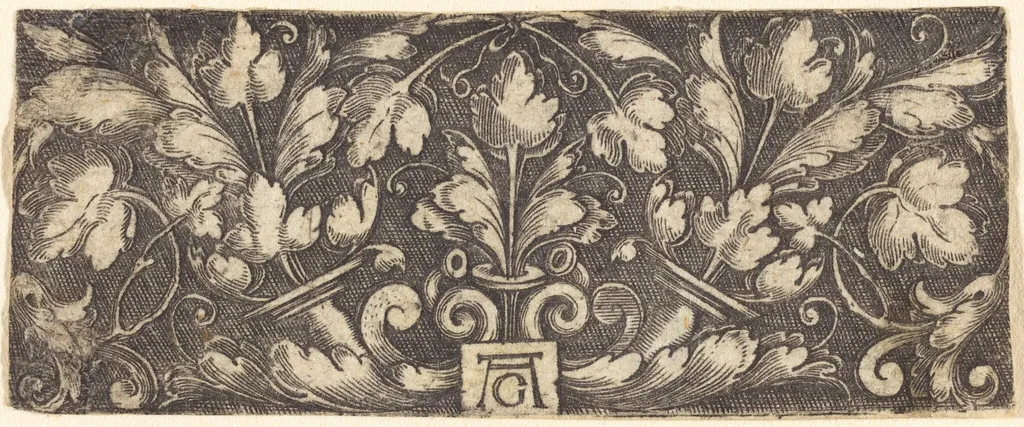
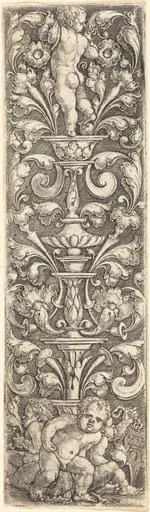
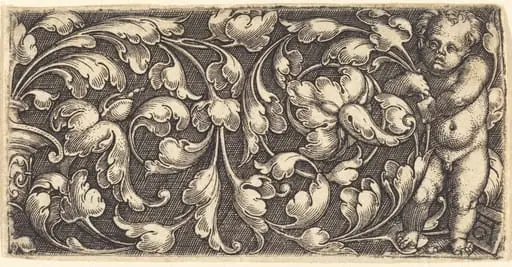
Ornament is a print by the Northern Renaissance artist Heinrich Aldegrever. It dates from 1532 and is held in the collection of the National Gallery of Art.
About this work
Overview
The piece exemplifies his mastery of etching and engraving techniques, producing sharp contrasts between light and dark areas without the use of tone or wash.
Created in 1532 by the German artist Heinrich Aldegrever, this print belongs to a group of small-scale engravings known as the work of the 'Little Masters.' Aldegrever focused on intricate decorative patterns rather than narrative scenes, using fine lines to produce detailed compositions. The piece exemplifies his mastery of etching and engraving techniques, producing sharp contrasts between light and dark areas without the use of tone or wash.
Subject & Meaning
The design features an abstract arrangement of botanical elements—leaves, flowers, and winding vines—arranged in a rhythmic, non-representational pattern. There is no literal narrative or symbolic message; instead, the work functions as a decorative motif, likely intended for use in book borders, textiles, or metalwork. Its stylized forms reflect Renaissance interest in natural forms filtered through artistic convention rather than direct observation.
Technique & Style
Aldegrever employed fine-line engraving to achieve remarkable precision, with each curl and leaf edge carefully incised into the metal plate. The high contrast between the dark background and the light, raised lines gives the impression of carved relief. The composition fills space with swirling, interlaced forms, avoiding empty areas through dense, ornamental patterning—a hallmark of his approach to surface decoration in printmaking.
History & Provenance
Produced during the early 1530s, this print emerged from a thriving market for decorative prints in southern Germany. Aldegrever’s works were widely circulated among craftsmen and collectors seeking models for ornamentation. While the specific early ownership history of this piece is undocumented, similar prints by Aldegrever appear in European collections from the late 16th century onward, indicating their use as design references in applied arts.
Context
Aldegrever worked in the wake of Albrecht Dürer, adopting the technical rigor of Northern Renaissance printmaking but shifting focus from religious or allegorical subjects to purely ornamental forms. His designs responded to the demand for reusable patterns in goldsmithing, bookbinding, and textile design. This shift reflected broader Renaissance trends where decorative arts gained autonomy from narrative traditions, emphasizing aesthetic harmony over storytelling.
Legacy
Aldegrever’s ornamental prints influenced generations of artisans who adapted his motifs into metalwork, ceramics, and printed textiles across Europe. Though less celebrated than his contemporaries, his systematic approach to pattern-making contributed to the standardization of decorative vocabularies in the 16th century. His work remains a key reference in the study of Renaissance graphic design and the transmission of visual motifs beyond fine art into craft traditions.
Artist & collection

Artist
Heinrich Aldegrever or Aldegraf was a German painter and engraver. He was one of the "Little Masters", the group of German artists making small old master prints in the generation after Albrecht Dürer.