Artwork
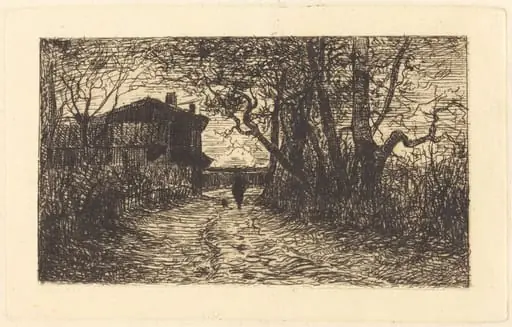
A Lonely Farm [Hawkridge]
![A Lonely Farm [Hawkridge], by Robert Polhill Bevan, crayon](https://artifactworldgallery.com/img/robert-polhill-bevan--a-lonely-farm-hawkridge--6b5607c9f673bdc2-w1024.webp)
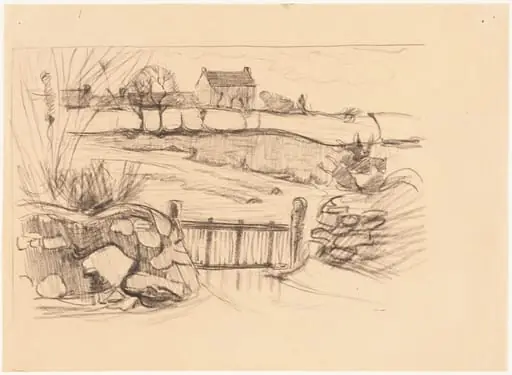
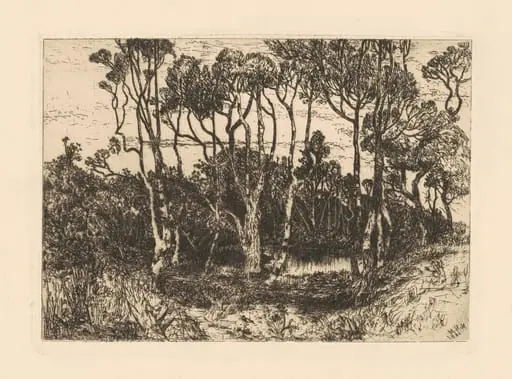
A Lonely Farm [Hawkridge] is a crayon print by Robert Polhill Bevan. It is held in the collection of the National Gallery of Art.
About this work
Overview
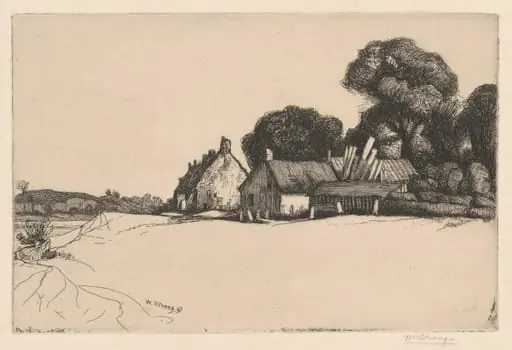
A Lonely Farm [Hawkridge] is a 1900 lithograph by Robert Polhill Bevan, executed in crayon-manner on coated wove paper. The work captures a rural English landscape with minimal detail, emphasizing atmosphere over narrative. Printed in black ink, it conveys a sense of stillness and solitude through restrained composition and textured surface.
Subject & Meaning
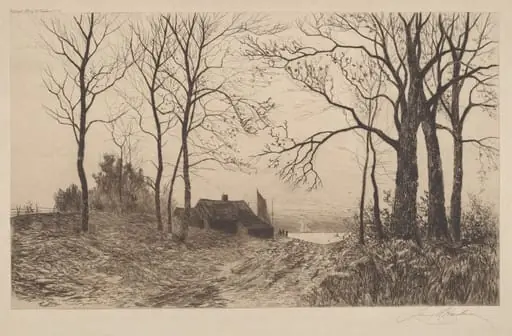
The scene depicts a solitary horse and rider traversing a dirt path beside bare trees and a distant farmhouse. No human figures are clearly rendered, and the structure in the background remains indistinct. The isolation of the figures and the unadorned setting suggest contemplation of rural life, free from romanticization or dramatic emphasis.
Technique & Style
Bevan employed crayon-manner lithography, a technique mimicking the spontaneity of hand-drawn marks. Loose, swirling lines define the uneven ground and tree trunks, while the paper’s coating enhances the contrast of the black ink. The result resembles a rapid sketch, prioritizing gesture and texture over precision, aligning with early modernist interests in expressive line.
History & Provenance
Created in 1900, the print belongs to Bevan’s early period, before his association with the Camden Town Group. It reflects his experimentation with printmaking techniques during a time when British artists were re-engaging with lithography as a medium for personal expression. No documented ownership history is widely recorded prior to institutional acquisition.
Context
At the turn of the century, British artists were moving away from academic traditions toward more intimate, observational subjects. Bevan’s work aligns with this shift, drawing from rural England’s quiet corners rather than urban or historical themes. The use of crayon lithography placed him among peers exploring the medium’s potential for immediacy and tonal nuance.
Legacy
Though not among Bevan’s most widely exhibited works, A Lonely Farm [Hawkridge] exemplifies his early commitment to capturing mood through simplified form and tactile mark-making. It contributes to a broader understanding of his printmaking practice and the role of lithography in early 20th-century British art beyond commercial reproduction.
Artist & collection