Artwork
Under the Hammer
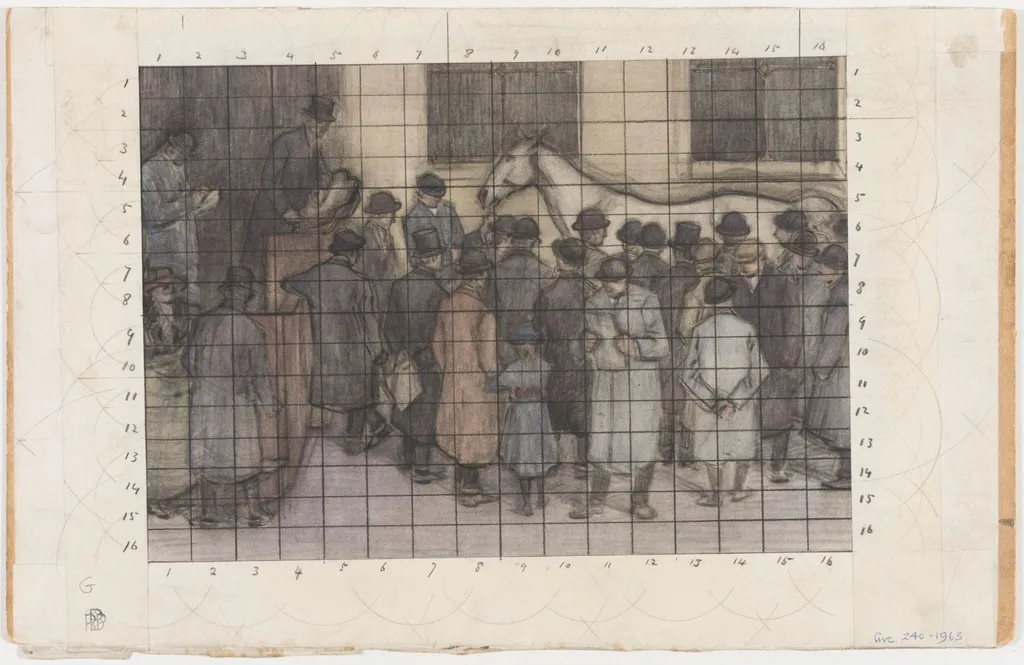
Under the Hammer is a watercolor work on paper by Robert Polhill Bevan. It is held in the collection of the Victoria and Albert Museum.
About this work
Overview
Created around 1902, Under the Hammer is a watercolour by Robert Polhill Bevan, depicting a rural auction scene. The work is part of the Victoria and Albert Museum’s collection and exemplifies Bevan’s interest in everyday British life. Executed on paper marked with a faint grid, the piece reflects a methodical approach to composition, balancing detail with atmospheric suggestion.
Subject & Meaning
The horse, centrally placed, serves as both literal focus and symbol of commerce, while the surrounding figures convey the social rhythm of rural market life.
The painting captures a moment at a country auction, where a horse is tethered to a post amid a small crowd. Figures in early 20th-century attire—coats, hats, and boots—gather in loose clusters, some observing the animal, others engaged in quiet conversation. The horse, centrally placed, serves as both literal focus and symbol of commerce, while the surrounding figures convey the social rhythm of rural market life.
Technique & Style
Bevan employed watercolour with restrained washes and precise linework, using the paper’s grid to structure the composition. His handling avoids overt drama, favoring subtle tonal shifts and careful placement of figures to suggest movement and quiet interaction. The medium’s transparency allows underlying pencil marks to remain visible, reinforcing the sketch-like immediacy of the scene.
History & Provenance
The work entered the Victoria and Albert Museum’s collection in the 20th century, likely through acquisition or donation. Its survival in good condition reflects its status as a study or finished work of modest scale, valued for its observational clarity rather than grandeur. No record of prior ownership or exhibition history is widely documented.
Context
Painted during a period when British artists were turning to everyday scenes over idealized narratives, Under the Hammer aligns with the social realism emerging in late Victorian and Edwardian art. Bevan’s focus on rural commerce reflects broader cultural interest in the fading traditions of market life, captured with quiet dignity rather than nostalgia.
Legacy
Though not widely exhibited, the painting remains a representative example of Bevan’s early work and his engagement with British rural subjects. It contributes to the understanding of how watercolour was used for observational studies outside the academic tradition, influencing later artists interested in candid depictions of ordinary life.
Artist & collection


![A Lonely Farm [Hawkridge], by Robert Polhill Bevan](https://artifactworldgallery.com/img/robert-polhill-bevan--a-lonely-farm-hawkridge--6b5607c9f673bdc2-w320.webp)