Artwork
Butcher's Shop, Reigate
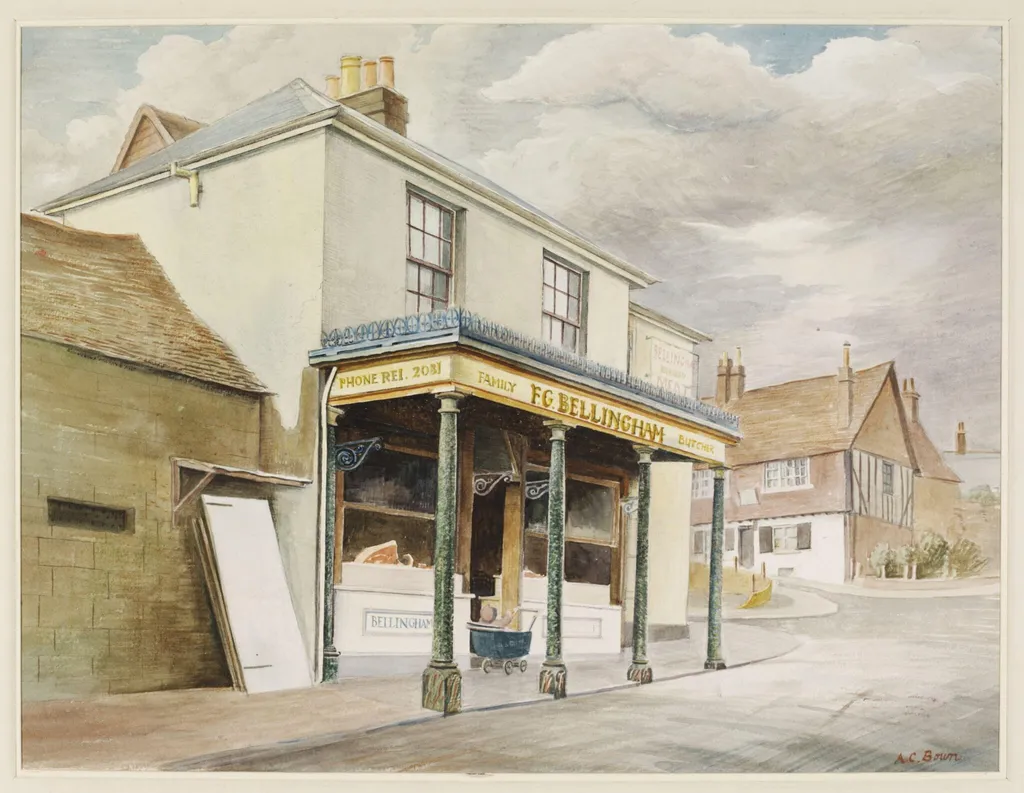
Butcher's Shop, Reigate is a watercolor work on paper by the Social Realist artist Bown. It dates from 1940 and is held in the collection of the Victoria and Albert Museum.
About this work
Overview
The work reflects a broader mission to preserve the visual character of ordinary British life through the eyes of trained artists.
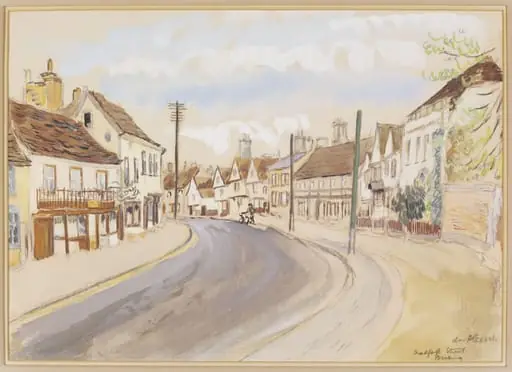
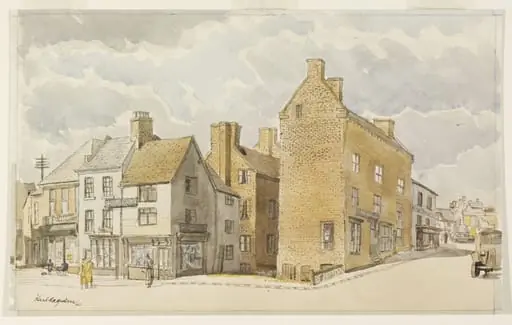
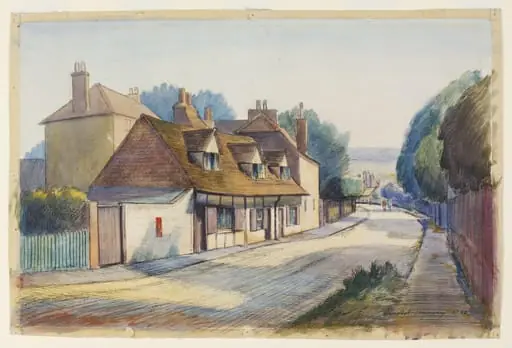
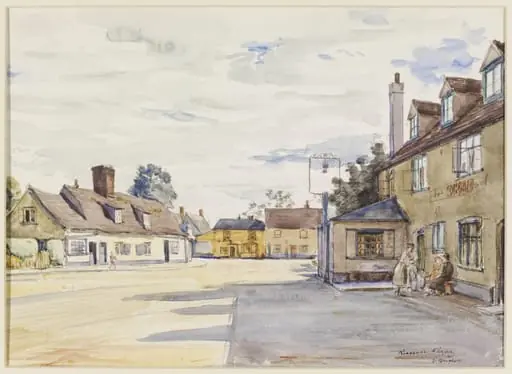
Painted in 1940 by Bown, this watercolour captures a modest butcher’s shop in Reigate, rendered with quiet precision. Created during the Second World War, it belongs to the 'Recording Britain' initiative, a government-backed effort to visually archive everyday scenes at risk of disappearance due to conflict or modernization. The work reflects a broader mission to preserve the visual character of ordinary British life through the eyes of trained artists.
Subject & Meaning
The scene centers on F.G. Bellingham’s butcher shop, a working-class establishment marked by its functional architecture and commercial signage. A baby carriage beneath the awning and hanging cuts of meat suggest daily life continuing amid wartime uncertainty. The inclusion of a visible phone number and small domestic details implies an intimate, local economy, grounding the image in the tangible reality of community commerce rather than idealized nostalgia.
Technique & Style
Bown employed delicate watercolour washes to convey subtle shifts in light and texture, favoring muted greens, browns, and off-whites to evoke a restrained, atmospheric tone. The architectural elements—pillared portico, tiled roof, chimneys—are rendered with careful observation, while the interior meat displays and wall-mounted details are suggested rather than overworked. The medium’s transparency enhances the sense of quiet realism, avoiding dramatic emphasis in favor of understated documentation.
History & Provenance
The painting was produced as part of the 'Recording Britain' project, launched in 1940 under the direction of Sir Kenneth Clark and funded by the Pilgrim Trust. Between 1940 and 1943, 97 artists contributed over 1,500 works documenting threatened vernacular architecture and rural industries. This watercolour entered the national collection through the project’s institutional framework, later held by the Victoria and Albert Museum alongside related works.
Context
During wartime, Britain faced widespread destruction and rapid social change. The 'Recording Britain' initiative responded to fears that traditional buildings and local trades would vanish under bombing or modernization. Artists like Bown were commissioned to record not grand monuments but the unassuming structures of daily life—shops, cottages, market stalls—creating a visual archive meant to sustain cultural memory when physical preservation was uncertain.
Legacy
The 'Recording Britain' collection endures as a significant historical record of mid-20th-century English vernacular life. Bown’s watercolour, like others in the series, offers a quiet testament to ordinary spaces that once anchored communities. These works continue to inform architectural conservation and social history, serving as reference points for understanding how Britain’s physical landscape was perceived during a time of profound upheaval.
Artist & collection
Artist
This British watercolorist captured quiet corners of southern England between 1940 and 1942.