Artwork
Windsor we build, they destroy
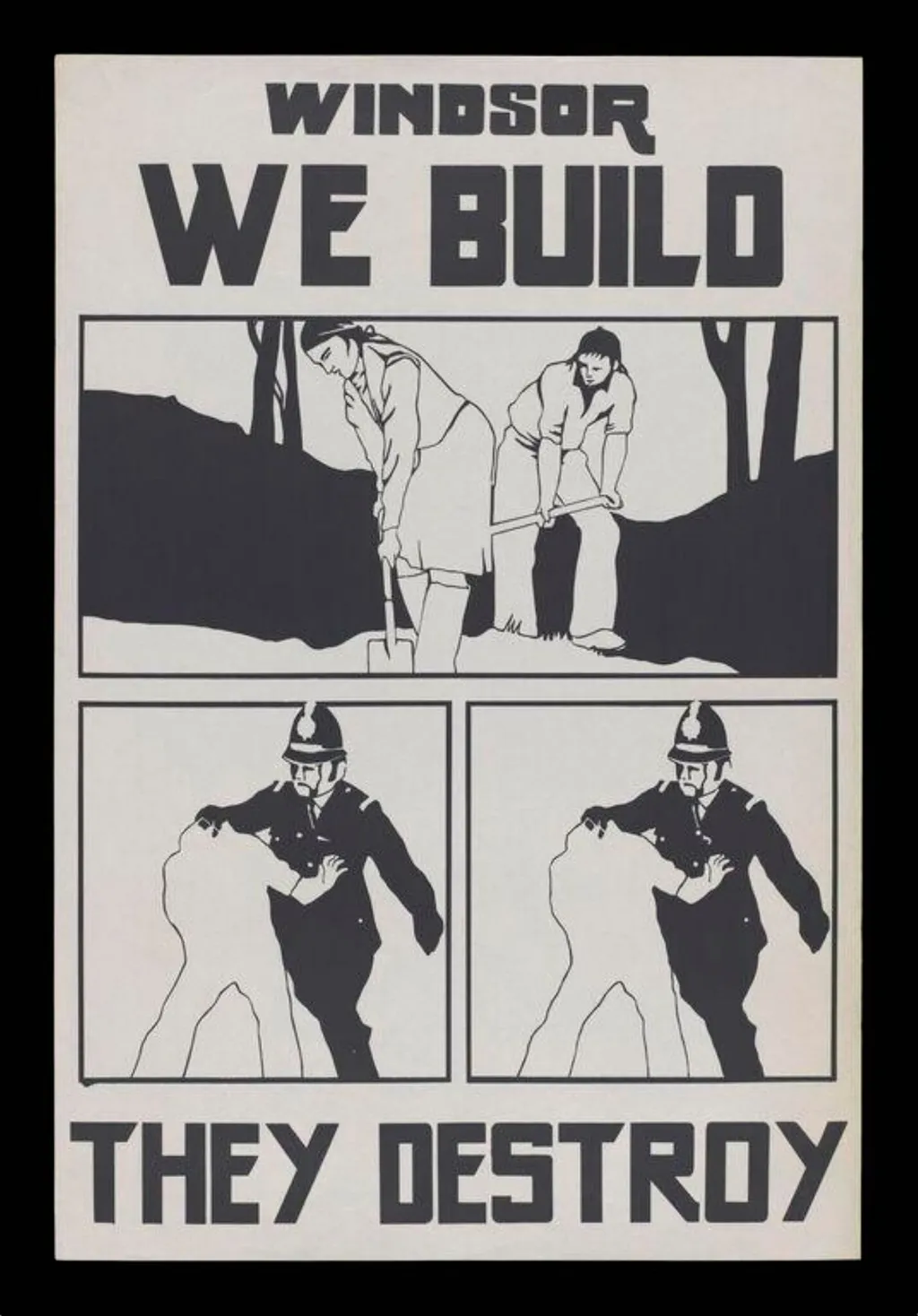
Windsor we build, they destroy is a poster by Bernadette Brittain. It dates from 1974 and is held in the collection of the Victoria and Albert Museum.
About this work
Overview
Created in 1974 by Bernadette Brittain, this black-and-white screen-printed poster responds to police intervention at the Windsor Pop Festival.
Created in 1974 by Bernadette Brittain, this black-and-white screen-printed poster responds to police intervention at the Windsor Pop Festival. Its minimalist design contrasts two scenes: laborers constructing and officers dismantling. The absence of color and detail focuses attention on the symbolic opposition between creation and suppression, framing the event as a clash of values rather than a mere disturbance.
Subject & Meaning
The poster juxtaposes two groups: workers bending over shovels, engaged in quiet labor, and uniformed officers wielding batons to demolish. The text above and below reinforces the dichotomy—'WE BUILD' versus 'THEY DESTROY.' It frames the festival attendees as builders of community and the authorities as agents of disruption, suggesting systemic hostility toward grassroots cultural expression.
Technique & Style
Rendered in stark monochrome, the poster uses high-contrast silhouettes to emphasize form over detail. The flat, graphic style draws from protest art traditions, prioritizing immediate legibility. Bold, sans-serif typography aligns with the visual rhythm, reinforcing the message without embellishment. The lack of shading or texture heightens the symbolic clarity of each figure.
History & Provenance
Produced in response to the 1974 Windsor Pop Festival, where police disrupted the event and arrested attendees, the poster circulated among activist networks in Ontario. It was later acquired by the Victoria and Albert Museum as part of its collection documenting political graphics from the 1970s, reflecting its role in grassroots visual resistance during a period of heightened social tension.
Context
In the mid-1970s, youth-led music festivals faced increasing police scrutiny across North America. Authorities often viewed these gatherings as threats to public order, leading to confrontations. Brittain’s poster emerged within this climate, aligning with broader movements that used visual art to challenge state power and defend cultural autonomy in public spaces.
Legacy
The poster remains a concise example of 1970s activist graphic design, notable for its clarity and emotional resonance. It is referenced in studies of protest art and public dissent, illustrating how simple imagery can articulate complex social critiques. Its preservation in institutional collections ensures its continued relevance as a historical document of civic conflict.
Artist & collection
Artist
These five posters came out of South Africa in 1974, sharp, black-and-white prints meant to wake people up.