Artwork
Benefit Dance
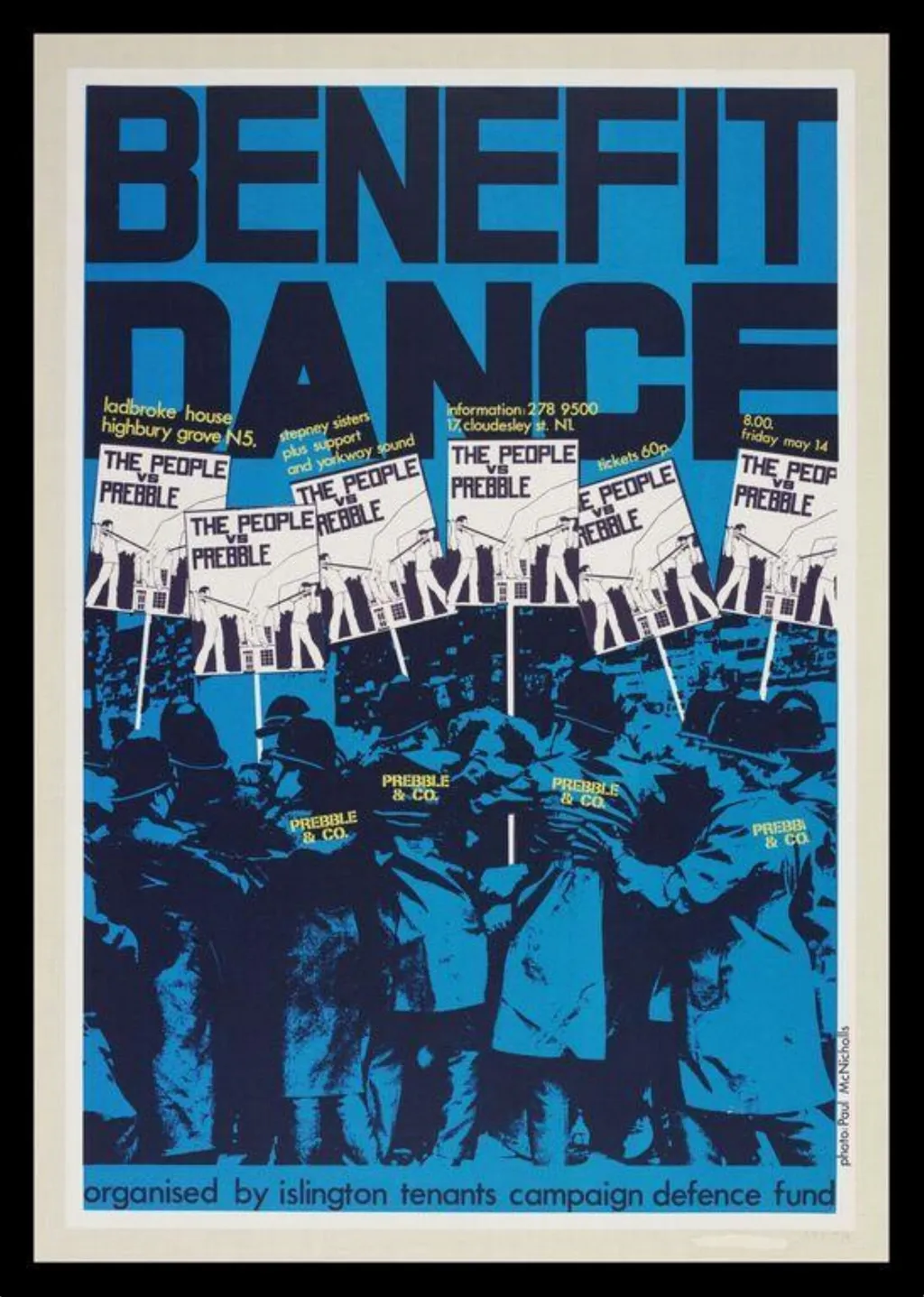
Benefit Dance is a poster by Martin Walker. It dates from 1976 and is held in the collection of the Victoria and Albert Museum.
About this work
Overview
The composition is dominated by large blocks of vivid blue that occupy most of the field, while the title appears in stark black lettering at the top.
Benefit Dance, produced in 1976 by graphic designer Martin Walker, is a poster held in the collection of the Victoria and Albert Museum. The composition is dominated by large blocks of vivid blue that occupy most of the field, while the title appears in stark black lettering at the top. Below, a dense crowd of figures brandishes placards reading “THE PEOPLE vs PREBBLE,” accompanied by additional details of location and time.
Subject & Meaning
The imagery suggests a public demonstration, with the crowd’s signs and overlapping text evoking the atmosphere of a protest rally. The phrase “THE PEOPLE vs PREBBLE” positions the work as a commentary on a specific legal or social conflict, inviting viewers to consider the dynamics of collective action and the role of visual communication in activist movements.
Technique & Style
Walker employs a graphic language that juxtaposes simple geometric forms—large blue rectangles and blocky lettering—with the frenetic arrangement of figures and text. The overlapping layers create visual tension, while the high‑contrast palette of blue, black, and darker silhouettes draws immediate attention to the central message. The overall effect balances clarity of information with a sense of chaotic energy.
History & Provenance
Created in the mid‑1970s, the poster reflects the era’s vibrant graphic design trends and the political climate of the time. It entered the Victoria and Albert Museum’s holdings as part of the museum’s effort to document contemporary poster art, where it remains accessible for study and public display.
Artist & collection
Artist
British designer Martin Walker turned bold typography and stark slogans into rallying cries on 1970s protest posters.