Artwork
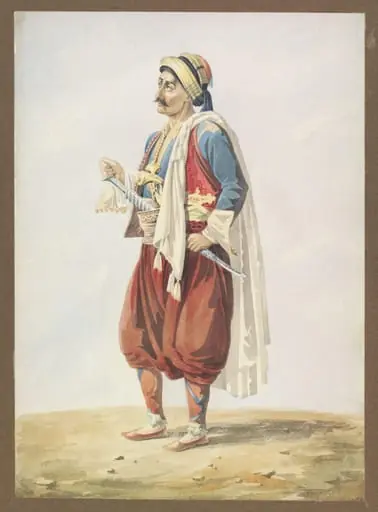
Seraskier Pasha General in Chief
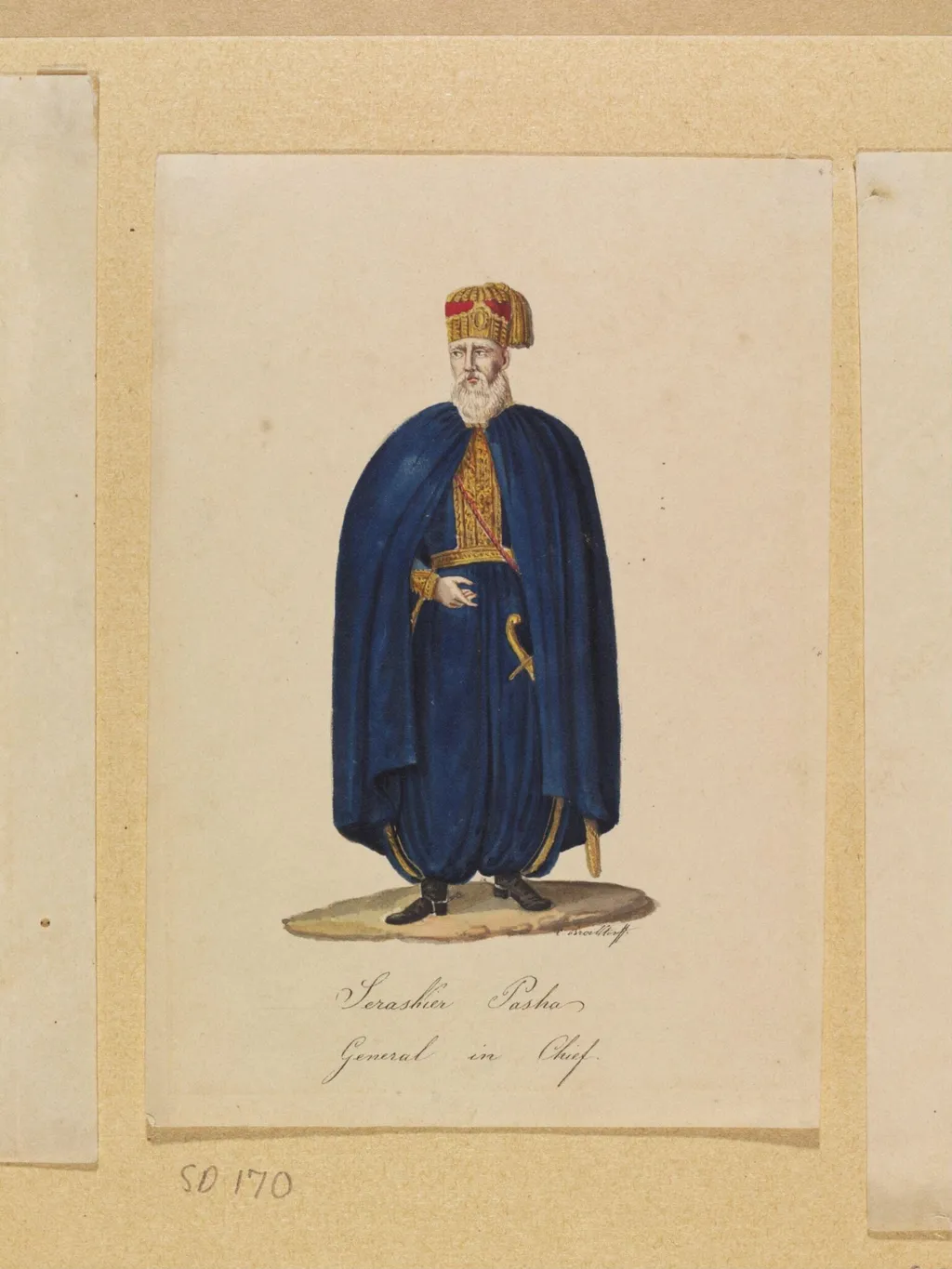
Seraskier Pasha General in Chief is a watercolor work on paper by the Romanticist artist Charles Frederick or Carlo Federico Brockdorff. It dates from 1835 and is held in the collection of the Victoria and Albert Museum.
About this work
Overview
The work is a straightforward depiction of authority, rendered in delicate watercolour washes that convey both texture and presence without overt embellishment.
Charles Frederick Brockdorff painted this watercolour portrait in 1835, capturing an Ottoman military commander in the role of Seraskier, the empire’s highest-ranking military official. The work is a straightforward depiction of authority, rendered in delicate watercolour washes that convey both texture and presence without overt embellishment. It was later acquired by W. Spencer in 1968, marking its transition into private collection history.
Subject & Meaning
The figure is identified as a Seraskier, a position equivalent to Minister of War, signifying supreme command over Ottoman forces. His dignified posture, with one hand on the hip and the other relaxed, conveys calm authority. The elaborate attire—blue robe, gold-trimmed cape, and ornate headgear—emphasizes rank and imperial affiliation, not personal vanity. The gaze to the left suggests alertness, as if observing an unseen command or horizon.
Technique & Style
Brockdorff employed watercolour with restrained precision, layering translucent washes to suggest the sheen of silk and the weight of fur trim. The beige floor grounds the figure without distraction, focusing attention on the intricate details of costume and facial structure. The soft modeling of the beard and mustache, rendered with fine brushwork, adds realism. The style aligns with 19th-century European orientalist portraiture, prioritizing accurate detail over dramatic flourish.
History & Provenance
Created in 1835 during Brockdorff’s time in the Ottoman Empire, the portrait likely served as a record of a high-ranking official for European audiences. It remained in private hands until October 1968, when it was purchased by W. Spencer for £18, suggesting it had been overlooked or undervalued for over a century. Its subsequent institutional or private ownership remains undocumented beyond this transaction.
Context
In the 1830s, European artists increasingly depicted Ottoman elites as part of a broader fascination with the East. Brockdorff’s work reflects this trend, offering a factual, non-sensationalized view of Ottoman military hierarchy. Unlike romanticized portrayals of the period, this portrait avoids exoticism, instead presenting the Seraskier as a figure of institutional power within a complex imperial system.
Legacy
The painting stands as a quiet document of cross-cultural observation, preserving the visual language of Ottoman command at a time of reform and external pressure. While not widely exhibited, it contributes to the archive of Western artists who recorded Ottoman life with relative neutrality. Its survival offers insight into how military authority was visually encoded beyond European traditions.
Artist & collection

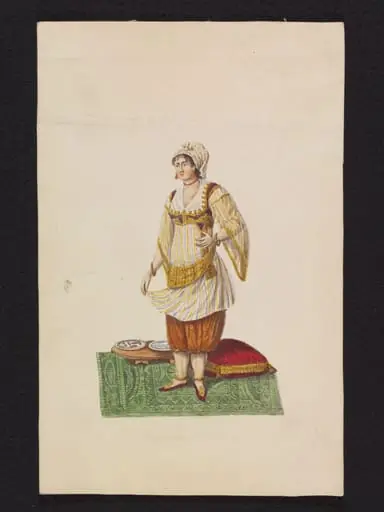
![Turkish Gentelman of Constantinople [sic], by Charles Frederick or Carlo Federico Brockdorff](https://artifactworldgallery.com/img/charles-frederick-or-carlo-federico-brockdorff--turkish-gentelman-of-constantinople-sic--d475be1b1d5e28d0-w320.webp)
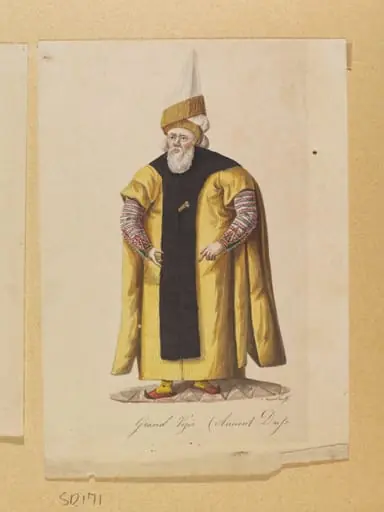
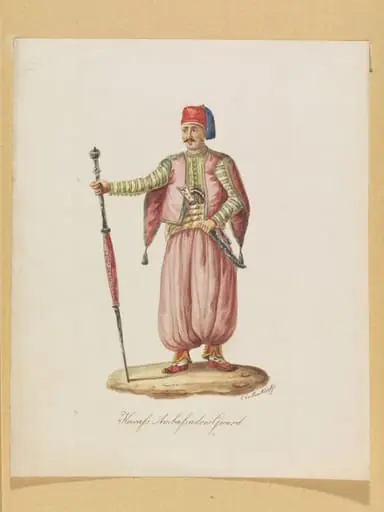
![A Servant of the Sultan[?], by William Page](https://artifactworldgallery.com/img/william-page--a-servant-of-the-sultan--e1a8abdac6100882-w320.webp)