Artwork
Untitled
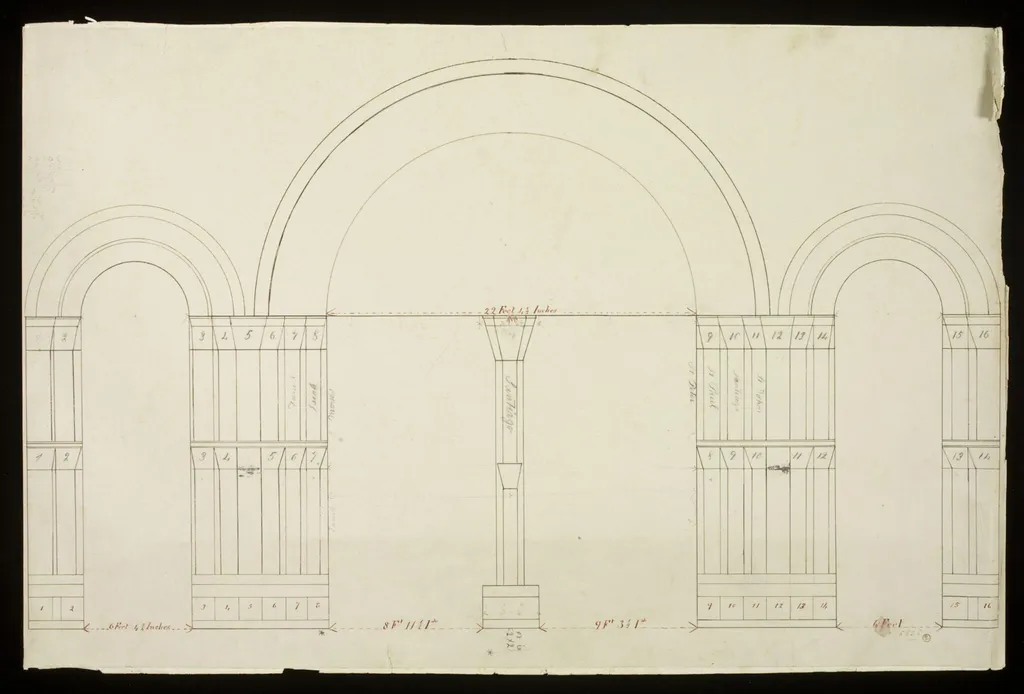
Untitled is a drawing by the Impressionist artist Domenico Brucciani. It dates from 1866 and is held in the collection of the Victoria and Albert Museum.
About this work
Overview
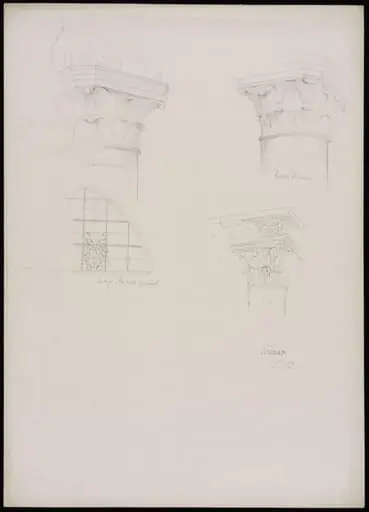
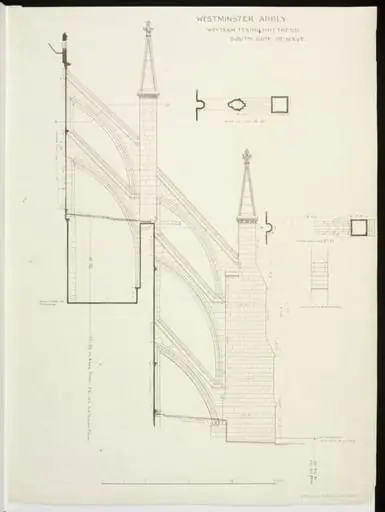
Created in 1866 by the architect‑draughtsman Domenico Brucciani, this black‑and‑white drawing records an elevation and measurement plan for the doors and sculptural program of the Santiago de Compostela Cathedral. Rendered as a precise architectural diagram, it presents a longitudinal view of a vaulted interior space, delineating three arched portals, a central column, and the surrounding wall sections with exact dimensions.
Subject & Meaning
The drawing functions as a technical specification rather than a decorative image, outlining the spatial organization and proportional relationships required for the cathedral’s entranceways and associated statuary. By marking the placement of arches, columns, and door frames, it conveys the intended visual rhythm and structural hierarchy that would guide the stone carving and construction processes.
Technique & Style
Executed with fine ink lines on paper, the work employs a grid of evenly spaced vertical strokes to indicate wall planes, while curved lines define the arches. Numerical annotations in feet and inches accompany the geometry, reflecting the 19th‑century practice of precise architectural drafting. The style is utilitarian, emphasizing clarity and accuracy over artistic flourish.
History & Provenance
The diagram originates from the mid‑19th‑century restoration efforts at Santiago de Compostela, a period when detailed plans were produced to document and guide interventions on historic fabric. It entered the collection of the Victoria and Albert Museum as part of its holdings of European architectural drawings, where it remains accessible for study of historic preservation practices.
Context
During the 1860s, European architects increasingly employed measured drawings to record medieval monuments, balancing scholarly documentation with restoration. Brucciani’s work fits within this tradition, providing a systematic visual record that supported both the cathedral’s ongoing conservation and the broader academic interest in Gothic architecture.
Legacy
As a primary source, the drawing offers insight into 19th‑century approaches to heritage management and the technical language used to communicate architectural intent. It continues to serve scholars examining the evolution of restoration methodology and the detailed planning required for large‑scale ecclesiastical projects.
Artist & collection
Artist

 Untitled
 Architectural Drawing of Columns (verso)
 Longitudinal section through Pantheon portico
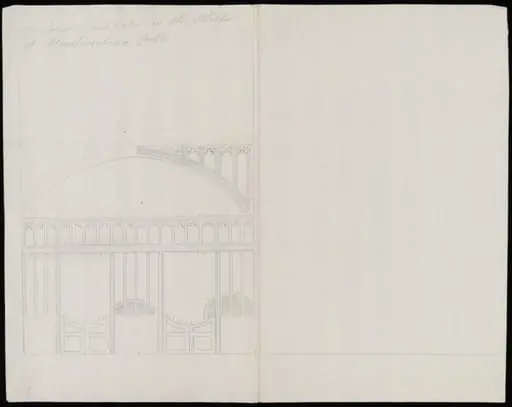 Elevation of screen in Hall.
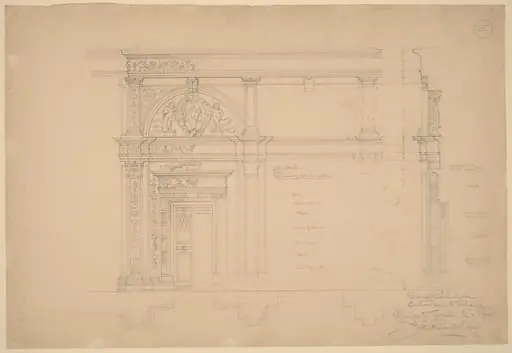 Siena Cathedral, Entrance to Library
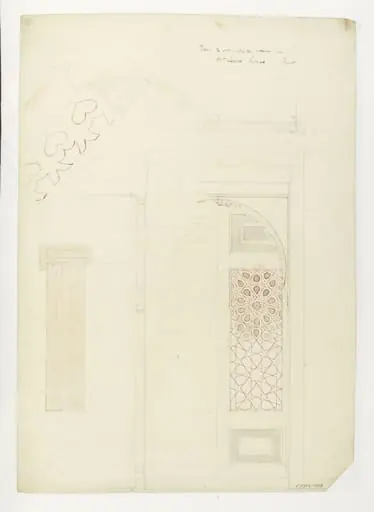 Drawing of a door, John Frederick Lewis house in Cairo
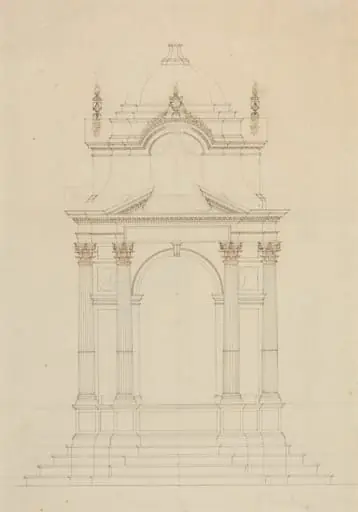 Design for a Baldaquin
 Untitled
 Elevations of the interior wall of Combe Bank
 Arcade Decoration
 Palazzo Communale, Bologna
 Untitled