Artwork
Dunstanborough Castle
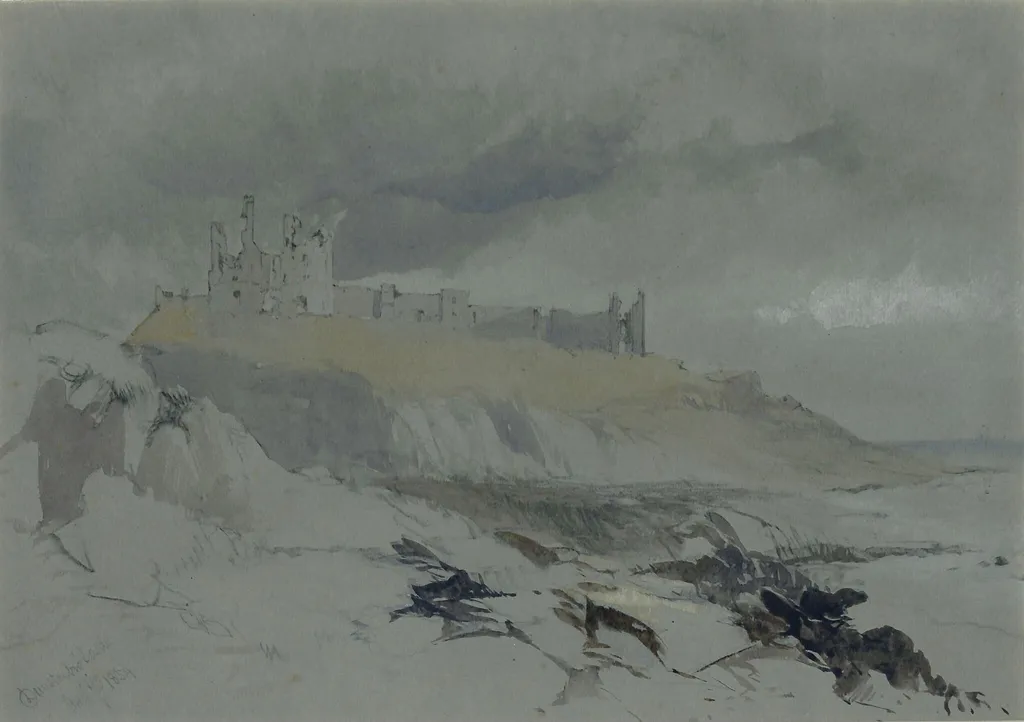
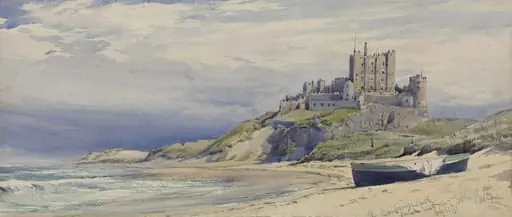
Dunstanborough Castle is a watercolor work on paper by the British Romanticist artist James Burrell Smith. It dates from 1854 and is held in the collection of the Victoria and Albert Museum.
About this work
The artist used loose, sketchy lines to capture light and movement, a style that makes the scene feel fresh and real.
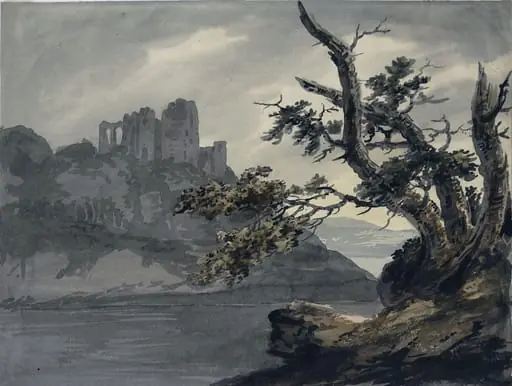
This painting shows a crumbling castle on a grassy hill, with a stormy sky above. In the foreground, a rocky shore has a few scattered sheep and a lone person walking. The colors are mostly muted blues, grays, and earthy browns, with quick brushstrokes that make the scene feel alive.
The artist used loose, sketchy lines to capture light and movement, a style that makes the scene feel fresh and real. This was painted in 1854 by a British artist who focused on landscapes.
Next, check out the Victoria and Albert Museum to see more works like this.
Overview
Painted in November 1854, this watercolour by British artist James Burrell Smith captures Dunstanborough Castle in Northumberland. The work is signed and dated by the artist, confirming its origin. Rendered in transparent washes, the piece reflects a quiet, observational approach to landscape, typical of mid-19th-century British watercolour practice. Its modest scale and intimate tone suggest it was made as a personal record rather than a public exhibition piece.
Subject & Meaning
The scene presents Dunstanborough Castle as a ruin nestled on a windswept hill, its stonework softened by time and weather. Below, a sparse shoreline holds a solitary figure and a few sheep, emphasizing isolation and the passage of time. The composition avoids narrative drama, instead inviting contemplation of nature’s reclamation of human structures. The quiet presence of the walker suggests a moment of personal reflection amid the landscape’s enduring silence.
Technique & Style
Smith employed loose, rapid brushwork and diluted pigments to convey atmosphere rather than detail. Muted blues, greys, and earth tones dominate, with minimal contrast to suggest a overcast sky and damp air. The sketchy handling of the castle’s ruins and the textured strokes of the grass and rocks create a sense of immediacy. Watercolour’s transparency allows the paper’s whiteness to suggest light, enhancing the feeling of fleeting weather and shifting daylight.
History & Provenance
The watercolour was completed in 1854 during a period when British artists increasingly turned to coastal and rural ruins as subjects. While its early ownership is unrecorded, it entered the Victoria and Albert Museum’s collection in the 20th century, where it remains part of a broader archive of 19th-century British watercolours. Its inscription confirms the artist’s direct engagement with the site on the date noted.
Context
In the 1850s, watercolour was widely used by amateur and professional artists alike for topographical and scenic studies. Dunstanborough Castle, a 14th-century fortification in decline, was one of many ruins visited by artists drawn to the romantic appeal of decay. Smith’s work aligns with a broader trend of documenting Britain’s architectural heritage through direct observation, often during sketching tours of the north.
Legacy
Though not widely exhibited in its time, this watercolour contributes to a quiet tradition of British landscape observation that valued subtlety over grandeur. It reflects the growing interest in naturalism and atmospheric effect during the mid-Victorian era. Today, it stands as a modest but authentic record of a specific moment in time, preserving both the appearance of the castle and the artist’s responsive technique.
Own this work as a print
Artist & collection

Artist
James Burrell Smith was a watercolour and landscape artist. He was born in London. In 1843 he moved to Alnwick, Northumberland where he trained with Thomas Miles Richardson. He travelled around the UK and Europe. During…